
3D Printed Clear Aligners: What Patients Should Know
If you have been researching modern orthodontic treatment, you may have come across growing interest in 3D printed clear aligners. The concept sounds futuristic, but the question most patients really want answered is simple: What does this mean for comfort, accuracy, convenience, and results?
For children, teens, adults, and families in Passaic and nearby New Jersey communities, this topic matters because orthodontics is changing quickly. Today’s patients want treatment that looks discreet, feels comfortable, fits busy schedules, and is guided by technology that improves precision. They also want reassurance that they are making a smart, safe decision.
At Eisenberger and Meister Orthodontics, we believe patient education should feel clear – not confusing. With 38 years in practice and 15,000+ smiles treated, our team combines experience with advanced technology, personalized treatment planning, and a premium, welcoming office experience. Whether you are exploring Invisalign, braces, or custom solutions like LightForce braces, understanding how new aligner technology works can help you feel more confident about your next step.
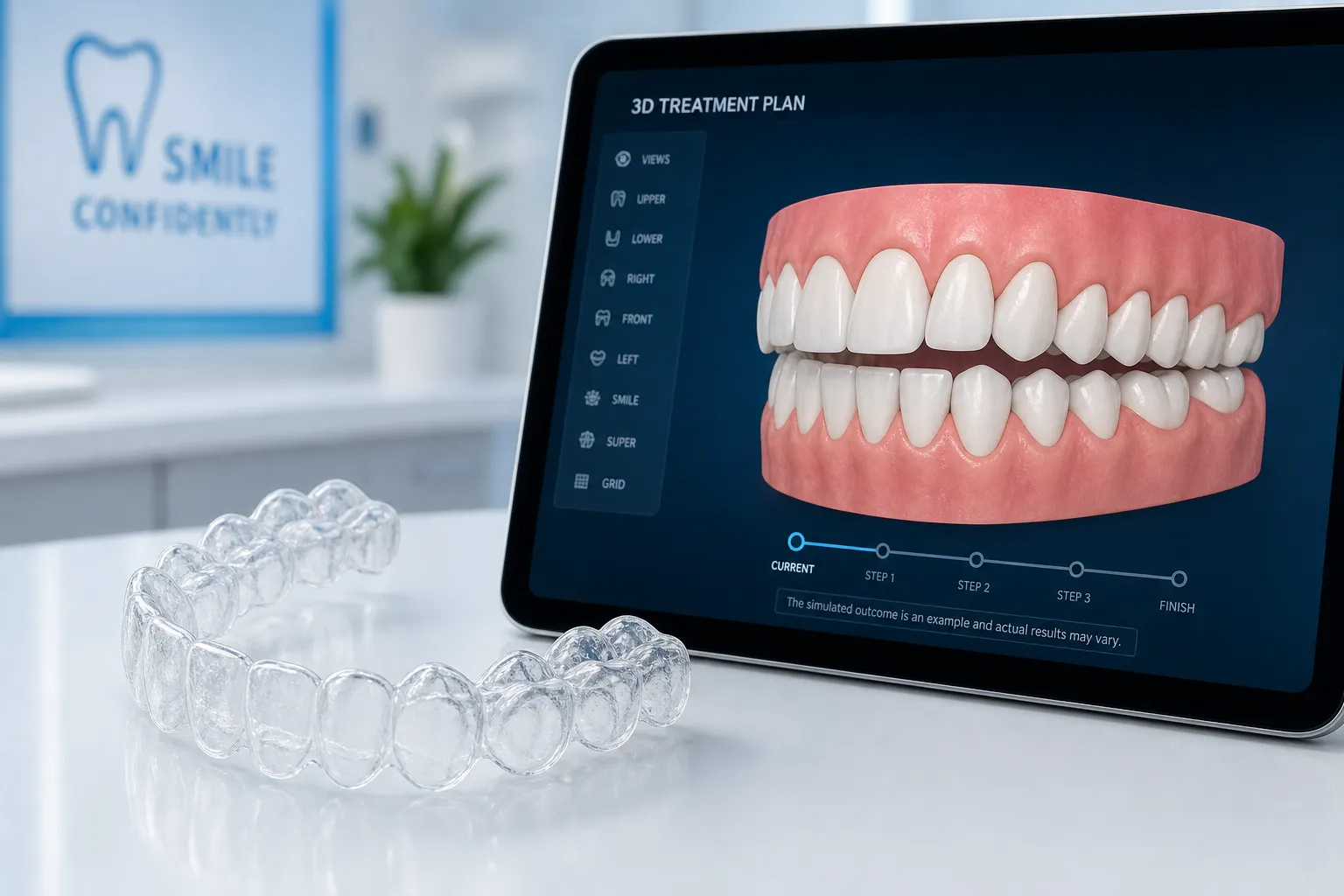
What Are 3D Printed Clear Aligners?
3D printed clear aligners refer to a newer approach to aligner manufacturing. Traditionally, clear aligners are usually made by:
-
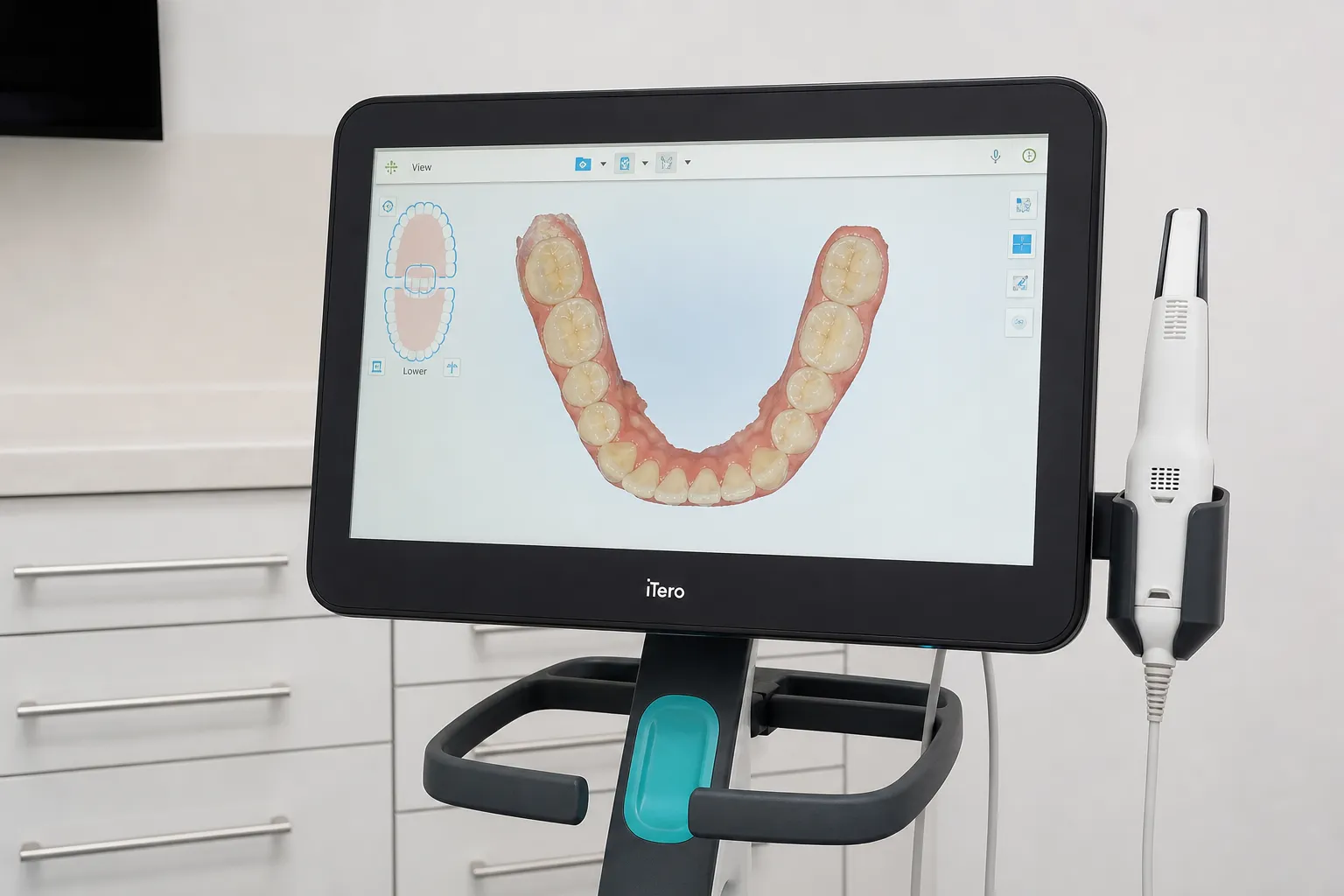
scanning the teeth,
-
digitally planning tooth movement,
-
3D printing a physical model of each treatment stage,
-
and then thermoforming plastic over those models.
That means the aligner itself is typically not directly printed. Instead, the printed part is the model, and the aligner is formed over it.
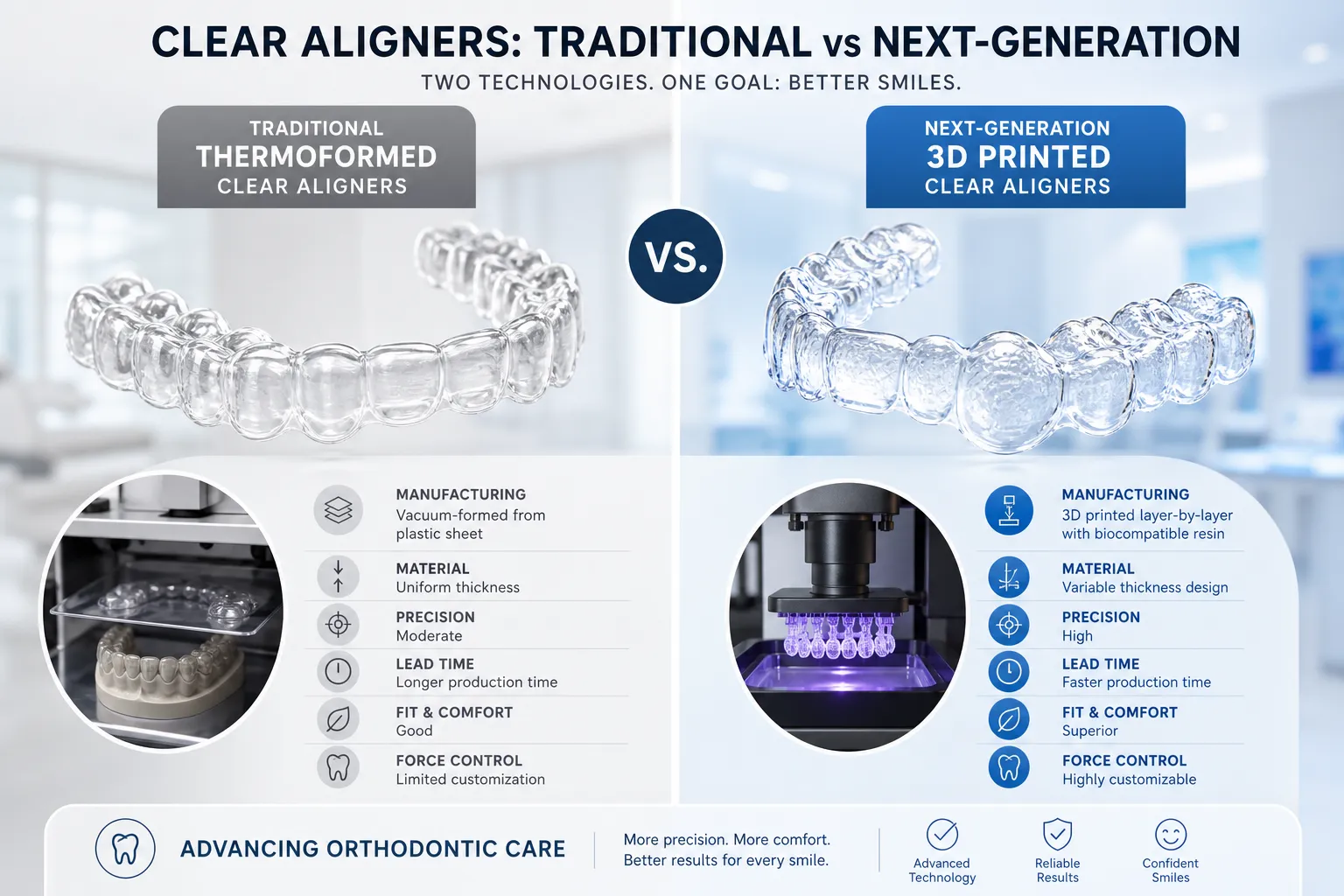
With newer developments, manufacturers and researchers are exploring ways to directly print the aligner itself, rather than forming it over a model. This has generated excitement because it may eventually allow even more control over aligner thickness, force delivery, fit, and consistency.
For patients, the key takeaway is this:
-
Most current clear aligner systems still rely on digitally planned treatment and 3D printed models
-
Directly printed aligners are an emerging innovation
-
The biggest benefit is not “tech for tech’s sake,” but the possibility of more precise, more customized treatment
Why Patients Are Hearing More About Them Now
Clear aligners have already transformed orthodontics by offering a removable, nearly invisible option for many patients. What is changing now is the manufacturing process.
As orthodontic technology advances, practices and dental manufacturers are looking for ways to improve:
-
fit and comfort,
-
production speed,
-
consistency from one tray to the next,
-
force control,
-
and overall treatment efficiency.
That is why 3D printing keeps showing up in conversations about modern orthodontics. Even when the aligner itself is not directly printed, digital workflows already improve the process in meaningful ways.
The Main Difference Patients Should Understand
Here is the simplest way to think about it:
|
Approach |
How It Works |
What Patients Should Know |
|---|---|---|
|
Traditional aligner fabrication |
Plastic is thermoformed over a physical model |
Very common and widely used |
|
Digital in-office/lab workflow |
Teeth are scanned digitally and models are 3D printed before aligners are made |
More efficient and precise than older impression-based methods |
|
Direct 3D printed aligners |
The aligner itself is printed rather than formed over a model |
Emerging technology with exciting potential, but still evolving |
How 3D Printing May Improve Clear Aligner Treatment
The reason this topic matters is that aligners work through tiny, controlled tooth movements. When treatment is measured in fractions of a millimeter, precision matters.
1. More Consistent Fit
In a conventional thermoforming process, heating and molding material can slightly change thickness and shape. Even small variations can affect how snugly an aligner fits.
Direct printing may reduce some of those variables by creating aligners in a more controlled way.
2. More Control Over Force
One of the most promising ideas behind directly printed aligners is the ability to vary thickness in different areas. That could help orthodontists guide force more selectively.
For patients, that could mean:
-
more targeted tooth movement,
-
fewer unwanted pressure points,
-
and potentially more efficient biomechanics.
3. Smoother Edges and Better Comfort
Digital production can allow for cleaner design and more consistent edges. That matters because comfort is one of the biggest reasons patients choose clear aligners in the first place.
4. Faster Workflow Potential
As technology matures, practices may be able to shorten turnaround time even more. That can be especially helpful if an aligner is lost or needs to be replaced.
5. Less Waste in Some Workflows
Some digital manufacturing methods may reduce the number of physical steps and materials involved, which could improve efficiency.
What Today’s Patients Should Realistically Expect
This is where many online articles oversimplify things: they make it sound like directly printed aligners are already the universal standard. They are not.
The more accurate picture is:
-
digital scanning is already mainstream,
-
3D printed models are already common in modern orthodontics,
-
directly printed aligners are promising,
-
but material approvals, clinical studies, and long-term performance data are still developing.
That does not mean the technology is untrustworthy. It means the best orthodontists stay honest about where innovation stands today and choose tools that are both advanced and clinically sound.
At Eisenberger and Meister Orthodontics, that philosophy matters. We are committed to cutting-edge treatment options, but never at the expense of proven results, safety, or individualized care.
How They Compare With Traditional Clear Aligners
Comfort
Traditional clear aligners are already known for being comfortable compared with many fixed appliances. 3D printed aligners may offer future improvements in edge smoothness and thickness control, but comfort still depends on:
-
treatment planning,
-
material quality,
-
tray fit,
-
and how teeth are programmed to move.
Appearance
Both traditional and future direct-printed aligners aim to be discreet and aesthetic. For many adults and teens, that remains a major benefit.
Precision
This is where direct printing generates the most interest. In theory, it may allow more exact control over shape and force. In practice, overall precision still depends heavily on the orthodontist designing the treatment.
Convenience
Clear aligners are convenient because they are removable and compatible with digital monitoring tools. At our practice, Dental Monitoring can make treatment even more convenient by reducing unnecessary office visits and giving patients less hassle between check-ins.
Predictability
Predictability is not just about the aligner material. It comes from:
-
accurate diagnosis,
-
smart staging of tooth movement,
-
patient compliance,
-
and close doctor oversight.
That is one reason experience matters so much. As an Invisalign Sapphire Provider in the top 0.5% of specialists, Eisenberger and Meister Orthodontics offers a level of expertise that can make a meaningful difference in planning and results.
What Most Competitor Articles Miss
Many articles about this subject focus almost entirely on the novelty of the technology. They often skip the practical questions patients actually care about.
The Doctor Matters More Than the Device
No aligner system – traditional or emerging – works well without excellent treatment planning. The software, scans, and trays are tools. The orthodontist’s diagnosis and biomechanics are what guide the result.
Not Every Case Is Best Treated the Same Way
Some patients are ideal candidates for aligners. Others may benefit more from braces, clear braces, or highly customized options like LightForce braces, which are custom 3D-printed ceramic braces designed specifically for each tooth. In some cases, those custom braces can allow for faster treatment and fewer appointments.
Convenience Should Include Real Life
Patients are not just choosing a treatment – they are choosing how treatment fits into school, work, sports, family life, and commuting. That is why conveniences like:
-
efficient appointment scheduling,
-
reduced waiting time,
-
remote check-ins with Dental Monitoring,
-
and a warm, spa-like office environment
can be just as meaningful as the appliance itself.
Affordability Is Part of Modern Care
Advanced orthodontics should still be accessible. That is why we offer complimentary consultations, flexible financing, 0% APR options, and no hard credit checks. A high-tech practice should also be a patient-friendly one.
Are 3D Printed Clear Aligners Safe?
This is an important question, and it deserves a balanced answer.
Researchers have noted that material selection, post-processing, and biocompatibility are critical when it comes to directly printed aligners. Some early studies suggest promise, but they also point to the need for continued testing and clinical validation.
In other words, safety is not something to assume casually. It depends on:
-
approved materials,
-
proper manufacturing protocols,
-
and doctor-guided treatment.
That is one reason patients should avoid the DIY mindset and seek care from qualified orthodontic specialists.
A Useful Research Insight
“The thermoforming procedure alters the properties of the material, and the intraoral environment further modifies the properties of a clear aligner, affecting overall performance of the material.” – Materials (Basel), PMC article
This matters because it explains why researchers are interested in direct printing in the first place. The goal is not just innovation – it is better consistency and control.
What About Invisalign?
Patients often use “Invisalign” as a catch-all term for all clear aligners, but Invisalign is a specific brand and treatment system. It remains one of the most trusted and widely used aligner options in orthodontics today.
At Eisenberger and Meister Orthodontics, our Invisalign Sapphire Provider status reflects a very high level of experience with aligner treatment. For many patients, Invisalign remains an excellent choice because it combines:
-
established materials,
-
refined treatment systems,
-
broad clinical use,
-
and proven effectiveness in many cases.
So if you are reading about 3D printed clear aligners and wondering whether that means you should avoid Invisalign, the answer is no. The better question is: Which system and treatment plan is best for your smile, bite, and goals?
Who May Be a Good Candidate for Clear Aligners?
Clear aligners may be a strong option for:
-
adults who want a discreet look,
-
teens who want flexibility and confidence,
-
busy professionals,
-
patients with mild to moderate crowding or spacing,
-
and many patients with more complex needs when overseen by an experienced orthodontist.
They may be especially appealing if you want treatment that fits your lifestyle in Passaic or nearby communities like Clifton, Garfield, Paterson, Wallington, East Rutherford, Rutherford, Wood-Ridge, Hasbrouck Heights, Lodi, Hackensack, Little Falls, Totowa, Wayne, Bloomfield, Nutley, Lyndhurst, North Arlington, Kearny, Secaucus, Carlstadt, Moonachie, Saddle Brook, Elmwood Park, Fair Lawn, Rochelle Park, Paramus, Ridgefield Park, Bergenfield, Teaneck, Montclair, Verona, Caldwell, West Caldwell, Cedar Grove, and Newark.
For families across northern New Jersey, the appeal is simple: a treatment that can look great, feel manageable, and work with a full schedule.
When Another Option May Be Better
Not every smile is best treated with aligners alone.
Some patients may do better with:
-
traditional braces,
-
clear braces,
-
LightForce custom braces,
-
palatal expanders,
-
airway-focused orthodontic care,
-
or a phased approach for younger children.
That is why a personalized consultation is so important. A premium orthodontic experience is not about steering everyone toward one product. It is about matching the right treatment to the right patient.
Clear Aligners vs. LightForce Braces
Because many patients researching advanced orthodontics compare different high-tech options, here is a practical side-by-side look:
|
Feature |
Clear Aligners |
LightForce Braces |
|---|---|---|
|
Appearance |
Very discreet and removable |
Tooth-colored, aesthetic fixed braces |
|
Compliance needed |
High; must be worn as directed |
Lower; braces stay on |
|
Best for lifestyle flexibility |
Excellent |
Good |
|
Best for certain complex movements |
Sometimes limited by case |
Often very strong option |
|
Customization |
Digital planning and staged trays |
Fully custom 3D-printed brackets |
|
Appointment frequency |
Often efficient, especially with remote monitoring |
May also be efficient due to customization |
At Eisenberger and Meister Orthodontics, this is one of our strengths: we can help patients compare premium options without pushing a one-size-fits-all solution.
Why the Office Experience Still Matters
A lot of blogs focus on the appliance and forget the patient experience.
Orthodontic treatment is a relationship over time. You want an office where you feel:
-
welcomed,
-
listened to,
-
respected,
-
and confident in the plan.
Our patients value not only advanced care, but also our luxurious, warm, spa-like environment, efficient scheduling, and personalized attention. That matters for kids starting early treatment, teens balancing school and activities, and adults who want expert care without unnecessary stress.
Questions to Ask at Your Consultation
If you are exploring clear aligners – especially newer manufacturing approaches – these are smart questions to ask:
How is my treatment being planned?
Ask whether your treatment is being designed by an orthodontist with advanced experience, not just processed through software.
What aligner system is being used?
Patients should understand whether they are receiving a well-established brand, an in-office fabricated aligner workflow, or an emerging direct-print option.
Am I a strong candidate for aligners?
A trustworthy doctor should explain not only whether aligners can work, but whether they are the best choice for your case.
What if I need something more customized?
This is where practices with broader expertise stand out. If aligners are not ideal, a practice that also offers custom options like LightForce braces can give you more flexibility.
How will treatment fit my lifestyle and budget?
Ask about remote monitoring, scheduling efficiency, financing, and total value – not just the appliance alone.
Why Expertise Matters More Than Hype
Orthodontic technology is exciting, but patients deserve more than trendy language. They deserve clinical judgment, personalization, and transparency.
That is what makes a difference between a treatment that is merely modern and one that is truly well executed.
At Eisenberger and Meister Orthodontics, patients choose us because we bring together:
-
38 years of experience
-
15,000+ smiles treated
-
top-tier Invisalign expertise
-
advanced orthodontic technology
-
custom treatment options for children, teens, and adults
-
Dental Monitoring for added convenience
-
complimentary consultations
-
flexible financing with 0% APR and no hard credit checks
-
and a premium, patient-centered office experience
Final Thoughts
3D printed clear aligners represent an exciting direction in orthodontics. They reflect a broader shift toward more digital, more customized, and potentially more precise treatment. But for patients, the most important truth is this:
The best orthodontic outcome comes from expert diagnosis, thoughtful treatment planning, and a personalized approach – not from buzzwords alone.
If you are considering clear aligners in Passaic or surrounding New Jersey towns, the next best step is a conversation with an experienced orthodontic specialist who can explain your options clearly and honestly.
At Eisenberger and Meister Orthodontics, we are proud to offer advanced orthodontic care with warmth, precision, and individualized attention. Whether you are interested in Invisalign, exploring modern alternatives, or comparing aligners with custom LightForce braces, we are here to help you find the treatment that fits your smile, your schedule, and your goals.
Schedule your complimentary consultation and discover what premium, personalized orthodontic care can look like for you or your family.
FAQ
Can I 3D print my own Invisalign aligners?
No. Invisalign is a doctor-supervised treatment system, and safe aligner care depends on expert diagnosis, precise planning, approved materials, and ongoing monitoring. DIY aligners can lead to poor fit, ineffective tooth movement, or unwanted bite changes.