
Adult invisible braces can be worth it if you want straighter teeth without drawing attention to treatment at work or in photos. “Invisible” usually means less noticeable: aligners can show at close range, and clear ceramic braces have a visible wire. You will need to weigh that discretion against your bite, your routine, and the treatment fee.
This short orthodontic video explains some of the practical appeal of braces:
What are adult invisible braces?
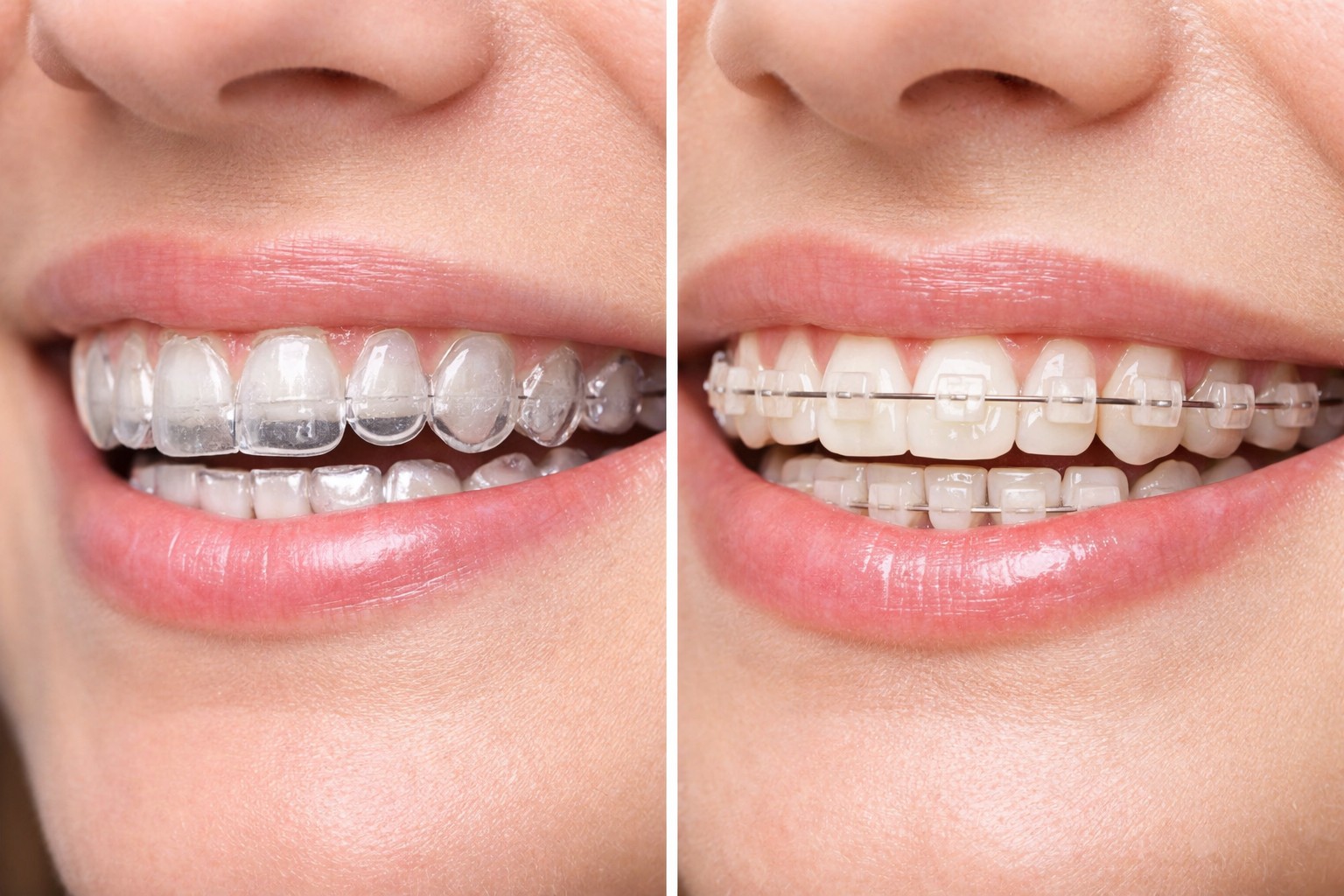
Adults use the phrase for several treatments with different day-to-day demands:
-
Clear aligners, including Invisalign: A sequence of removable, transparent trays moves teeth over time. Some plans also use small, tooth-colored attachments to help the trays grip and move particular teeth.
-
Clear or ceramic braces: Brackets blend with tooth color, but a wire still runs across the teeth. They stay in place until your orthodontist removes them.
-
Lingual braces: Brackets attach behind the teeth. They can be hard to see from the front, though their fit, availability, and cost differ from front-facing braces. Ask whether a provider actually offers them rather than assuming every office does.
Metal braces are visible. Still, their fixed design and ability to handle challenging tooth movements can make them the better choice for some adults.
Are you a good candidate for discreet treatment?
Crowding, spacing, and some bite problems can respond to aligners or clear braces in adulthood. Your age alone does not rule out treatment. As the American Association of Orthodontists explains, an orthodontist needs to assess whether aligners or braces are better suited to your needs.
Untreated decay or gum disease needs attention as part of your plan. Crowns or missing teeth can affect which movements are practical, too. If your teeth do not meet comfortably, an examination is especially important, even when you are mainly concerned about the front teeth.
Your routine matters, too. Aligners suit someone who can wear them as instructed and put them back after eating or drinking anything other than water. If you snack often, have an unpredictable schedule, or know you will forget them, fixed braces may be a better fit. Clear ceramic braces offer a quieter look without requiring you to remember trays.
Invisalign gives a concrete benchmark for that commitment:
“the recommended 20 to 22 hours daily.” – Invisalign
Tell your orthodontist about dental work, gum concerns, jaw symptoms, and the change you want to see. Your front teeth can look straight while your bite still needs attention. A sound plan accounts for both.
Clear aligners vs. clear and metal braces
|
Consideration |
Clear aligners |
Clear ceramic braces |
Metal braces |
|---|---|---|---|
|
Appearance |
Low-profile trays; attachments may show |
Tooth-colored brackets; wire still visible |
Brackets and wire are visible |
|
Eating |
Remove trays for food and most drinks |
Stay on; avoid foods that can damage brackets |
Stay on; avoid foods that can damage brackets |
|
Cleaning |
Brush and floss without brackets; clean trays too |
Brush and floss around brackets and wire |
Brush and floss around brackets and wire |
|
Responsibility |
Requires consistent daily wear and storage |
Fixed in place |
Fixed in place |
|
Suitability |
Depends on the movement and your ability to wear trays |
Depends on the movement and material choice |
Often considered when fixed-appliance control is useful |
Work, meetings, and photos
In a meeting or a photo, clear aligners tend to draw less attention than brackets. Someone close to you may still see the attachments or tray edge, and your speech may feel different at first. Clear braces show more up close, though you can sit down to lunch with colleagues without taking anything out.
If you have an important event coming up, discuss it with your orthodontist. You may be able to remove aligners briefly, but doing that often can interfere with your plan.
Meals and cleaning
With aligners, you eat without trays in your mouth. Afterward, you need somewhere clean to keep them while you eat, time to clean your teeth, and a habit of putting them straight back in. Even a coffee break takes a little planning because drinks other than water call for tray removal.
Braces spare you the on-off routine. Food can lodge around brackets, though, and brushing and flossing take more care. Ceramic brackets blend in better than metal ones; they still come with food restrictions and the possibility of a broken bracket.
Comfort and appointments
Expect some pressure or soreness as your teeth begin to move with either option. Aligners have no protruding wires; braces mean you will not have to keep track of trays. Speed and comfort vary with the person and the plan, so be wary of a blanket promise that one method always wins.
Are invisible braces worth the cost?
No single price applies to adult invisible braces. Your fee depends on the difficulty of the movements, appliance choice, treatment length, and what the practice includes. Clear aligners can cost about the same as braces, while ceramic and metal braces may have different fees. A consultation gives you a figure tied to your bite instead of a broad online range.
Ask for the total estimated fee for each option your orthodontist recommends. Does the quote cover records or scans, adjustments or additional aligners, emergency visits, and retainers? Those details can change how an attractive starting price looks.
|
Ask at your consultation |
Why it matters |
|---|---|
|
Which option fits my bite, and what is included in the fee? |
A cheaper appliance is not a bargain if it cannot deliver the planned correction. |
|
What if treatment needs more time or another set of aligners? |
Find out which changes are covered and which could cost extra. |
|
How will I pay for retainers and follow-up? |
Budget for finishing and retention, not just the initial trays or brackets. |
Some dental policies contribute to adult orthodontics; others do not, and limits differ. Your plan administrator can tell you how an HSA or FSA handles eligible expenses. With financing, look at the down payment, term, and total you would pay, including any conditions on a promotional rate.
Eisenberger and Meister Orthodontics offers a complimentary consultation and financing options, including 0% APR options without a hard credit check. The estimate lets you weigh discretion against what you would pay.
What does treatment realistically ask of you?
Discreet treatment still takes time for appointments, cleaning, and retention after your teeth have moved. Aligners may need attachments or other aids; ceramic braces need adjustments and careful brushing. Speech can feel different at first, and you may feel pressure as treatment begins. Your orthodontist will set the schedule around the movements your teeth need.
You will need a retainer plan after either method because teeth can shift once treatment ends. Convenience matters over the whole course of care, so ask how the practice handles visits, remote check-ins, and unexpected repairs.
Finding discreet orthodontic care near Passaic, NJ
At its Passaic office, Eisenberger and Meister Orthodontics offers adult orthodontics, Invisalign, clear braces, and LightForce custom 3D-printed ceramic braces. You can discuss more than one discreet option at a consultation. The practice also uses Dental Monitoring for added convenience and plans treatment around each patient’s needs.
The practice cites 38 years of experience and more than 15,000 smiles treated. It holds Invisalign Sapphire Provider status, which it says places it among the top 0.5% of orthodontic specialists. If visits are a concern, the warm, spa-like office and efficient scheduling may make them easier to fit into your life. LightForce’s custom design may mean fewer visits for some patients, though your own plan determines how often you come in.
The Passaic office is an option for people in neighboring Clifton, Garfield, Wallington, and Rutherford, as well as nearby Nutley, Lodi, Belleville, Bloomfield, Lyndhurst, and East Rutherford. When comparing practices, consider whether getting to appointments from your home or workplace will be manageable throughout treatment.
The verdict: choose discretion you can sustain
If you can stick to a removable-tray routine, aligners may be worth the added convenience and subtle appearance. If you want an aesthetic option without managing trays, ask about ceramic braces. Metal braces remain a sensible choice when visibility matters less than a fixed, straightforward routine or the control your orthodontist recommends.
Choose the treatment that can address your bite at a fee and daily commitment you can manage. Book a complimentary consultation with Eisenberger and Meister Orthodontics to compare suitable options in Passaic and discuss your goals.
FAQ
Is it worth getting Invisalign as an adult?
It can be worth it if a discreet, removable option fits your bite and you can follow the wear routine. Invisalign lets you eat without trays in place, but you must put them back in consistently and clean them. Compare its full treatment estimate with clear or metal braces before deciding.