
See an adult orthodontist if your teeth have shifted, your bite feels uneven, or crowding makes cleaning hard. You can also ask about a change to your smile. At Eisenberger and Meister Orthodontics in Passaic, a free consultation helps you explore Invisalign, braces, and other options.
If you have tooth pain, bleeding gums, a broken tooth, or another active dental problem, contact your dentist first. Healthy teeth and gums are the starting point for any orthodontic plan.
When should an adult see an orthodontist?
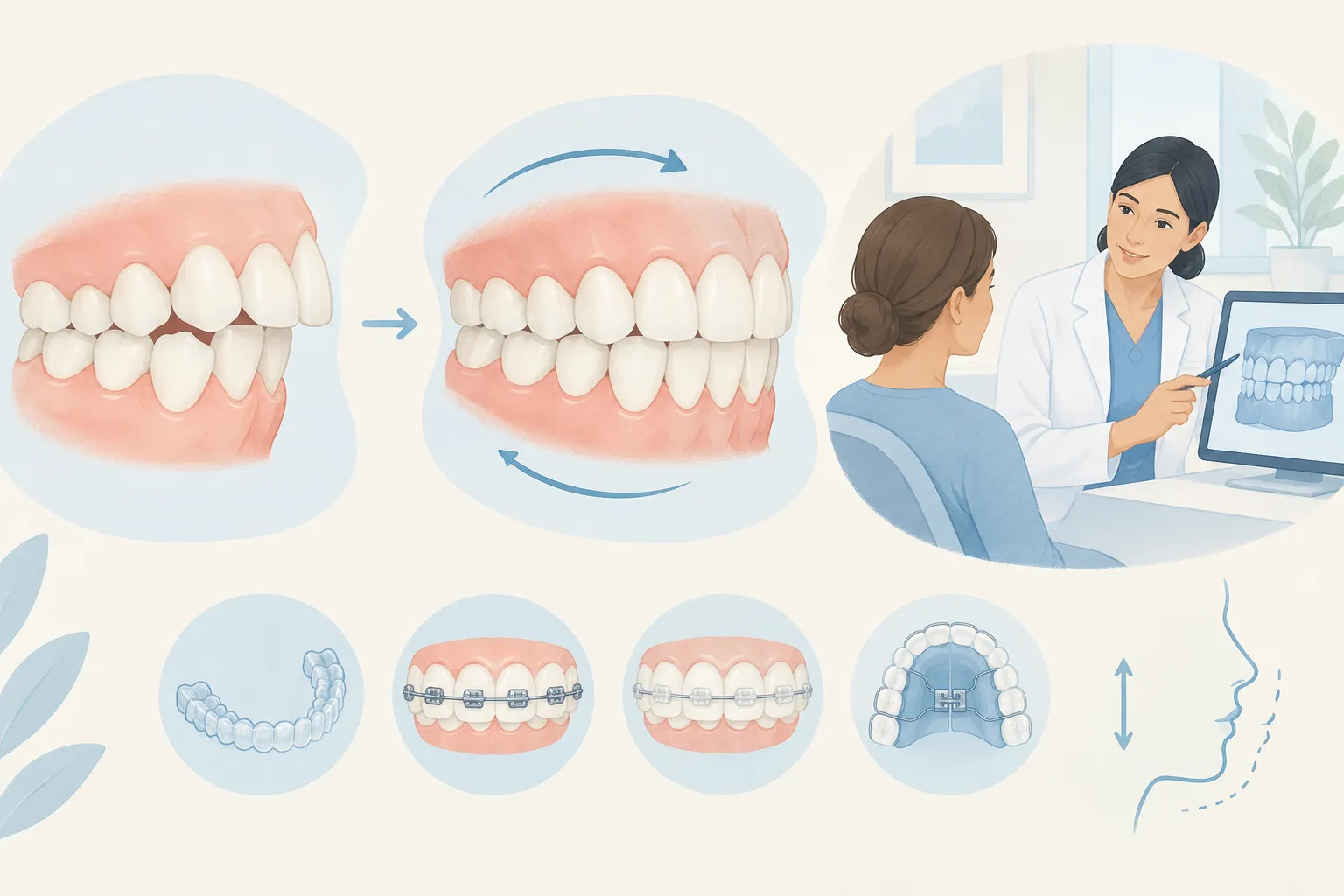
You may notice a change in your teeth without knowing what to do about it. Reasons to make an appointment include:
-
Overlapping teeth that trap food, or gaps you would like to address.
-
Upper and lower teeth that do not meet comfortably, including one tooth that hits before the others when you close.
-
Teeth that have shifted since previous braces or since you stopped wearing a retainer.
-
Difficulty brushing or flossing around crowded teeth, or uneven wear that you and your dentist have noticed. An exam can establish whether alignment plays a part.
-
A change you would like to make to your smile, even if it feels minor.
Your dentist might suggest an adult orthodontics visit before restorative work. Your dentist and orthodontist can plan the order of care together. If a tooth is newly loose, you have swelling, or your gums keep bleeding, see your dentist first.
Dentist or orthodontist: who should you see?
Your dentist handles preventive care, cavities, gum concerns, and restorations. An orthodontist assesses how your teeth and jaws line up and whether tooth movement could address your concern. If you need both kinds of care, ask the clinicians to coordinate.
|
What you notice |
First call |
Why |
|---|---|---|
|
Teeth have shifted or the bite no longer feels even |
Orthodontist |
The question is whether tooth movement could help and what the plan would involve. |
|
Pain, a broken tooth, swelling, or bleeding gums |
Dentist |
Active dental problems need evaluation before an alignment plan. |
|
Crowding makes cleaning difficult |
Dentist and orthodontist |
The dentist assesses oral health; the orthodontist assesses tooth position. |
|
You want straighter teeth but have no treatment preference |
Orthodontist |
Diagnosis comes before a braces-versus-aligners choice. |
You can book before the problem looks severe or you know which treatment you want. Your orthodontist might recommend treatment, ask you to address dental health first, or suggest watching the change. If you are unsure whom to call, lead with the immediate concern: your dentist for tooth pain, your orthodontist for shifting teeth.
What happens at an adult orthodontic consultation?
Tell the orthodontist what you have noticed and what you hope to change. Share your dental history too. The orthodontist checks your teeth and bite. The team may take photos, a digital scan, or X-rays if needed. At Eisenberger and Meister Orthodontics, the exam guides your plan. You do not need to choose an appliance first. Before you leave, ask what comes next.
“At a consultation appointment, you’ll explain your concerns about your teeth and your smile to the orthodontist. The orthodontist will examine your teeth and other oral tissues.” – American Association of Orthodontists
Mention previous orthodontic treatment, retainers, gum treatment, crowns, implants, and planned dental work. These details can change the plan. Bring your insurance information if you have it, and ask:
-
Is the change I notice an orthodontic issue, a dental issue, or both?
-
Do my teeth and gums need other care before tooth movement?
-
Which treatment approaches could address my bite as well as my smile?
-
What would appointments, home care, and retainer wear involve?
-
What is the full proposed fee, and what might my plan pay?
How are braces and Invisalign decisions made?
Your orthodontist recommends an approach after examining the tooth movements needed, your bite, and your dental health. Your willingness to keep up with the daily routine matters too. A discreet appliance still needs to address the bite problem found in the exam.
|
Consideration |
Braces |
Clear aligners such as Invisalign |
|---|---|---|
|
How they work in daily life |
Fixed to the teeth, with attention needed around brackets and wires when cleaning |
Removable for eating and cleaning, but require consistent wear as prescribed |
|
Visibility |
Metal or less noticeable bracket options may be available |
Clear trays are less noticeable on the teeth |
|
Planning question |
Would a fixed appliance best achieve the prescribed movements? |
Can removable trays achieve the prescribed movements, and does the routine suit you? |
Ask which approach your orthodontist recommends for your teeth, where the trade-offs lie, and how you will maintain the result with retainers. Eisenberger and Meister Orthodontics offers braces, clear braces, LightForce custom braces, and Invisalign. Your exam findings can guide the choice.
How long does adult orthodontic treatment take?
Treatment time depends on your bite, oral health, and how far your teeth need to move. Ask how long treatment may take and how often you will need visits. The estimate may change as treatment goes on. After treatment, wear your retainer as directed to help keep your result.
Is there an age limit, and will insurance cover it?
Adults of many ages seek treatment, even if they had braces before. The American Association of Orthodontists’ guide to adult orthodontics explains that age alone does not rule out treatment. Your orthodontist will check whether your teeth and gums are ready. You may need dental or gum care first.
Dental coverage does not necessarily include orthodontic care. Your plan might have an age restriction, a lifetime maximum, a waiting period, or no adult orthodontic benefit. Even if you have “orthodontia coverage,” your share of the cost depends on the policy. Ask the practice to show you the proposed fee, estimated insurance contribution, and remaining balance before you commit.
Eisenberger and Meister Orthodontics offers complimentary consultations and patient financing through HFD, including 0% APR options without a hard credit check. Ask for a written breakdown of the treatment fee, your estimated insurance benefit, and the payment schedule. Insurance benefits and financing terms are separate, so you can compare them side by side.
Book an adult orthodontist consultation in Passaic
Eisenberger and Meister Orthodontics welcomes adults from Passaic and across North Jersey for an evaluation. Nearby communities and towns farther afield include:
-
Passaic County: Passaic, Clifton, Paterson, Haledon, North Haledon, Prospect Park, Hawthorne, Little Falls, Totowa, Woodland Park, Wayne, Pompton Lakes, Wanaque, Ringwood, Bloomingdale, and West Milford.
-
Bergen County: Garfield, Wallington, East Rutherford, Rutherford, Carlstadt, Wood-Ridge, Hasbrouck Heights, Lodi, Saddle Brook, Elmwood Park, Fair Lawn, Hackensack, Paramus, Ridgewood, Teaneck, Fort Lee, and Englewood.
-
Essex County:Nutley, Belleville, Bloomfield, Montclair, Verona, Glen Ridge, Cedar Grove, West Orange, Livingston, Maplewood, South Orange, Newark, and Caldwell.
-
Hudson County: Kearny, Harrison, Secaucus, North Bergen, Union City, Jersey City, Hoboken, Weehawken, and Bayonne.
-
Morris County: Lincoln Park, Pequannock, Riverdale, Montville, Parsippany-Troy Hills, Boonton, Denville, Morristown, and Randolph.
-
Union County: Hillside, Union, Elizabeth, Roselle Park, Cranford, Springfield, Summit, and Westfield.
The Passaic practice offers personalized care, Invisalign and braces, plus Dental Monitoring when appropriate. Expect a warm, spa-like office and efficient scheduling.
Book a complimentary consultation to find out whether treatment would help and what it would involve. You do not need to choose an appliance before you arrive.
FAQ
What is orthodontia for adults?
Adult orthodontia is care that evaluates and, when appropriate, changes the position of adult teeth and the way the bite fits. An orthodontist assesses your dental health and goals before recommending braces, aligners, or another next step.
Are braces painful for adults?
Braces may cause temporary soreness or pressure after placement or an adjustment. Tell your orthodontist if pain is severe, persists, or seems to come from a damaged appliance, rather than assuming it is part of normal treatment.
What does orthodontia coverage mean?
It means your insurance plan includes some benefit for orthodontic services. It does not guarantee that adult treatment is covered in full: eligibility, age limits, maximums, and your share of the fee depend on your specific plan.
Why doesn’t insurance cover adult orthodontics?
Some plans exclude adult orthodontics or limit orthodontic benefits to younger members. Other plans do include an adult benefit, often with restrictions, so the answer depends on the plan rather than on whether an adult can receive treatment.