
All Types of Braces: Which Option Fits You?
Choosing between all types of braces can feel overwhelming. You may be weighing appearance, comfort, treatment time, and cost. Whether you’re a parent, teen, or adult, understanding the different types of braces makes the choice easier. The right fit depends on your bite, daily routine, and goals.
At Eisenberger and Meister Orthodontics, we help patients in Passaic and nearby New Jersey communities choose with confidence. Families come to us for advanced technology, personal care, and support from the first visit.
With 38 years in practice and 15,000+ smiles treated, Eisenberger and Meister Orthodontics combines experience with innovation – from Invisalign Sapphire Provider expertise in the top 0.5% of specialists to custom LightForce braces, Dental Monitoring, efficient scheduling, complimentary consultations, and flexible financing with 0% APR options and no hard credit checks.

What Braces Actually Do
Orthodontic treatment uses gentle pressure to move teeth and improve the bite over time. The types of braces differ in how they move teeth, how visible they are, and how much care they need. Some also work better for certain cases.
Braces and aligners can help correct:
-
Crowded teeth
-
Crooked teeth
-
Gaps between teeth
-
Overbites
-
Underbites
-
Crossbites
-
Open bites
-
Rotated teeth
-
Jaw alignment concerns in growing children
Looks are only part of the choice. You also need to consider how well an option fits your case, how easy it is to keep clean, and whether you can follow the wear schedule. A discreet option is only better if it can deliver the result you need.
The Cleveland Clinic’s guide to braces notes that aligners need at least 22 hours of daily wear. It also reports that about 20% of orthodontic patients in the United States are adults.
The Different Types of Braces
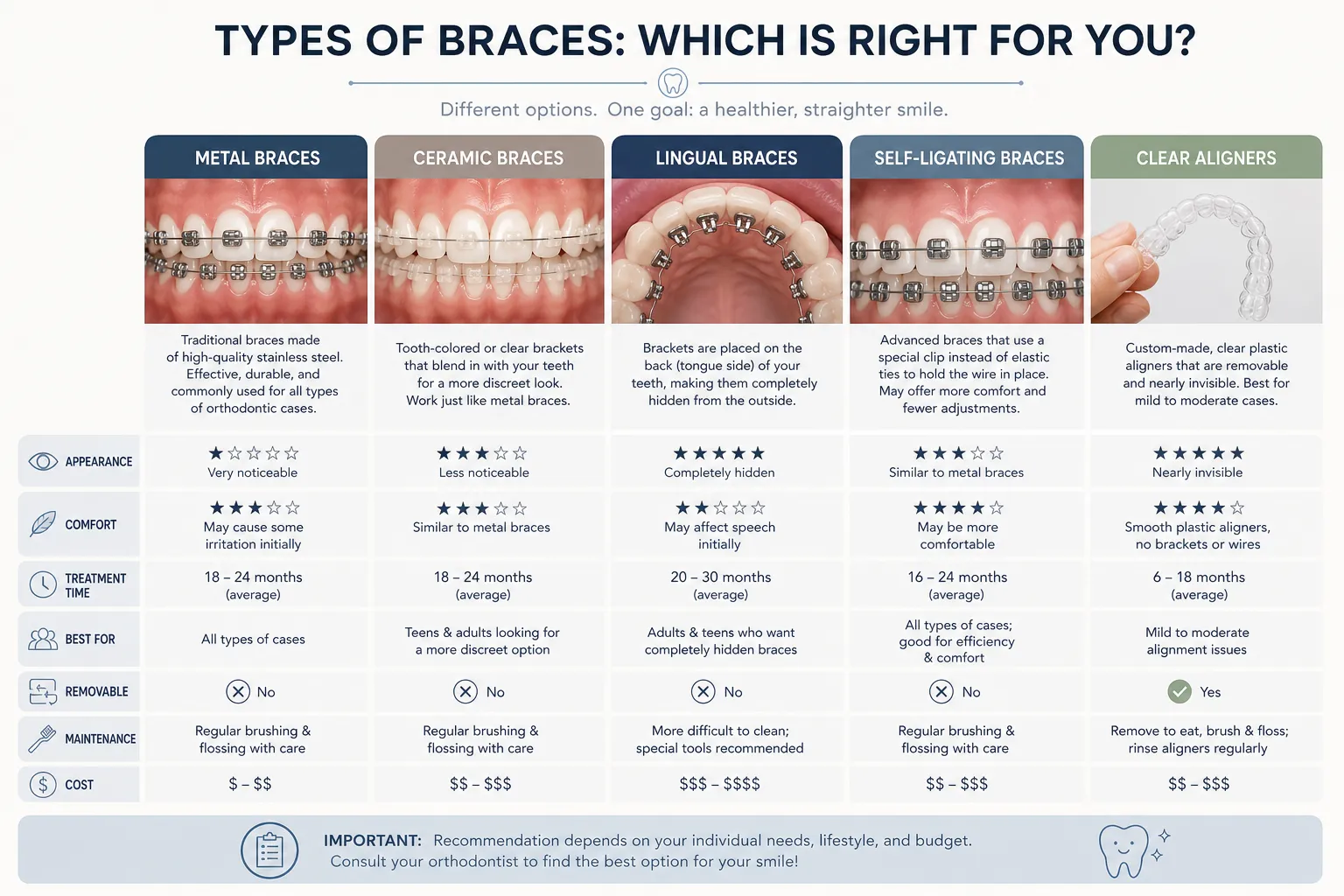
When people ask about the types of braces, they’re usually comparing visibility, comfort, results, and upkeep. Here’s how the options differ.
Traditional Metal Braces
Traditional metal braces are a familiar, versatile choice. Steel brackets and wires guide teeth into place. They can address mild crowding and more complex bite problems. The American Association of Orthodontists’ braces guide explains how brackets and wires move teeth over time.
Best for
-
Children and teens
-
Moderate to severe alignment issues
-
More complex bite problems
-
Patients who want the most time-tested option
Pros
-
Highly effective for nearly all cases
-
Durable and reliable
-
Often the most cost-efficient choice
-
No risk of forgetting to wear them
Considerations
-
Most visible option
-
Some food restrictions
-
May cause initial soreness after adjustments
Metal braces are often the benchmark against which other ortho braces types are measured. They may not be the most subtle, but they are often the most predictable.
Ceramic Braces
Ceramic braces work like metal braces but use tooth-colored or translucent brackets for a more discreet appearance. They are especially popular with older teens and adults who want fixed treatment without the look of full metal brackets.
Best for
-
Image-conscious teens
-
Adults who want a lower-visibility fixed option
-
Patients needing the power of braces with a more refined appearance
Pros
-
Less noticeable than metal braces
-
Effective for many moderate and complex cases
-
Fixed in place, so no compliance issue like removable aligners
Considerations
-
Brackets can be more fragile than metal
-
Clear ties may stain without careful hygiene
-
Usually cost more than metal braces
Lingual Braces
Lingual braces are placed behind the teeth instead of on the front, making them virtually invisible from a conversational distance. They appeal to patients who want fixed treatment but do not want braces to show.
Best for
-
Adults in public-facing or professional roles
-
Patients who prioritize hidden treatment
-
Select cases where lingual orthodontics is appropriate
Pros
-
Hidden from view
-
Fixed in place
-
Can be effective for certain alignment issues
Considerations
-
Typically one of the most expensive forms of braces
-
Harder to clean
-
Can affect speech at first
-
Not ideal for every case
Self-Ligating Braces
Self-ligating braces look similar to traditional braces but use a built-in clip instead of elastic ties to hold the wire. This system may reduce friction and, in some cases, simplify adjustment visits.
Best for
-
Patients who want a modern fixed appliance
-
Those interested in potentially fewer in-office adjustments
-
Many mild to complex cases
Pros
-
No elastic ties
-
Efficient mechanics in appropriate cases
-
Can be easier to keep cleaner around the bracket
Considerations
-
Not automatically “faster” for everyone
-
Still visible if metal
-
Results depend more on diagnosis and treatment planning than marketing terms
Clear Aligners
Clear aligners, including Invisalign, use a series of removable trays to gradually shift teeth. They are one of the most popular choices for teens and adults because they’re nearly invisible and can be removed for meals and brushing.
Best for
-
Responsible teens
-
Adults seeking discreet treatment
-
Mild to moderate crowding or spacing
-
Patients committed to wearing trays consistently
Pros
-
Nearly invisible
-
Removable for eating and oral hygiene
-
No brackets or wires
-
Comfortable, smooth design
Considerations
-
Must be worn 20–22 hours a day
-
Easier to lose or forget
-
Not every complex bite can be corrected with aligners alone
-
Success depends heavily on compliance
At Eisenberger and Meister Orthodontics, our Invisalign Sapphire Provider status places us in the top 0.5% of Invisalign specialists. Your orthodontist’s treatment plan matters as much as the trays themselves.
A Modern Option Worth Special Attention: LightForce Custom Braces
Standard braces are not the only fixed option. Custom braces technology offers another approach.
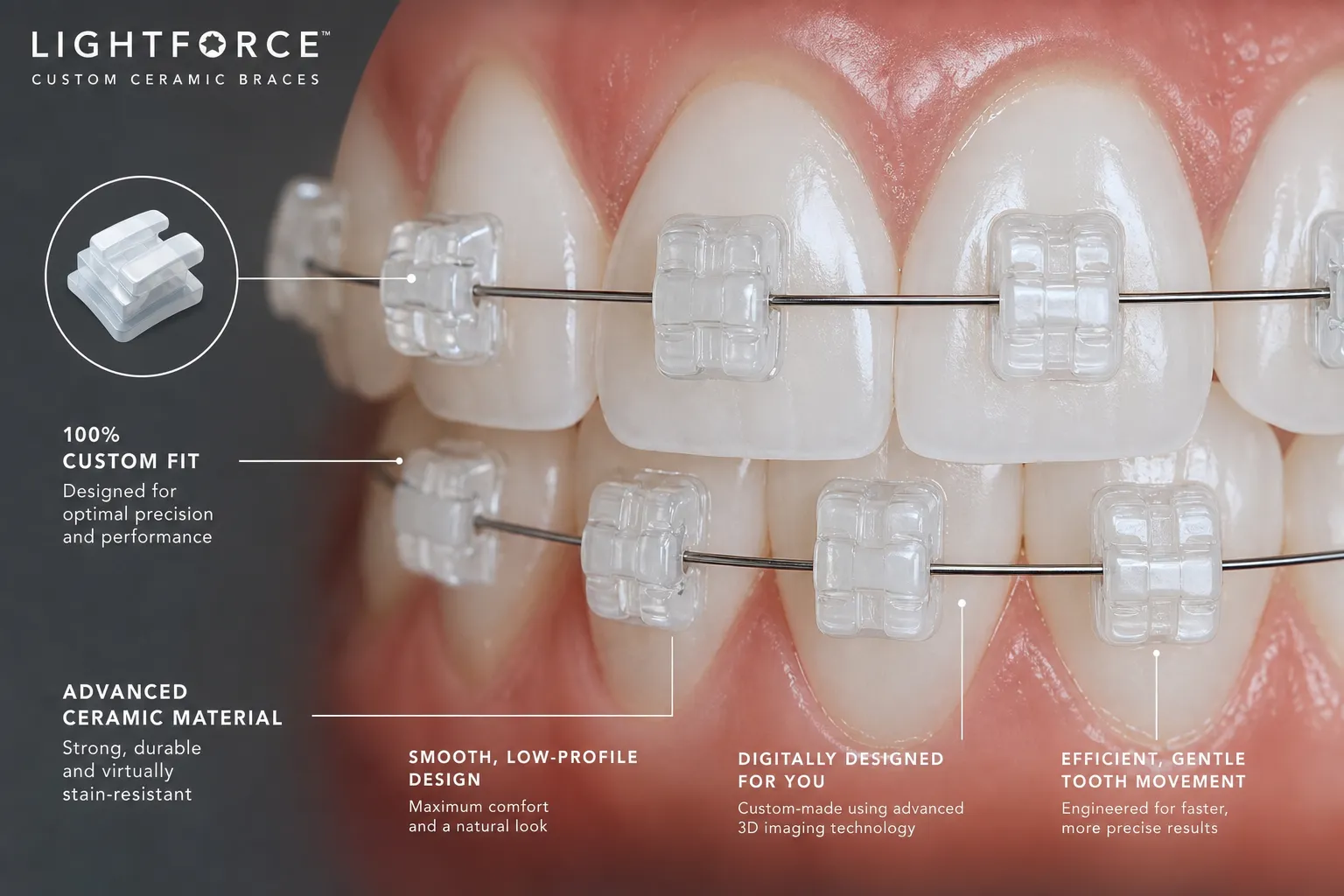
LightForce braces are custom 3D-printed ceramic braces designed specifically for each individual tooth. Instead of using a one-size-fits-most bracket, this system is personalized from the start.
Why LightForce Stands Out
Precision fit
Each bracket is custom designed, which can allow for more precise tooth movement.
Aesthetic appeal
Because LightForce brackets are ceramic, they blend more naturally with the teeth than traditional metal braces.
Potentially fewer appointments
More precise planning may reduce unnecessary refinements, which can mean fewer office visits in some cases.
Potential for faster treatment
For the right patient, custom bracket systems can support more efficient treatment mechanics.
For patients who want something more advanced than standard braces, LightForce is an excellent example of how treatment has evolved beyond the classic categories.
Comparing All Types of Braces at a Glance
|
Option |
Visibility |
Removable |
Best For |
Compliance Required |
Typical Cost Range |
|---|---|---|---|---|---|
|
Metal Braces |
Most visible |
No |
Mild to complex cases |
Low |
Lower |
|
Ceramic Braces |
Less visible |
No |
Teens and adults wanting subtle fixed treatment |
Low |
Moderate |
|
Lingual Braces |
Hidden |
No |
Adults wanting invisible fixed braces |
Low |
Higher |
|
Self-Ligating Braces |
Varies |
No |
Patients wanting a modern fixed system |
Low |
Moderate |
|
Clear Aligners |
Nearly invisible |
Yes |
Mild to moderate cases, compliant teens and adults |
High |
Moderate to higher |
|
LightForce Custom Braces |
Low visibility |
No |
Patients wanting custom ceramic technology |
Low |
Moderate to higher |
How to Choose the Right Type for You or Your Child
The best option differs for each patient. A personal recommendation looks beyond appearance.
1. Case Complexity
For complex issues such as severe crowding, impacted teeth, or hard-to-move teeth, fixed braces may offer better control than aligners.
2. Age and Responsibility
Children and younger teens may do better with braces because there’s no tray to lose or forget. Adults and highly responsible teens often do beautifully with clear aligners.
3. Lifestyle
Your routine matters. Contact sports, stage work, or frequent meetings may shape your choice. Patients often want an option that looks good and fits daily life.
4. Oral Hygiene Habits
Some patients are better candidates for aligners because they can remove them to brush and floss normally. Others benefit from a fixed option because they may not reliably wear trays.
5. Budget
Different braces come with different costs, but financing can make premium treatment much more accessible. At Eisenberger and Meister Orthodontics, complimentary consultations and flexible payment options – including 0% APR financing and no hard credit checks – help families move forward with less stress.
Braces vs. Aligners: The Real-World Question Patients Ask Most
When people search for the different types of braces, they are often really deciding between fixed braces and clear aligners. For many families in Passaic, Clifton, Nutley, West Orange, Livingston, and nearby North Jersey towns, the right answer comes down to daily habits as much as aesthetics.
Fixed Braces May Be Better If:
-
You want a treatment that works 24/7 without needing reminders
-
Your case is more complex
-
You have a child or younger teen
-
You want maximum control over difficult tooth movements
Clear Aligners May Be Better If:
-
You want the most discreet option
-
You’re committed to wearing trays consistently
-
Your case is mild to moderate
-
You want easier mealtime and brushing routines
What matters most is not what looks best in theory, but what you will actually follow through with successfully.
Comfort, Appearance, and Maintenance
Another area many articles gloss over is the daily experience of treatment. Here is what patients often notice once braces are actually on.
Most discreet
-
Clear aligners
-
Lingual braces
-
Ceramic braces
Most durable
-
Metal braces
-
Self-ligating metal systems
Easiest to remove for meals
-
Clear aligners only
Lowest-maintenance for compliance
-
Fixed braces of any kind
Most hygiene-sensitive
-
Ceramic braces with clear ties
-
Lingual braces
-
Aligners that are not cleaned properly
How Long Does Treatment Usually Take?
Treatment time depends on the severity of the orthodontic issue, the type of appliance, growth stage, and how well instructions are followed. Some patients finish in under a year, while others need closer to two years or more.
Clear aligners can be highly efficient in the right hands, but only when worn as directed. On the braces side, modern technology like LightForce and virtual check-ins with Dental Monitoring can help streamline treatment for eligible patients.
At Eisenberger and Meister Orthodontics, we focus on efficient appointment scheduling, less waiting time, and carefully planned treatment that respects your calendar as much as your smile.
What Makes a Premium Orthodontic Experience Different?
Orthodontic treatment is not just about straightening teeth. It is also about how supported, informed, and comfortable you feel along the way.
Eisenberger and Meister Orthodontics was built for patients who want more than a transactional office visit.
Personalized treatment planning
No rushed, one-size-fits-all recommendations.
Advanced technology
From digital planning to custom appliances and Dental Monitoring, treatment is designed for precision and convenience.
Invisalign expertise at the highest level
As an Invisalign Sapphire Provider, the practice is among the top 0.5% of specialists.
A warm, spa-like office environment
For anxious children, busy parents, and adults who appreciate elevated care, the office experience feels calm, luxurious, and welcoming.
Convenience that matters
Dental Monitoring allows some progress checks to happen remotely, reducing unnecessary visits and hassle.
Affordability without compromise
Complimentary consultations and financing options help patients start treatment without feeling boxed in by cost.
Which Option Is Often Best by Age Group?
Children
Early orthodontic evaluations can identify jaw development issues, spacing concerns, and bite problems before they become more difficult to treat. Expanders, limited early braces, or observation may be recommended depending on growth.
Teens
Teens often have the widest range of options: metal braces, ceramic braces, LightForce custom braces, and Invisalign. The right fit depends on complexity, maturity, and aesthetic preference.
Adults
Adult orthodontics is more common than ever. Many adults prefer ceramic braces, LightForce braces, or Invisalign because these options are more discreet and professionally friendly.
Common Misconceptions About the Types of Braces
“The least visible option is always the best.”
Not necessarily. If the appliance cannot predictably solve the problem, a subtler look may come at the expense of results.
“All orthodontists offer the same Invisalign experience.”
They do not. Invisalign outcomes depend heavily on the provider’s skill, planning ability, and experience level.
“Braces are only for kids.”
Far from it. Many adults start treatment for the first time or return for retreatment after shifting.
“The most expensive option is automatically the most advanced.”
Not always. The best value is the treatment that fits your clinical needs and gets you to a stable, healthy result efficiently.
Orthodontic Care Near Passaic and Clifton
We welcome patients from Passaic and Clifton, as well as families across nearby North Jersey counties:
-
Passaic County: Paterson, Little Falls, Wayne, Totowa, and Woodland Park.
-
Bergen County: Garfield, Wallington, Rutherford, East Rutherford, Lodi, Hackensack, Fair Lawn, and Paramus.
-
Essex County: Nutley, Bloomfield, Montclair, Belleville, Newark, and West Orange.
-
Hudson County: Secaucus, Hoboken, and Jersey City.
If you live nearby, a complimentary consultation can help you compare braces and Invisalign for your needs.
The Bottom Line
If you’re comparing all types of braces, the goal is not to find the “best-looking” option in a vacuum. It’s to find the one that gives you the healthiest, most predictable, and most practical path to the smile you want.
For some patients, that means traditional metal braces. For others, ceramic braces, lingual braces, custom LightForce braces, or Invisalign will make more sense. The right choice depends on your bite, your age, your goals, your habits, and the expertise of the orthodontic team guiding you.
At Eisenberger and Meister Orthodontics, you get more than a menu of treatment options – you get advanced technology, elite Invisalign expertise, custom solutions, a welcoming spa-like environment, efficient scheduling, and highly personalized care shaped by 38 years of experience and 15,000+ smiles treated.
If you’re in Passaic or a nearby North Jersey community, start with a complimentary consultation. We’ll help you find the type of braces that fits you or your child.
FAQ
Is $5000 expensive for braces?
$5,000 is within a common orthodontic range for many patients, especially depending on treatment complexity and the type of braces chosen. What matters more is the total value of the care, the experience of the orthodontist, and whether flexible financing makes treatment comfortable for your budget.
Which braces hurt the least?
Clear aligners are often perceived as the most comfortable because they don’t have brackets or wires rubbing against the cheeks and lips. That said, every option can cause temporary pressure as teeth move, and comfort also depends on your specific treatment plan.
What type of braces is best?
There is no single best choice for everyone. The best option is the one that matches your bite, your lifestyle, your goals, and your ability to follow treatment instructions, whether that means metal braces, ceramic braces, LightForce braces, lingual braces, or Invisalign.
Is 4 years of braces too long?
Four years can be longer than average, but it is not automatically too long if the case is complex or treatment has been interrupted by missed visits, poor aligner wear, or growth-related factors. A personalized orthodontic evaluation is the best way to understand what timeline is reasonable for your situation.