
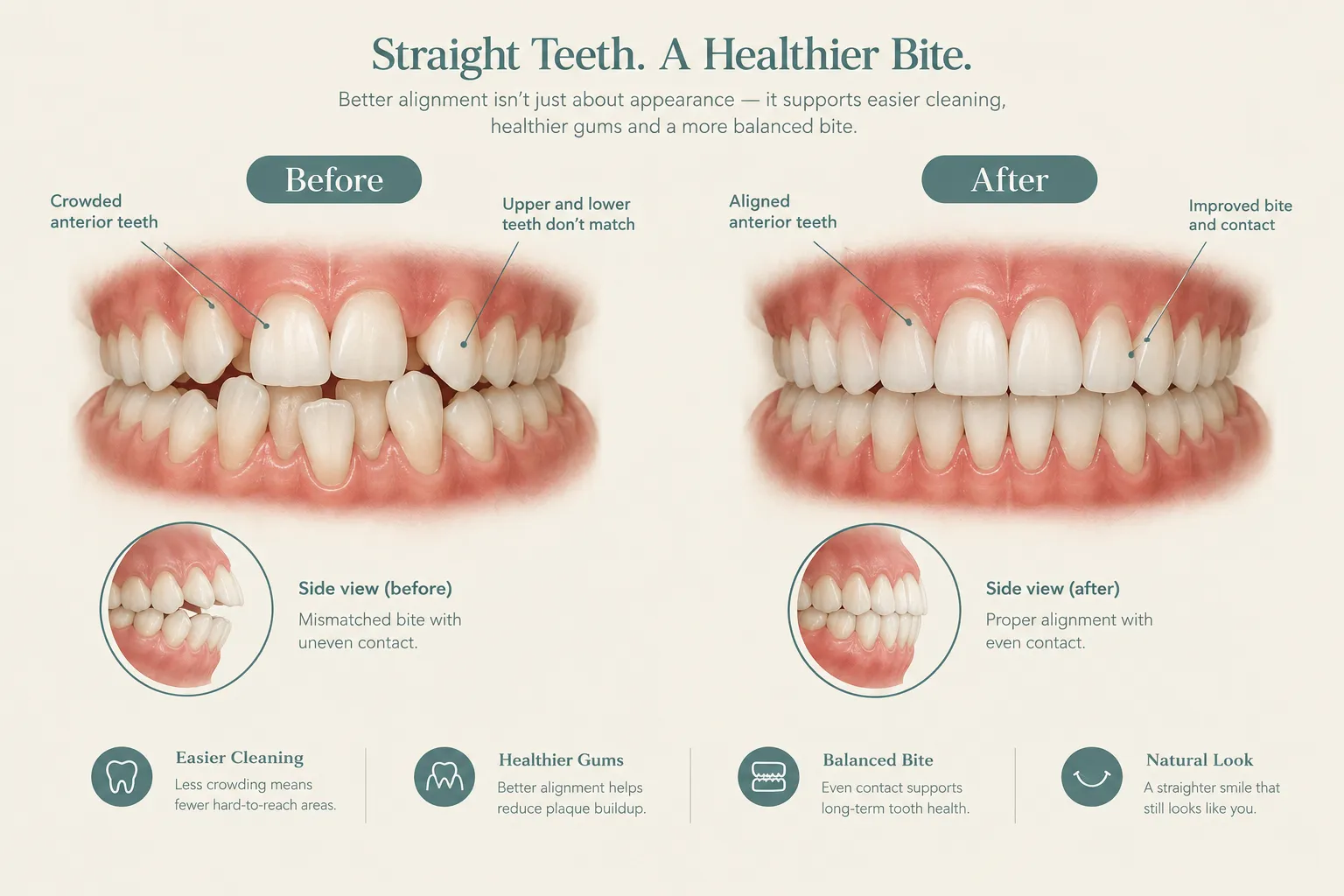
If you searched for “before after teeth braces” photos, remember that they can show straighter teeth and a better-fitting bite, but cannot predict your result. Dental braces can straighten crowded or spaced teeth and improve how the upper and lower teeth fit together. Your result depends on where the teeth started and what your treatment plan needs to correct; a new jaw shape or a copy of someone else’s photo is not a realistic promise.
If you’re considering braces for yourself or your child, ask what the orthodontist expects to change. A pair of photos may show the smile, but it cannot explain the treatment behind it.
Before after teeth braces photos: What can change?
Brackets and wires move teeth with controlled pressure. You may see a big change when crowded front teeth straighten, while work on the bite is less obvious in photos.
|
Starting concern |
What may look or function different after treatment |
What affects the result |
|---|---|---|
|
Crowded or rotated teeth |
Teeth can line up more evenly in the arch. |
Available space, tooth size, gum health and the planned movement. |
|
Gaps between teeth |
Spaces can close or become more balanced. |
The reason for the gaps, including tooth size or missing teeth. |
|
Protruding front teeth |
Front teeth may sit in a different position and the lips may look different at rest. |
How much movement is possible and whether the issue involves the jaws. |
|
Overbite, underbite, crossbite or open bite |
Upper and lower teeth may fit together better. |
Whether the mismatch comes mainly from tooth position or jaw structure. |
An orthodontist looks at the smile from the front and at how the teeth meet from the side. Where teeth overlap, cleaning between them can be harder; maintaining dental health during treatment still requires brushing, flossing and regular dental care. Front teeth can look straight even when the back teeth do not meet well, and better bite alignment may be hard to see in a smile photo.
Do braces make teeth perfectly straight?
The goal is an alignment and bite that suit your anatomy and can be maintained. Tooth shape, gum levels and jaw relationships still affect the look of your smile. Braces can move a tooth that sits crooked, but they cannot change its shape.
What braces do not reliably change
Braces move teeth. That movement can change how an adult’s lips rest or how their profile looks, though the size of the change varies. If the jaws themselves have a large mismatch, the orthodontist may discuss jaw surgery.
“Unlike children, adults are no longer growing, so surgery is the only way to modify the size, shape, or position of an adult’s jaw bones.” – American Association of Orthodontists
Braces will not whiten teeth or replace missing teeth, and they cannot correct every source of facial asymmetry. Teeth whitening is a separate cosmetic choice. Discuss gum health and any planned restorative dental work before treatment, since both can affect how the finished smile looks.
Look for photos of someone who started with a similar problem, preferably with the bite visible in both images. The images may leave out extractions, elastics, jaw surgery or restorative work. Ask what else was involved before deciding a photo reflects what braces alone can do.
How braces results develop over time
Patients may notice front teeth straightening months before the orthodontist finishes correcting the bite. The timetable depends on the work your teeth need.
How long does it take to see braces results?
Sometimes the first visible change is a less crowded front tooth. In other cases, the orthodontist must first make room or change how the upper teeth meet the lower teeth, so early progress is harder to spot. Bite issues can take longer to resolve than the change you see in a mirror; timelines vary with the starting bite and overall treatment plan.
-
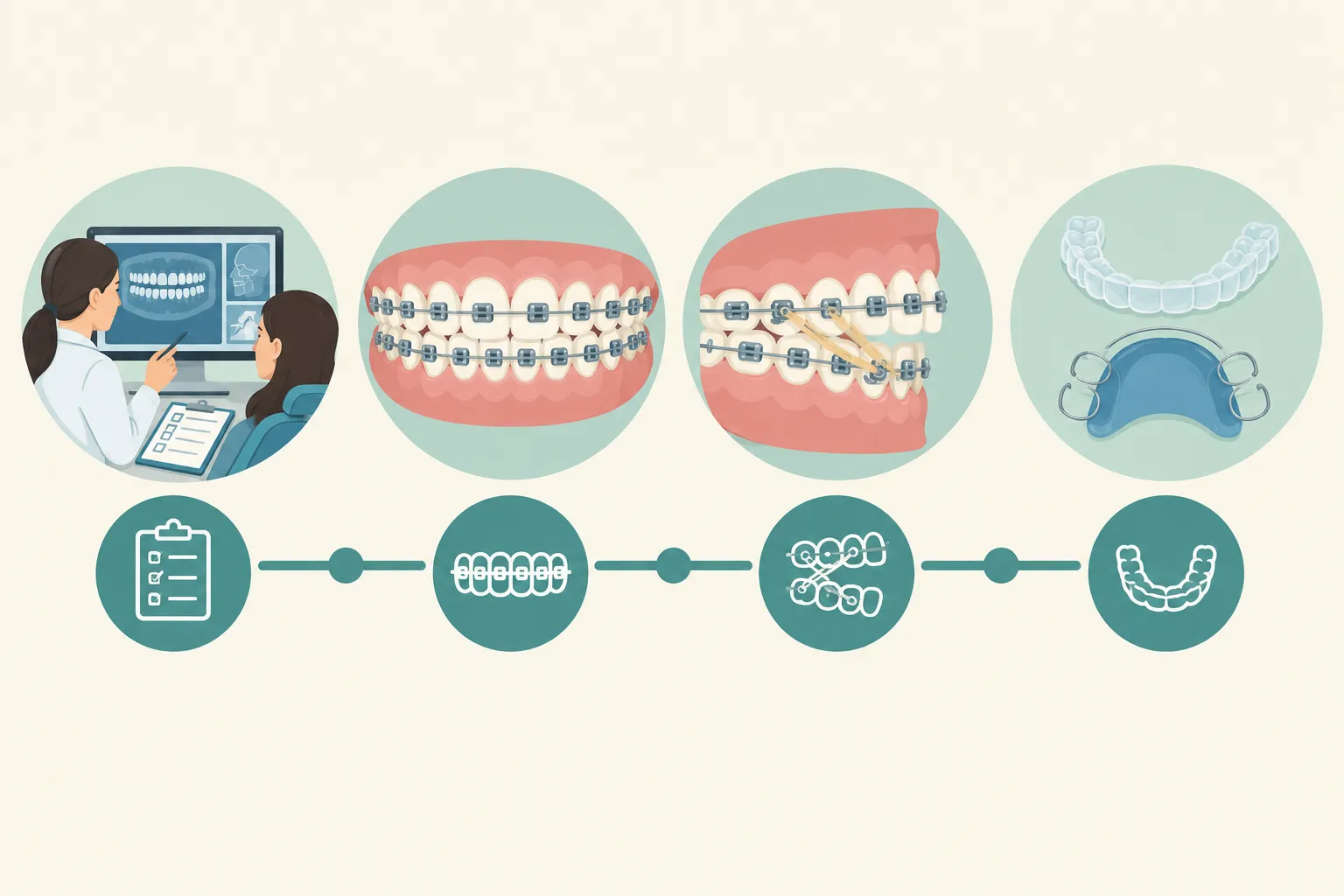
Planning: Your orthodontist examines the teeth, bite and jaws, then explains what treatment can change.
-
Initial alignment: Teeth start to line up as the orthodontist manages crowding or gaps. Your bite may feel different during movement. After fittings or adjustments, soft foods can be more comfortable if your teeth feel tender.
-
Bite work and detailing: At adjustment appointments, the orthodontist works on how your teeth meet and corrects remaining rotations or spaces. The plan may include elastics.
-
Retention phase: Once braces come off, retainers help hold the teeth in their new positions.
The American Association of Orthodontists’ guide to braces says most people wear braces for 12 to 24 months, depending on the person and the bite problem. Complex movements may take longer. So can missed appointments, broken appliances or skipped elastics. If your estimate surprises you, ask which part of the bite needs more time.
Braces before and after for adults and children
You can have braces as an adult even if you missed treatment as a teenager. Tooth movement is still possible after jaw growth ends. If your main hope is a major change to your profile, ask the orthodontist to assess the position of your jaws as well as your teeth.
For a child, an orthodontist may recommend treatment while the teeth and jaws develop or choose to watch growth first. Starting early does not guarantee an earlier finish. Ask what the early phase is meant to accomplish.
|
If you are considering treatment for… |
Ask about… |
|---|---|
|
An adult |
The bite goal, realistic profile changes, gum health and whether other dental care is needed. |
|
A teen |
Expected compliance with any elastics, appliance care and how the plan fits school and activities. |
|
A younger child |
Why treatment is recommended now, what can wait and whether a later phase is expected. |
How to understand your own likely before-and-after result
At a consultation, ask the orthodontist to name the starting problem: crowded teeth, a bite mismatch, jaw position or a combination. Find out what will change in the smile and how the teeth should meet afterward. Mention any concern about your profile, gum disease or other dental care needs; a front-facing smile photo cannot answer those questions.
It helps to leave with answers to these questions:
-
What can braces address on their own, and what would need another kind of treatment?
-
Is the goal to create space, close gaps, change the bite or all three?
-
Will elastics or another appliance be needed to reach the planned result?
-
What would make the treatment timeline longer?
-
What is the retainer plan after removal?
Plan for retainers before braces come off. Teeth can shift after active treatment; wearing retainers as directed helps keep the alignment you achieved.
Personalized braces care in Passaic
In Passaic, New Jersey, Eisenberger and Meister Orthodontics offers braces, clear braces and custom LightForce ceramic braces. Your diagnosis and preferences determine which appliance makes sense. Read about less-visible braces options or payment plan options for families if those are part of your decision. At a complimentary consultation, you can discuss what you want to change about your smile, what your bite needs and how orthodontic care could fit your budget and routine.
Patients visit from Passaic and surrounding towns, including Clifton, Garfield, Wallington, Rutherford, East Rutherford, Nutley, Lyndhurst, Lodi, Saddle Brook, Paterson, Bloomfield, Montclair, Hackensack and Wayne. Parents can also read about braces for teens in Passaic. Your plan should reflect your starting bite and the changes you want.
Straighter teeth and a better-fitting bite may be achievable for you. Dramatic facial change is far less predictable. Eisenberger and Meister Orthodontics can explain what a personalized plan would address and where its limits lie. Book a complimentary consultation to discuss your starting point and the result you want.
Frequently asked question
Is 3 years with braces too long?
Three years is longer than the 12 to 24 months the American Association of Orthodontists says most people wear braces, but it is not automatically too long. Complex bite correction and other factors can extend treatment. Ask your orthodontist what remains to be corrected and what the current finish estimate depends on.