
Bite turbos for braces are the blue or clear bumps you may feel behind your front teeth. These bite blocks keep teeth from closing onto lower braces or help your bite move into position. Spacers for braces, also called separators, are small rubber rings between back teeth. They make room for bands that may be fitted around molars. Leave both in place until your orthodontist tells you otherwise.
If you have a turbo, you may find that your back teeth no longer touch when you chew. Separators are more likely to leave your molars feeling tender. These changes generally ease, but the way you clean around each appliance matters.
Bite turbos for braces vs. spacers for braces
|
Bite turbos (bite ramps or bite blocks) |
Spacers (separators) |
|
|---|---|---|
|
What you see or feel |
Bonded bumps, often clear or colored |
Small elastic rings, sometimes metal separators |
|
Where they go |
Often behind the upper front teeth; sometimes on back teeth |
Between back teeth, commonly beside molars |
|
Why they are used |
Keep teeth from striking brackets and give certain bites room to change |
Open a small gap so a molar band can fit |
|
What feels different |
Your back teeth may not meet as they used to; chewing and speech may change |
Pressure or soreness between back teeth |
|
When they come off |
When the orthodontist decides your bite no longer needs them |
Usually at the appointment when bands are placed |
Where the appliance sits tells you a lot: a bump attached to a tooth is likely a turbo; a little ring between teeth is likely a separator. Your orthodontist may use both at different points in treatment.
Why are there blue or clear bumps behind your front teeth?
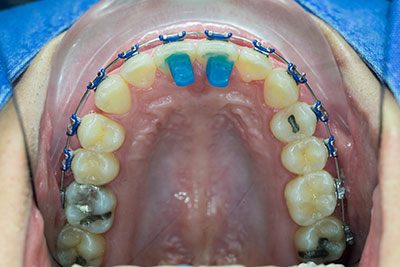
Your orthodontist bonds a bite turbo to a tooth. As you close your mouth, the lower teeth meet that bump before the upper teeth strike the lower brackets or close too far. This helps protect braces while your orthodontist treats a deep bite or crossbite and your teeth move. You might have two bite turbos behind your front teeth or turbos on your molars.
What eating and speaking feel like at first
With turbos behind your front teeth, chewing a sandwich can feel surprisingly difficult because your molars may not meet. Soft options include mashed potatoes, scrambled eggs, yogurt, pasta, cooked vegetables or flaky fish. Cut food into small bites and take your time. Skip hard or sticky foods that could damage braces or loosen an attachment.
A front-tooth turbo may get in the way of your tongue for certain sounds. A temporary lisp is possible; speaking aloud at a slower pace can help you adjust. There is no need to bite harder to make your back teeth meet.
When your orthodontist removes bite turbos
Once your teeth can meet without hitting brackets or interfering with bite correction, your orthodontist can remove the turbos. They may stay on for months, depending on your bite and treatment plan. For the best results, leave them in place until your orthodontist removes them; trying to pry them off could cause damage to the attachment or your braces.
Why do rubber separators go between back teeth?
Some braces plans call for a metal band around a molar. When the neighboring teeth fit tightly together, your orthodontist places a small elastic separator between them to make room for the band. Metal separators are another option. Not everyone with braces needs separators or molar bands.
The first sign of a separator is often a feeling that food is caught between your molars, along with pressure or tenderness. As the space opens, that feeling usually eases. Separators typically stay in for days before your band appointment, when the team removes them and fits the bands if your plan calls for them.
“In a study of 62 adolescents, separator pain decreased significantly after the first two days.” – Aldrees, Journal of Orthodontic Science
Separators are not bonded to teeth. If one falls out, call your orthodontist rather than pushing it back in. There may already be enough room for the band, or the team may need to replace the separator.
How to eat, brush and floss with each appliance
|
Daily task |
With bite turbos |
With spacers |
|---|---|---|
|
Eating |
Choose soft, easy-to-chew foods at first; cut bites small and avoid hard or sticky foods. |
Choose softer foods if molars are sore; avoid gum, caramel and other sticky foods that may pull a separator out. |
|
Brushing |
Brush the bumps, the tooth surfaces around them and the gumline; clean around brackets as usual. |
Brush all tooth surfaces gently, including the molars; do not pick at the rings. |
|
Flossing |
Floss the teeth as directed for your braces; clean around the bonded turbos without prying at them. |
Floss other teeth, but do not floss between the teeth holding a separator unless your orthodontist gives different instructions. |
After meals, a water rinse can help dislodge food. For soreness, ask your orthodontic team whether an over-the-counter pain reliever is appropriate for you, then follow the package directions. Avoid nudging either appliance with a finger, toothpick or your tongue.
When should you call the orthodontist?
If a turbo loosens or falls off, call the office right away if a tooth starts hitting a bracket. The team also needs to know if a separator slips out before banding, even if the tooth feels fine. They can tell you whether it needs replacing; do not use glue or put the separator back in yourself.
Contact your orthodontist if pain persists, worsens or stops you eating, if a sharp edge cuts your mouth, or if your bite changes and a bracket seems broken. Mild pressure and unfamiliar chewing are common; severe or escalating pain calls for advice. Seek prompt medical attention for marked swelling, fever or trouble swallowing or breathing.
Orthodontic care near Passaic, NJ
Eisenberger and Meister Orthodontics treats children, teens and adults in Passaic. With a combined 38 years in practice and more than 15,000 smiles treated, the team plans care around each patient’s bite. If a turbo or separator comes loose, contact the practice for advice instead of trying to fix it at home. If you are considering braces, a complimentary consultation gives you time to discuss whether your plan may include either appliance.
Families visit from Passaic and other North Jersey communities across several counties:
|
County |
Communities around Passaic |
|---|---|
|
Passaic |
Clifton, Paterson, Woodland Park, Little Falls, Totowa, Haledon, North Haledon, Prospect Park, Hawthorne, Wayne, Pompton Lakes |
|
Bergen |
Garfield, Lodi, Elmwood Park, Saddle Brook, Fair Lawn, Glen Rock, Ridgewood, Paramus, Rochelle Park, Maywood, Hackensack, Hasbrouck Heights, Teterboro, Wood-Ridge, Moonachie, South Hackensack, Carlstadt, East Rutherford, Rutherford, Lyndhurst, North Arlington, Wallington, Teaneck, Bogota |
|
Essex |
Nutley, Belleville, Bloomfield, Glen Ridge, Montclair, Verona, Cedar Grove, West Orange, Orange, East Orange, Newark |
|
Hudson |
Secaucus, Kearny, Harrison, North Bergen, Union City, Weehawken, Jersey City |
|
Morris |
Lincoln Park, Pequannock, Riverdale, Montville |
|
Union |
Hillside, Union, Elizabeth |
Driving time from these North Jersey communities depends on your route and traffic.
The bottom line
Bite turbos protect your braces and help control how your teeth meet. Spacers create the room needed for molar bands. Soft meals can help while you adjust, and you should skip flossing between teeth that hold a separator. For questions about your bite or braces, Eisenberger and Meister Orthodontics offers personalized care and complimentary consultations for North Jersey families.
FAQ
Can bite turbos be used with braces?
Yes. Bite turbos are often bonded to teeth during braces treatment to stop teeth from striking brackets and to give the bite room to change. Your orthodontist decides whether your bite needs them.
How long do bite turbos stay on?
They remain until your orthodontist finds that your teeth can meet without damaging braces or interfering with bite correction. This can take months and varies from person to person. Do not remove them yourself.
Why can’t I eat with bite turbos?
You can eat, but your back teeth may not meet normally at first, which makes chewing feel difficult. Start with softer foods, take small bites and give yourself time to adjust. Contact your orthodontist if pain keeps you from eating.
Do bite turbos break easily?
They are bonded for everyday use, but bite blocks can break or come off. Avoid hard and sticky foods, and call your orthodontist if one breaks or your tooth starts hitting a bracket.
Can bite turbos damage teeth?
Bite turbos are placed to keep teeth from striking braces and to guide how the bite meets. They can feel strange or cause temporary soreness, but persistent pain or a rough or loose attachment warrants a call to your orthodontist. Do not try to remove one yourself.
How am I supposed to chew with bite turbos?
Begin with soft foods and cut meals into small bites. Chew gently rather than forcing your teeth together; your bite may feel unfamiliar while you adjust.