
In most cases, blue braces have blue elastic ties around silver brackets. The ties hold the archwire in place. If your orthodontist prescribes a power chain, its connected loops can also be blue. Your choice of color does not affect how the teeth move.
The video shows braces color examples. For a closer match to your own smile, compare the color samples at your appointment.
What actually turns blue on braces?
On standard metal braces, the brackets and wire are silver. Blue comes from the small rings around the brackets. A bracket that looks blue in a photo might have a different finish, catch a reflection or appear tinted by the camera.
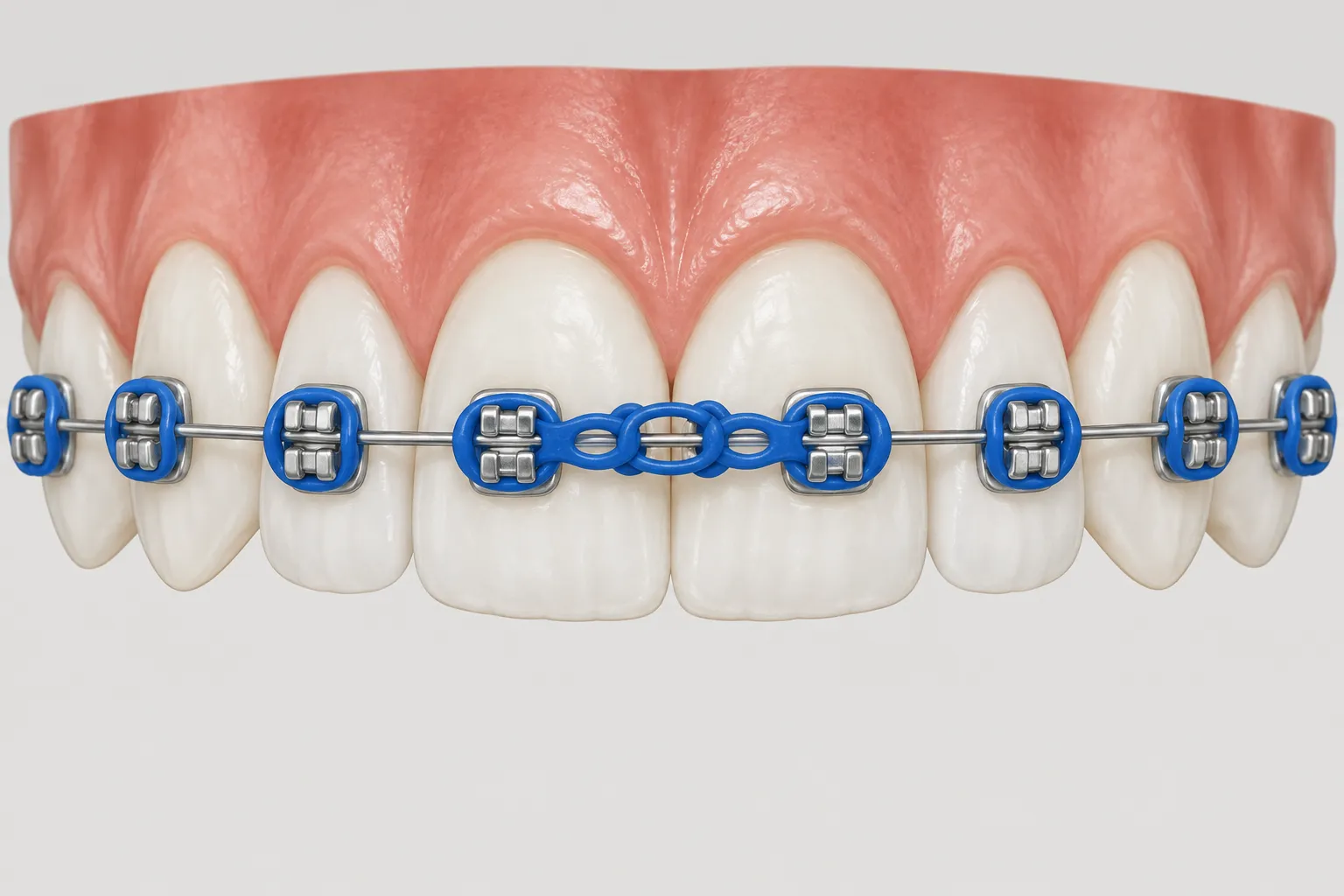
Educational illustration, not a patient photo. Compare the individual ties with the linked chain; exact appliances vary.
|
Part you see |
What it does |
Can it be the blue part? |
|---|---|---|
|
Bracket |
Attached to a tooth and holds the wire in position |
Usually not: standard metal brackets appear silver |
|
Archwire |
Runs through the brackets to guide movement |
Usually metallic, not the blue color you chose |
|
Elastic ligature or O-ring |
Holds the wire at an individual bracket |
Yes, this is the usual source of the blue color |
|
Power chain |
Connected elastic loops spanning multiple brackets |
Yes, when prescribed; it is not simply a longer decorative tie |
|
Interarch elastic |
Runs between upper and lower teeth when prescribed |
Different from the colored ties around brackets |
“The archwire is held to each bracket with a ligature, which can be either a tiny rubber band or a twisted wire.” – American Association of Orthodontists
Blue ties versus a blue power chain
Individual O-rings leave a spot of blue at each tied bracket. Linked power-chain loops look more like a continuous strip. Your orthodontist prescribes the chain for a particular tooth movement; when your plan calls for one, ask whether you can choose its color.
Self-ligating brackets may not need those O-rings. Clear or ceramic brackets look different beneath the ties, which may remain visible depending on the appliance. If you want less noticeable brackets, ask about appliance options as well as color.
Which blue shade should you choose?
Hold the sample next to your teeth in ordinary light. Your tooth color and bracket material may make it look different from the blue you saw on a phone.
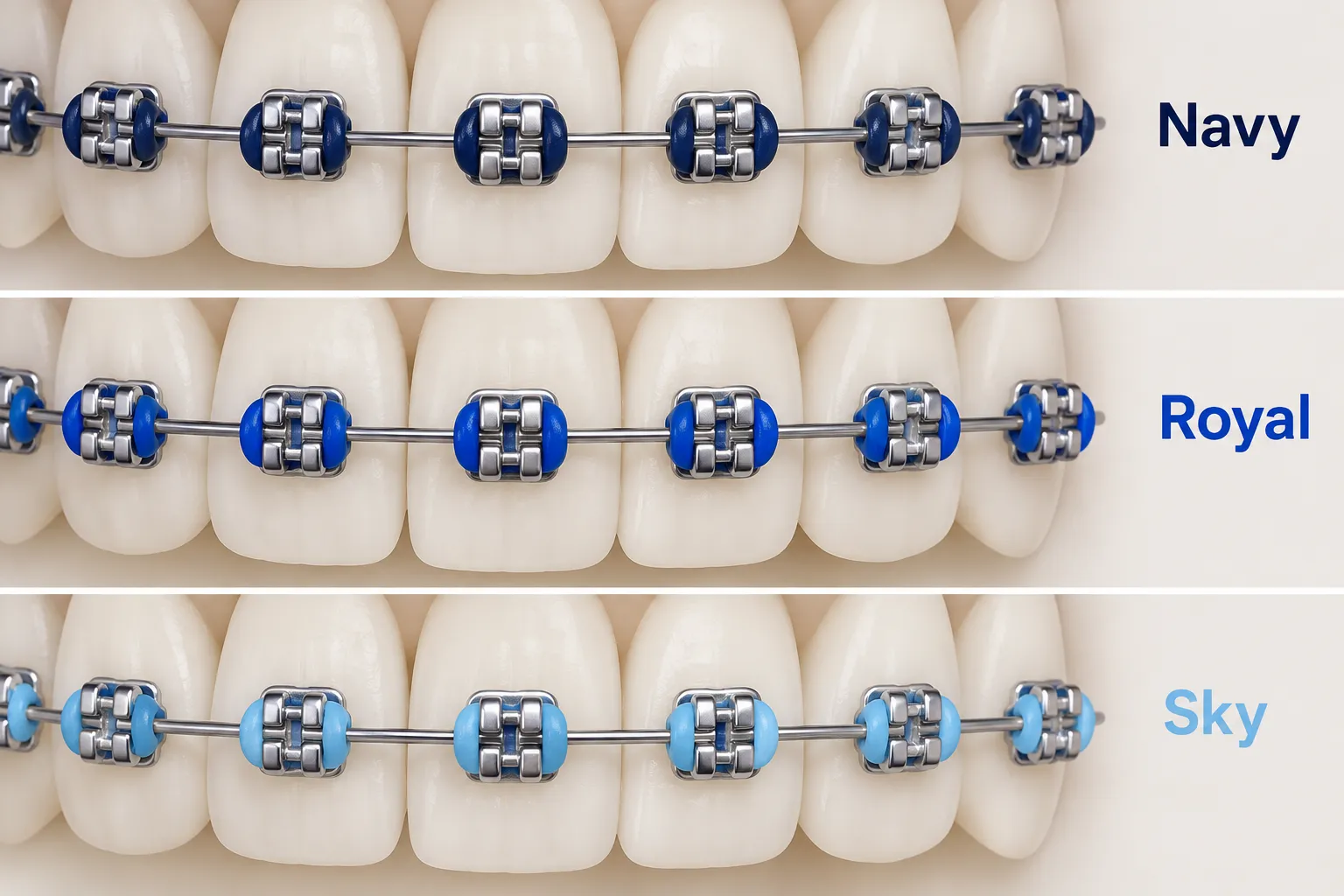
Illustrated shade comparison, not actual patient results or a practice color chart.
|
Shade family |
Typical visual effect |
Consider if you want |
|---|---|---|
|
Navy or dark blue |
A deeper contrast with enamel; less luminous in dim light |
A quieter, defined blue |
|
Royal or cobalt blue |
Saturated color that is easy to notice |
A bold, classic blue |
|
Sky or baby blue |
Soft and airy, with less contrast against teeth |
A lighter look |
|
Teal or turquoise |
Blue with a green cast that can change under warm light |
A bright, playful look |
|
Blue with silver |
Alternating color and neutral accents |
Color without blue on every tied bracket |
The table describes possible looks, not confirmed inventory at Eisenberger and Meister Orthodontics. Available shades and patterns depend on the samples at the office.
Blue color combinations for school, events and everyday wear
If your appliance uses individual ties and the colors are available, navy with silver makes a restrained pair. Royal and light blue stand out more. You might also pair blue with a school or team color, especially if you have photos or an event before the next planned change. One shade across the whole smile is fine. These choices affect appearance, not treatment.
Will blue make teeth look whiter?
Navy’s contrast can make enamel appear whiter, although the color does not whiten teeth. Light blue can look subtle beside bright teeth or draw attention to warmer tooth tones in a photo. The mirror gives you a better comparison than a filtered image.
Skin tone, gender and age need not dictate your blue. Royal blue may stand out against your complexion; you might prefer the softer effect of navy or teal. Compare samples next to your face and teeth. Both kids and adults can choose a single shade or alternating colors.
What will it look like between visits?
Food, drinks and wear can dull the look of fresh bands over the weeks; pale blue may show discoloration more than navy. Camera light changes the effect as well. Sky blue can look almost white under a flash, while navy can look close to black in shadow. If a shade disappoints you, ask about switching when your treatment plan next calls for new ties.
How to keep blue braces looking clean
Brush along the gumline and around each bracket. Use the tools your orthodontic team recommends to clean between teeth and beneath the wire. Food caught around blue bands changes how the color looks even if the ties have not discolored. Cleaning protects your teeth no matter which shade you choose.
The American Association of Orthodontists advises brushing at least twice a day, ideally after meals, and cleaning between teeth daily. Its orthodontic patient FAQs also advise avoiding hard, sticky and chewy foods that could damage braces. If a tie comes loose, a bracket breaks or a wire pokes, contact your orthodontic team rather than trying to replace a tie yourself.
Blue braces at Eisenberger and Meister Orthodontics
Our Passaic practice treats children, teens and adults. We offer custom, translucent LightForce braces and Invisalign aligners. LightForce changes the bracket design; Invisalign has no bracket ties to color. Our published treatment information does not specify which blue ligature shades we stock or whether every appliance accepts colored ties, so we cannot promise a particular blue before an appointment.
At a complimentary consultation, we can discuss which appliance suits your clinical needs and how it would look. We offer Dental Monitoring for suitable treatment plans, and our office has a warm, spa-like setting. You can discuss financing alongside appearance; our site lists 0% APR options and no hard credit checks.
North Jersey communities near our Passaic office
Our office is in Passaic, New Jersey; our treatment page identifies the Passaic-Clifton area. These selected nearby municipalities provide geographic context by county. They are not additional office locations or a promise of service to every town:
|
County |
Nearby municipalities |
|---|---|
|
Passaic |
Passaic, Clifton, Paterson, Haledon, Prospect Park, Woodland Park, Little Falls, Totowa, Wayne |
|
Bergen |
Garfield, Wallington, East Rutherford, Rutherford, Carlstadt, Lodi, Hasbrouck Heights, Hackensack, South Hackensack, Wood-Ridge |
|
Essex |
Nutley, Bloomfield, Belleville, Montclair, Glen Ridge, Newark, East Orange |
|
Hudson |
Secaucus, North Bergen, Kearny, Harrison |
Driving distance depends on your route and starting point; this is not a fixed-radius list. North Jersey families can visit our Passaic office to discuss whether fixed braces suit them and what they would look like.
The short answer
For most patients, blue braces mean blue ties on standard brackets. A blue power chain is an option only if the treatment plan calls for a power chain. Compare real samples beside your teeth; your choice of color will not change the plan or the need to clean around your braces. In North Jersey, schedule a complimentary consultation with Eisenberger and Meister Orthodontics to discuss the appliance and the look you want.
FAQ
Does light blue stain braces?
Light blue elastic ties can show discoloration as you wear them, especially compared with darker blue ties. Keep the brackets clean and ask about replacing the color at your next scheduled adjustment; stained ties are different from stains on your tooth enamel.
What color is best for braces?
The best color is the one you like against your own teeth. Navy gives stronger contrast and often makes enamel appear brighter; royal blue is more vivid, and light blue is softer. Compare samples in person because photos can shift their appearance.
What is the #1 braces color?
There is no reliable universal ranking of braces colors. Blue is a common choice because it offers both quiet shades such as navy and bolder ones such as royal blue; choose based on your own smile rather than a popularity claim.
What foods should you avoid with braces?
Avoid hard, sticky and chewy foods that could damage your brackets or wires, regardless of which color ties you choose. Brush around the brackets after eating when possible, and follow your orthodontist’s instructions for your specific appliance.