
Braces for older adults can be an option after 50. Before choosing them, your orthodontist needs to examine your gums, the bone supporting your teeth, and any dental work you already have. Those findings, along with your goals, will shape a plan for braces or another treatment.
Are you too old for braces after 50?
There is no set age limit for orthodontic treatment. In your 50s, 60s, or beyond, you might want help with crowded teeth, gaps, a changing bite, or a straighter smile. Tell the orthodontist if your teeth have shifted since earlier treatment.
“1 in 3 orthodontic patients is an adult.” – American Association of Orthodontists
An examination of your bite, teeth, and supporting tissues helps determine the scope of care. The plan might involve making space for a future restoration or addressing alignment issues. If you have active gum disease or untreated decay, your dental team may address that first.
What adult braces can help with
When crooked teeth overlap, the tight areas can be hard to clean. Straightening crowded areas may give you better access for brushing and flossing; daily cleaning still matters for preventing tooth decay. Depending on the examination, orthodontic care may also address spacing, an open bite, or uneven contact that contributes to abnormal wear.
What to check before starting treatment
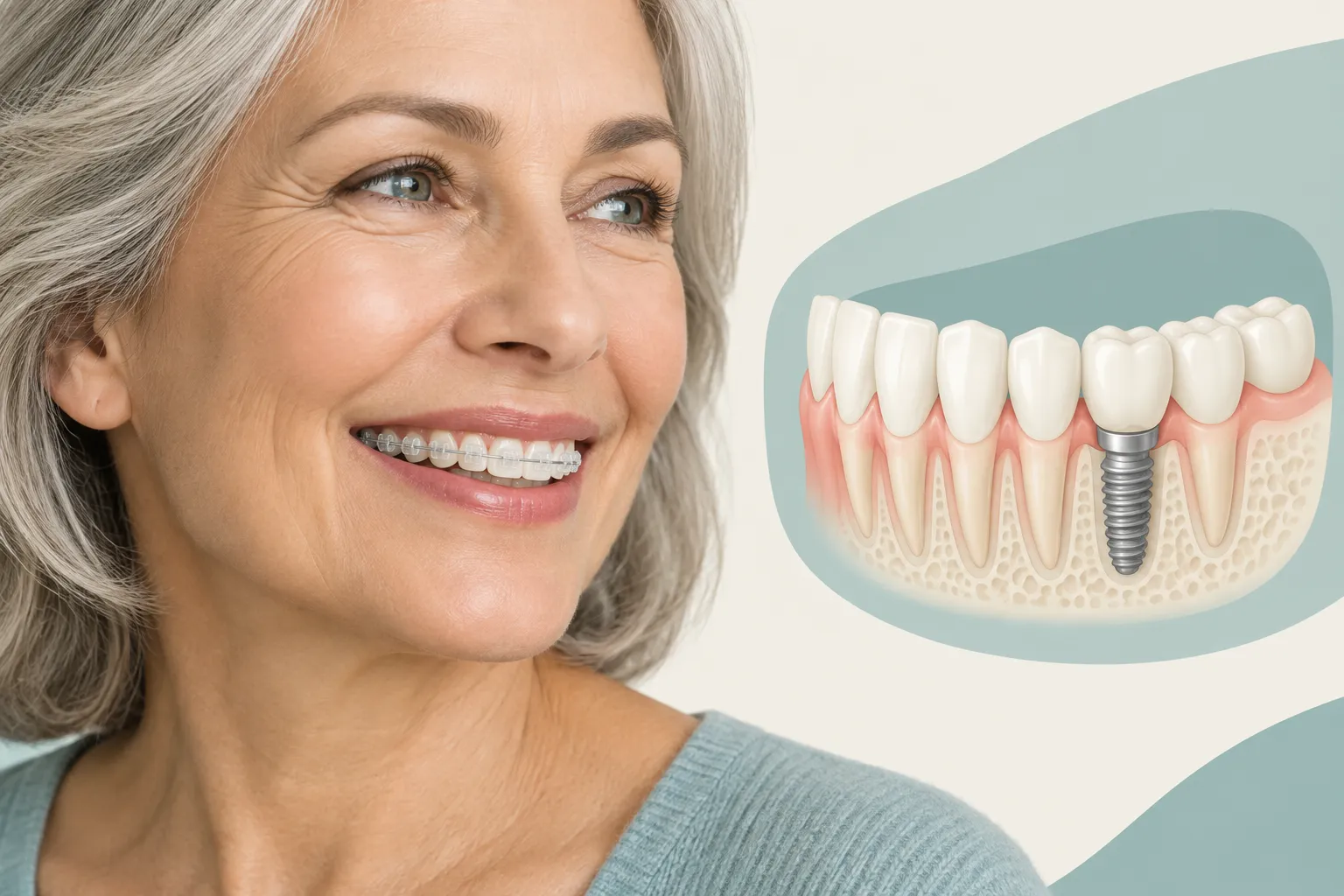
If your dentist has mentioned a crown, an implant, or gum treatment, bring those plans to the orthodontic visit. A list of past dental work and your current concerns helps the two offices coordinate.
Gum health and bone support
Teeth move within the bone that supports them. Your orthodontist should assess inflamed gums, periodontal disease, recession, and bone density or prior bone loss before you start. The American Association of Orthodontists advises addressing active gum disease before moving teeth; your dentist or periodontist may need to treat and stabilize it first. A history of gum disease calls for careful planning and monitoring, even if treatment remains an option.
Ask who will oversee your gum health while your teeth move. Bleeding gums, loose teeth, or a new change in your bite deserve a dental assessment before you decide on braces.
Crowns, bridges, implants, and missing teeth
A natural tooth with a crown can still move, although the crown may affect how your orthodontist attaches an appliance. A bridge connects teeth, while an implant cannot be moved by conventional orthodontic forces. Your orthodontist needs to map which teeth can move and whether a gap should stay open or close.
|
Existing dental work |
What to discuss before treatment |
|---|---|
|
Crown or large filling |
Whether the tooth can be used for the planned movement and how an appliance will attach |
|
Bridge |
Whether the connected teeth limit the proposed movement or affect appliance design |
|
Implant |
Which natural teeth can move around it; the implant itself is not repositioned with braces |
|
Missing tooth |
Whether orthodontics should create space for a replacement or close the gap |
If an implant, bridge, veneer, or new crown is in your plans, have your dentist and orthodontist agree on the order of care. Your orthodontist may first make space for a replacement. Existing work may also limit where teeth can go.
Other health factors and daily cleaning
Tell the orthodontist about medications, medical conditions, and changes in your oral health; keep taking prescribed medication unless your prescriber tells you otherwise. Dry mouth and difficulty cleaning around teeth can affect your choice. Fixed braces add surfaces to clean. Removable aligners let you brush and floss without an appliance in place, but you must wear them consistently. If hand dexterity is an issue, bring it up while comparing the two.
Keep seeing your general dentist during orthodontic treatment. The orthodontist monitors tooth movement and the bite; your dentist continues to address routine dental care and any new problems with teeth or gums.
Different types of braces for older adults: which fits your routine?
The choice of appliance depends on the movements your bite needs and any existing restorations. You also have to live with its cleaning routine and appearance every day.
|
Option |
Practical advantage |
Trade-off to discuss |
|---|---|---|
|
Metal braces |
Metal brackets are fixed in place, so there are no trays to remember |
Brackets and wires require careful cleaning; they are visible |
|
Clear or ceramic braces |
Fixed treatment with tooth-colored brackets |
Brackets still need careful cleaning and can be more visible than aligners |
|
Clear aligners, including Invisalign |
Removable for meals and brushing |
They only work as planned when worn consistently; suitability depends on the case |
Lingual braces attach behind the teeth. If you want to avoid the look of a “metal mouth,” you might ask whether you can choose lingual braces; cleaning can be harder, and some offices do not offer them. Your bite still determines whether they are suitable.
Eisenberger and Meister Orthodontics in Passaic offers North Jersey adults clear braces and LightForce custom ceramic braces for a subtler fixed option. The practice also offers Invisalign and holds Invisalign Sapphire Provider status, reflecting extensive experience with that system. Your bite, rather than a provider credential, should guide the choice; ask what each appliance could achieve in your case.
What to expect during treatment and afterward
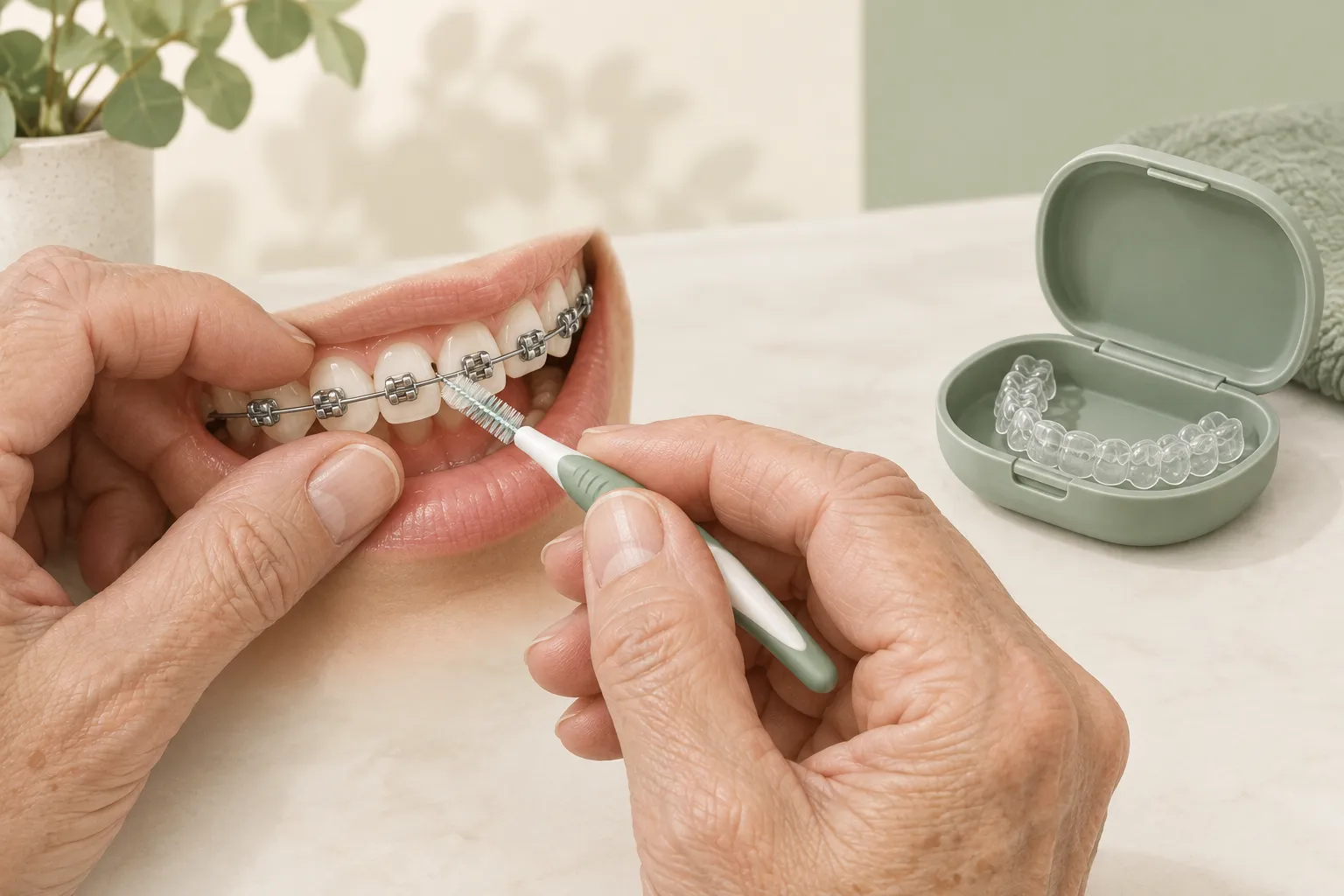
You may feel tenderness after an adjustment or a new aligner. Call the treating office about persistent or unusual pain. Your orthodontist should estimate treatment length based on the movement needed, your oral health, and how your teeth respond, rather than your age alone.
Plan on seeing both your orthodontist and your general dentist during treatment. If you have had gum problems, you may also need periodontal follow-up. Eisenberger and Meister Orthodontics offers Dental Monitoring for convenience; ask which parts of your care still require an in-person visit.
Discuss retainers before treatment begins. Teeth can shift after treatment, and you will need to know how often to wear yours and what to do if it is lost or damaged. Ask for the treatment fee in writing, including what it covers. Dental insurance plans vary in adult orthodontic coverage, so discuss your benefits and financing. The Passaic practice offers complimentary consultations and financing options, including 0% APR options and no hard credit checks; ask which terms apply to you.
Plan your Passaic consultation
Nearby New Jersey communities by county
Patients near Passaic may come from communities across several counties. Examples include:
-
Passaic County: Clifton, Haledon, Hawthorne, Little Falls, Paterson, Prospect Park, and Woodland Park.
-
Bergen County: Carlstadt, East Rutherford, Garfield, Hasbrouck Heights, Lodi, Lyndhurst, Rutherford, and Wallington.
-
Essex County: Belleville, Bloomfield, Cedar Grove, Montclair, Newark, Nutley, and Verona.
-
Hudson County: Harrison, Hoboken, Jersey City, Kearny, North Bergen, Secaucus, Union City, and Weehawken.
These are examples, not a verified list of every municipality within a 20-mile straight-line radius. Travel time to the Passaic office varies by location.
Questions to bring
Bring recent dental records if you have them. You can use these questions to discuss your options before choosing an appliance:
-
Are my gums and supporting bone ready for orthodontic movement, or should my dentist or periodontist treat something first?
-
How will my crowns, bridge, implants, or missing teeth affect what can move?
-
Should planned dental work happen before, during, or after orthodontic treatment?
-
What result is realistic for my bite, and which movements would you avoid?
-
What cleaning, follow-up visits, and retainer routine will my plan require?
-
What is included in my estimate, and how would the available payment options work?
Take the answers back to your dentist if you have other dental procedures planned.
A sensible next step
Braces after 50 can make sense when your gum health, existing dental work, and goals allow for a coordinated plan. If you need gum treatment or restorative work, your dental team can establish the order before you commit to an appliance.
At Eisenberger and Meister Orthodontics in Passaic, North Jersey adults can discuss those decisions during a complimentary consultation in a warm, spa-like office. Bring your dental history and ask how the proposed plan fits both your current teeth and any care you may need next.
FAQ
Do braces cause pain?
Braces can cause temporary tenderness after placement or adjustments. Tell your orthodontist if pain is persistent or unusual rather than trying to judge whether it is normal on your own.
Why do teeth shift as you age?
Teeth can change position over time, including after past orthodontic treatment. Changes to gum support, missing teeth, and not wearing a retainer can also matter, so an examination is the right way to understand your own case.