
Braces for overcrowded teeth can align overlapping teeth without extractions in some cases. First, an orthodontist needs to find where the room will come from. They also check whether the bite and supporting structures can accommodate the movement. Slight overlap in the front teeth calls for a different plan than a narrow upper jaw, a tooth with no clear path into place, or crowding with a bite problem.
For families and adults in Passaic, a personalized assessment is the first step toward choosing an appliance and understanding whether additional space is needed.
Why teeth get crowded
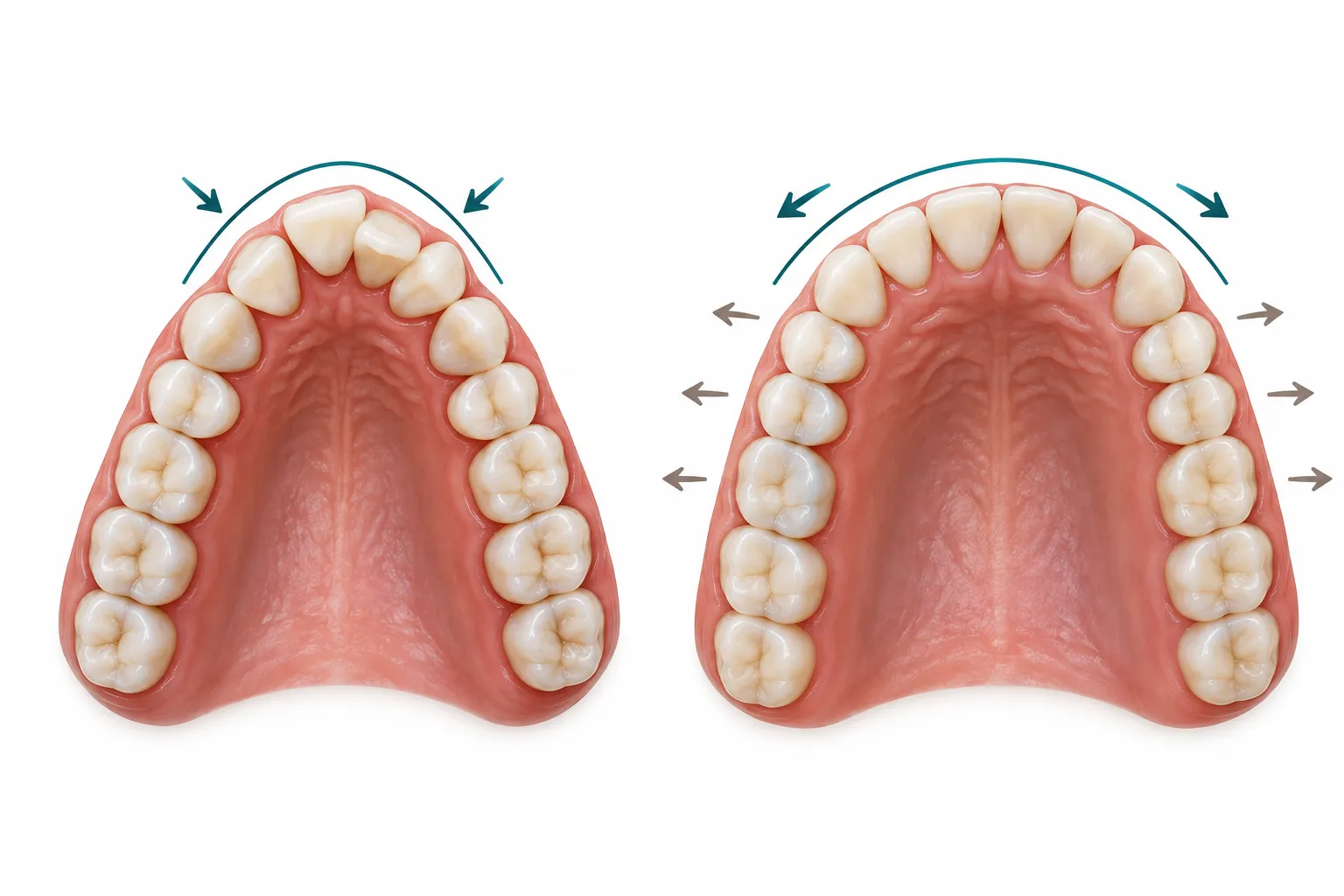
Crowding occurs when teeth do not fit comfortably along the dental arches. Teeth may twist, overlap, erupt outside the usual line of the arch, or become difficult to clean between. The visible overlap tells only part of the story because the upper and lower teeth also need to meet in a workable bite.
For a growing child, the orthodontist looks at which baby teeth remain, how the permanent teeth are coming in, and whether the upper jaw is narrow. Adult jaws have largely finished growing, so the ways to create space differ. One shifted lower front tooth may need far less room than several teeth displaced from the arch.
|
What you notice |
What the orthodontist needs to assess |
|---|---|
|
One or two teeth overlap |
Whether the overlap is limited to those teeth or reflects a broader space shortage |
|
A permanent tooth is coming in high or out of line |
Its position, available space, and the path into the arch |
|
Upper teeth seem crowded and the upper arch looks narrow |
Whether jaw width and the way the arches meet affect the plan |
|
Crowding returns after earlier treatment |
Whether the teeth have shifted and what retention will be needed |
These clues help frame the appointment; photographs alone cannot show the full bite or determine a safe space plan.
How an orthodontist decides whether space is needed
An orthodontist compares the space available with the space the teeth need. They also check how the upper and lower teeth meet. Crowding can stem from a local overlap, a wider space shortage, or a narrow upper jaw. This assessment guides the plan, but it does not point to just one appliance. The evaluation also covers:
-
Tooth positions and available room. The clinician looks at which teeth are displaced and whether enough space exists along the arch to bring them into line.
-
The bite. Upper and lower teeth need to fit together, not merely look straight when viewed from the front.
-
Jaw width and growth. A narrow upper jaw in a growing patient may raise a different set of options than crowding in an adult.
-
Tooth and gum health. A proposed movement must be appropriate for the structures supporting the teeth.
-
Records and priorities. An examination, images or scans as indicated, and a discussion of appearance and daily routine help the orthodontist explain the trade-offs of each option.
Ask where the room in your proposed plan would come from. If the orthodontist recommends expansion, changes in tooth positions, or removing teeth, ask how that choice affects the bite. You should leave knowing why the approach fits your mouth.
A child’s crowding is also a timing question
The American Association of Orthodontists recommends an orthodontic check-up no later than age 7. An orthodontist can spot developing crowding while baby and permanent teeth are both present. A check-up does not mean a child needs braces at seven: the orthodontist may monitor growth or recommend earlier intervention for a specific jaw or eruption problem.
Ways to make room for crowded teeth
An orthodontist may combine ways of creating space. The choice depends on where room is lacking, how much is needed, how the teeth meet, and whether the jaw is still growing.
|
Approach |
When it may come up |
Important limit |
|---|---|---|
|
Repositioning teeth with braces or aligners |
Teeth can be aligned within a workable space and bite plan |
An appliance moves teeth; it does not create unlimited room |
|
Adjusting arch form or tooth positions |
Small changes in how teeth sit may help accommodate crowding |
Tooth movement still has to respect the supporting gums and bone |
|
Palatal expansion |
A narrow upper jaw contributes to the problem, particularly in a growing patient |
An expander is not necessary for every crowded smile, and adult options differ |
|
Removing selected teeth |
The space shortage or bite cannot be adequately managed by the other options alone |
Extractions are not a routine requirement for braces |
When might an expander be discussed?
A palatal expander addresses the width of the upper jaw. If a child’s upper jaw is narrow and crowding is developing, an orthodontist may discuss expansion and its timing. The American Association of Orthodontists says expansion can help some patients avoid tooth extraction. Others may still need extractions or a different approach.
“Can help, in some cases, avoid tooth extraction.” – American Association of Orthodontists
Are extractions always needed for severe crowding?
No. With severe crowding, a clinician weighs the available space, bite, tooth positions, jaw dimensions, and support for the teeth before recommending extraction. Some plans make room without removing permanent teeth; other plans include extraction when the space shortage and overall bite call for it. The decision also takes the finished bite and long-term stability into account.
Braces for overcrowded teeth: options and treatment time
Braces guide teeth with brackets and wires. Clear braces make the brackets less noticeable, and Eisenberger and Meister Orthodontics also offers custom LightForce ceramic braces. Invisalign aligners come out for meals and cleaning, which means patients have to remember to wear them as directed. The space and bite assessment helps determine which appliance makes sense, alongside your preference for its appearance and daily care.
|
Option |
Practical consideration for crowding |
|---|---|
|
Metal or clear braces |
Fixed in place, so there is no need to remember to put an appliance back in after eating |
|
Custom LightForce braces |
A custom bracket option for patients who prefer a ceramic appearance |
|
Invisalign aligners |
Removable for meals and cleaning, but successful treatment depends on consistent wear |
The practice’s published treatment-time guide says most patients wear braces for 12 to 24 months. Your estimate depends on the space shortage, any bite correction, growth, appliance choice, and how treatment progresses. The orthodontist can give you a projected timeline after assessing the full bite.
After active treatment, retainers help hold teeth in their new positions. Without a retention plan, teeth may shift again.
When to seek an evaluation
If a permanent tooth has little room to come in, several teeth overlap, the bite seems off, or crowded areas are hard to clean, arrange an orthodontic assessment. Adults can seek care even if they never had braces as children. For a younger child, the orthodontist may recommend monitoring growth before starting treatment.
Eisenberger and Meister Orthodontics offers complimentary consultations in Passaic for children, teens, and adults. Depending on the space and bite findings, the practice can discuss braces, clear braces, custom LightForce braces, Invisalign, or palatal expansion. Flexible financing includes 0% APR options. Families across North Jersey can discuss their options in person instead of trying to judge a space shortage from a smile photo.
North Jersey communities near our Passaic office
Patients seeking braces for overcrowding visit from communities in and around Passaic, including:
-
Passaic County: Passaic, Clifton, Paterson, Woodland Park, Little Falls, Haledon, and Hawthorne.
-
Bergen County: Garfield, Wallington, Lodi, Hasbrouck Heights, Rutherford, East Rutherford, Carlstadt, and Hackensack.
-
Essex County: Nutley, Belleville, Bloomfield, and Montclair.
-
Hudson County: Secaucus, Kearny, and North Bergen.
If you live elsewhere in North Jersey, you can still contact the Passaic office to arrange an evaluation.
Braces for overcrowding can straighten teeth once the orthodontist knows how much space is needed and where it can safely come from. Book a complimentary consultation with Eisenberger and Meister Orthodontics to talk through the bite, the available space, and a treatment route suited to you or your child.
FAQ
Can gaps reopen after braces?
Yes. Teeth can move after active treatment, and spaces or crowding may return. Follow the retention plan your orthodontist gives you to help maintain the result.
Can braces widen my teeth?
Braces move teeth; they do not make individual teeth physically wider. Changes in tooth positions or arch form may make a smile appear wider, while a palatal expander addresses a narrow upper jaw in selected cases.
At what point are teeth not fixable?
The amount of crowding alone does not tell you whether orthodontic treatment is possible. An orthodontist needs to examine the bite, teeth, gums, and available space before recommending a plan or explaining its limits.