
Can braces or Invisalign help jaw clicking? They may be worth considering if you also have an orthodontic problem that needs treatment. Neither appliance reliably cures a TMJ disorder (TMD). A painless click alone is no reason to straighten your teeth. If you are looking for a TMJ orthodontist in Passaic, NJ, start with an assessment of your jaw movement before choosing an appliance.
The temporomandibular joints (TMJs) sit just in front of your ears. TMD describes problems involving those joints or the chewing muscles. Some people hear a click and feel fine. Others have pain, trouble opening, headaches, or difficulty eating. The symptoms matter more than the sound alone.
Can braces or Invisalign help jaw clicking in Passaic, NJ?
Braces and clear aligners move teeth and can correct certain bite problems. If you have crowding or a bite discrepancy that merits treatment, your orthodontist can plan for a more functional bite. Jaw symptoms sometimes change during treatment, but a straighter bite cannot guarantee that clicking or TMJ pain will stop. Moving teeth does not repair a damaged joint or reposition its disc.
The National Institute of Dental and Craniofacial Research says there is insufficient evidence that bite-changing procedures, including orthodontics, treat TMD. An orthodontic plan should stand on its own merits, not be offered as a cure for joint pain.
You can have TMD and still be a candidate for braces or Invisalign. Your orthodontist will ask whether symptoms are stable and whether you can open comfortably. They will also assess whether moving your teeth makes sense apart from the jaw pain. If painful clicking is your main concern, you may need a TMD-focused examination first.
Why does my jaw click?
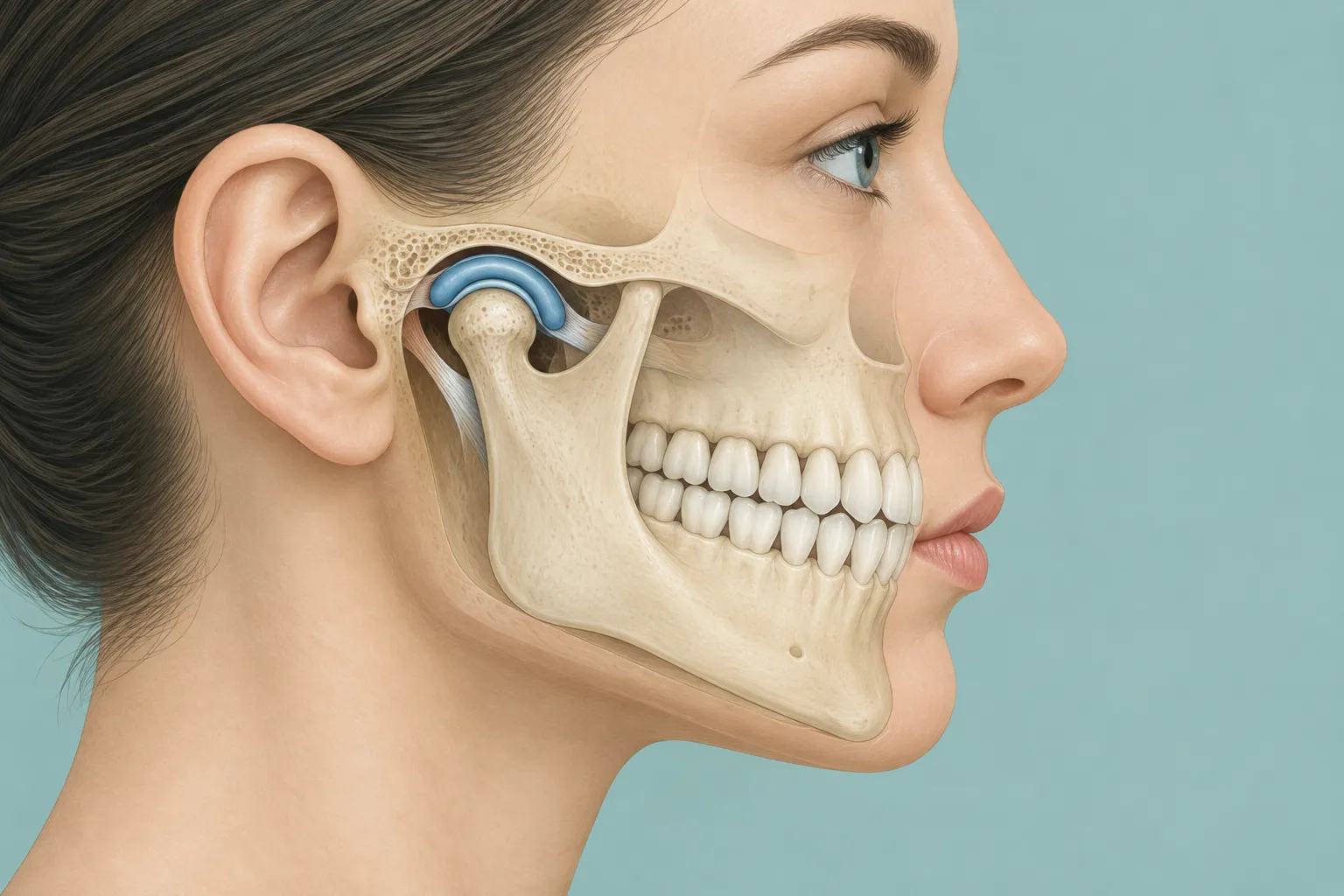
A click often happens as structures in the joint move when you open or close your mouth. A cushioning disc may shift and then return as the lower jaw moves. The sound alone cannot establish the cause. Injury, arthritis, clenching or grinding, and sore jaw muscles may also contribute to symptoms. A misaligned bite can coexist with these problems, but it is not automatically the root cause of a joint sound.
|
What you notice |
What it may mean for the next step |
|---|---|
|
A click with no pain and normal opening |
Mention it at your dental or orthodontic visit; treatment may not be necessary just for the sound. |
|
Clicking with recurring pain or tenderness |
Have the joint and chewing muscles assessed before choosing an orthodontic appliance. |
|
Catching, locking, or difficulty opening fully |
Seek a prompt clinical assessment; tooth alignment alone may not address the problem. |
|
New jaw symptoms after an injury |
Arrange a dental or medical evaluation rather than waiting for an orthodontic consultation. |
No symptom chart can diagnose TMD at home. Note when the noise began and whether it happens on opening or closing. Does chewing, yawning, or waking make the pain worse? Mention frequent headaches, ear pain, or tenderness in the facial muscles too. These details help a clinician assess the joint and muscles.
“Clicking or popping sounds in the TMJs, without pain, are common, are considered normal, and do not require treatment.” – National Institute of Dental and Craniofacial Research
What does an orthodontist assess before recommending treatment?
An orthodontist assesses your teeth, bite, jaw movement, and symptoms together. A click alone does not prove your jaw is misaligned. Expect questions about pain, locking, past injuries, grinding, and any change in symptoms. During the exam, the orthodontist may observe your opening, check how your teeth meet, and feel for tenderness around the joints and chewing muscles.
The orthodontist also checks whether crowding or bite alignment gives a reason to move teeth. They examine how the upper and lower teeth meet, then explain what treatment could change. If symptoms point to the joint or muscles, a dentist or orofacial pain clinician may need to examine you before orthodontics begins. Imaging is not needed for every click. The clinician decides based on your history and examination.
Tell the team about any night guard you wear or past jaw-pain treatment. A retainer, aligner, sports mouth guard, and appliance prescribed for clenching serve different purposes. One does not replace another.
Braces, Invisalign, or another approach?
Your bite and jaw examination should guide the choice. Neither Invisalign nor braces has a special role as a treatment for joint clicking.
|
Approach |
What it is intended to address |
Important limit for jaw clicking |
|---|---|---|
|
Braces, including clear or custom brackets |
Tooth positioning and selected bite problems |
They do not directly treat joint disease or promise relief from pain. |
|
Invisalign clear aligners |
Tooth positioning and bite correction in suitable cases |
Aligners are not a substitute for a diagnostic TMD appliance or a guarantee against grinding. |
|
Conservative TMD care coordinated with a dentist or orofacial pain clinician |
Symptom management, joint function, or muscle pain, according to the diagnosis |
It may help symptoms without changing tooth alignment. |
|
Observation of a painless click |
Avoiding unnecessary intervention when function is normal |
Return for assessment if pain, locking, or limited opening develops. |
For a sore jaw, a clinician may suggest softer foods for a time, help with clenching habits, or recommend physical therapy or an oral appliance. Your diagnosis guides that choice. Avoid permanent bite changes solely to quiet a click you have not had evaluated.
Can orthodontic treatment make TMJ symptoms worse?
Jaw discomfort can fluctuate during orthodontic treatment or without it. If your muscles are sore, holding your mouth open at a visit or adapting to an appliance may feel uncomfortable. Tell your orthodontist about new or worsening symptoms. Do not push through pain or change your aligner schedule on your own; the team can reassess your jaw and treatment plan.
When should you seek help for jaw pain or clicking?
Arrange an assessment if clicking hurts, interrupts meals, or comes with catching or locking. Seek prompt care if you cannot open or close normally, your jaw hurts after an injury, or you have significant swelling or fever. A dentist or physician can direct urgent care; an orthodontic consultation is not an emergency service.
If you have no pain and can chew and open normally, mention the click at your next dental visit. You can have the sound assessed without starting aligner treatment.
Orthodontic consultations near Passaic, NJ
Eisenberger and Meister Orthodontics is based in Passaic and sees children, teens, and adults from across North Jersey. If you have jaw clicking alongside crooked teeth or an uneven bite, you can discuss both at a consultation. The orthodontic plan should address your teeth and bite without promising a TMD cure.
The practice offers braces and Invisalign, including clear braces and LightForce custom braces. It also offers mouth guards and retainers, which serve different purposes. Ask which option fits your bite and whether a separate TMD evaluation should come first. A complimentary consultation makes it easier to discuss care before committing to an appliance.
North Jersey communities near Passaic, by county
Families from nearby towns can visit the Passaic office. The county-by-county list below covers a broad area around the city. Some addresses may be more than 20 miles away by road; these towns are not separate office locations.
|
County |
Nearby municipalities and communities |
|---|---|
|
Passaic County |
Passaic, Clifton, Paterson, Haledon, North Haledon, Prospect Park, Hawthorne, Wayne, Totowa, Little Falls, Woodland Park, Pompton Lakes, Bloomingdale, Ringwood, Wanaque |
|
Bergen County |
East Rutherford, Rutherford, Wallington, Wood-Ridge, Carlstadt, Moonachie, Teterboro, Hasbrouck Heights, Lodi, Garfield, Elmwood Park, Saddle Brook, Fair Lawn, Paramus, Hackensack, South Hackensack, Little Ferry, Ridgefield Park, Bogota, Teaneck, Englewood, Leonia, Fort Lee, Ridgefield, Palisades Park, Cliffside Park, Edgewater, North Arlington, Lyndhurst, Maywood, Rochelle Park, Glen Rock, Ridgewood, River Edge, New Milford, Oradell, Dumont, Bergenfield, Tenafly, Cresskill |
|
Essex County |
Belleville, Nutley, Bloomfield, Glen Ridge, Montclair, Cedar Grove, Verona, West Orange, East Orange, Orange, Newark, Irvington, Maplewood, South Orange, Millburn, Livingston, Roseland, Caldwell, North Caldwell, West Caldwell, Fairfield, Essex Fells |
|
Hudson County |
Secaucus, Kearny, Harrison, East Newark, North Bergen, Guttenberg, West New York, Union City, Weehawken, Hoboken, Jersey City, Bayonne |
|
Morris County |
Lincoln Park, Montville, Pequannock, Riverdale, Kinnelon, Butler, Boonton, Boonton Township, Parsippany-Troy Hills, East Hanover, Florham Park, Denville, Mountain Lakes, Morris Plains |
|
Union County |
Hillside, Elizabeth, Union, Roselle Park, Roselle, Kenilworth, Springfield, Summit, New Providence, Berkeley Heights |
If you live in Passaic or elsewhere in North Jersey, ask what orthodontic treatment would do for your bite and how the clinician plans to assess your jaw symptoms.
The next step for a clicking jaw
Braces or Invisalign can make sense when you need tooth or bite correction. Neither is a dependable cure for TMJ pain or clicking. If you also have pain, locking, or limited opening, have your joint evaluated before deciding on tooth movement. Eisenberger and Meister Orthodontics offers a complimentary Passaic consultation to discuss your bite, your options, and whether another clinician should assess your jaw first.
FAQ
Can braces help realign my jaw?
Braces move teeth and can correct certain bite problems, but they do not directly reposition a joint disc or treat every cause of jaw pain. If your jaw clicks or hurts, an orthodontist should assess the bite and symptoms before recommending braces.
Does Invisalign cause TMJ issues?
Having jaw symptoms while wearing Invisalign does not by itself show that the aligners caused a joint disorder. If you develop new pain, locking, or difficulty opening during treatment, let your orthodontist know so they can reassess the jaw and plan.
Is Invisalign worth it for TMJ?
Invisalign may be worthwhile if you have an orthodontic problem that aligners can correct. It should not be purchased solely as a remedy for TMJ pain or clicking, because the symptom may come from the joint or muscles rather than the bite.