
Aligners for teens can work well if an orthodontist finds them suitable for your teen’s bite and your teen will wear them as directed. Age alone won’t tell you either. Before choosing clear aligners for teens, picture a school day: will the trays go back in after lunch and stay in through homework and sleep? A consultation can address the clinical side of orthodontic treatment; your teen’s routine answers the rest.
Are clear aligners for teens a good fit?
Sit down with your teen and work through these questions. If their daily routine for keeping track of trays falls apart by lunchtime, ask about traditional braces too.
|
Fit question |
A promising sign |
A reason to discuss another approach |
|---|---|---|
|
Does the proposed plan suit their teeth and bite? |
The orthodontist can explain the planned movements and how progress will be assessed. |
The bite or tooth movements call for a different approach or combined treatment. |
|
Can they keep trays in most of the day? |
They can describe when trays come out, where they go and when they go back in. |
Trays are likely to sit in a pocket through lunch, practice and the afternoon. |
|
Can they manage hygiene and storage? |
They already brush reliably and will use a case at meals. |
They often lose small items or skip brushing after eating. |
|
Will they tell you when something is wrong? |
They will report a lost tray, poor fit or missed wear promptly. |
They tend to hide problems until the next appointment. |
Clinical readiness is not a birthday
A 13- or 14-year-old may be ready for aligners, while an older teen may need a different approach. The orthodontist will assess bite issues, tooth positions, teeth that have yet to come in and growth. Ask whether aligners can make the planned correction, whether attachments or other aids are needed, and what would prompt a change in plan. Removable trays do not guarantee a faster finish than braces.
If teeth are still coming in, ask how the orthodontist will account for them and whether features such as eruption tabs are relevant to the proposed aligner system. For complex cases, ask which movements suit clear aligners and which might be better managed with traditional braces. An age cutoff or a photo cannot answer that.
Daily responsibility matters as much as the scan
Aligners only move teeth as planned when worn as directed. The American Association of Orthodontists gives this benchmark:
“Clear aligners must be worn at least 22 hours each day.” – American Association of Orthodontists
That leaves little time for meals, drinks other than water, cleaning and contact sports when your orthodontist advises removal. Have your teen talk through breakfast, lunch, practice and bedtime. Where do the trays go at each point?
The American Association of Orthodontists’ guidance for aligner patients says to remove trays for eating and drinks other than water, then brush before putting them back in. Your teen can eat, brush teeth and floss normally with the trays out. Oral hygiene takes more planning at school, though. Ask how aligners may feel during the adjustment period and how often your teen should change trays; follow the prescribed schedule rather than assuming each set lasts two weeks.
Try asking, “Where will your aligners be during lunch?” Your teen might say, “In the case in my backpack, then back in after I clean my teeth.” That gives you something concrete to plan around.
The school, sports and social-life test
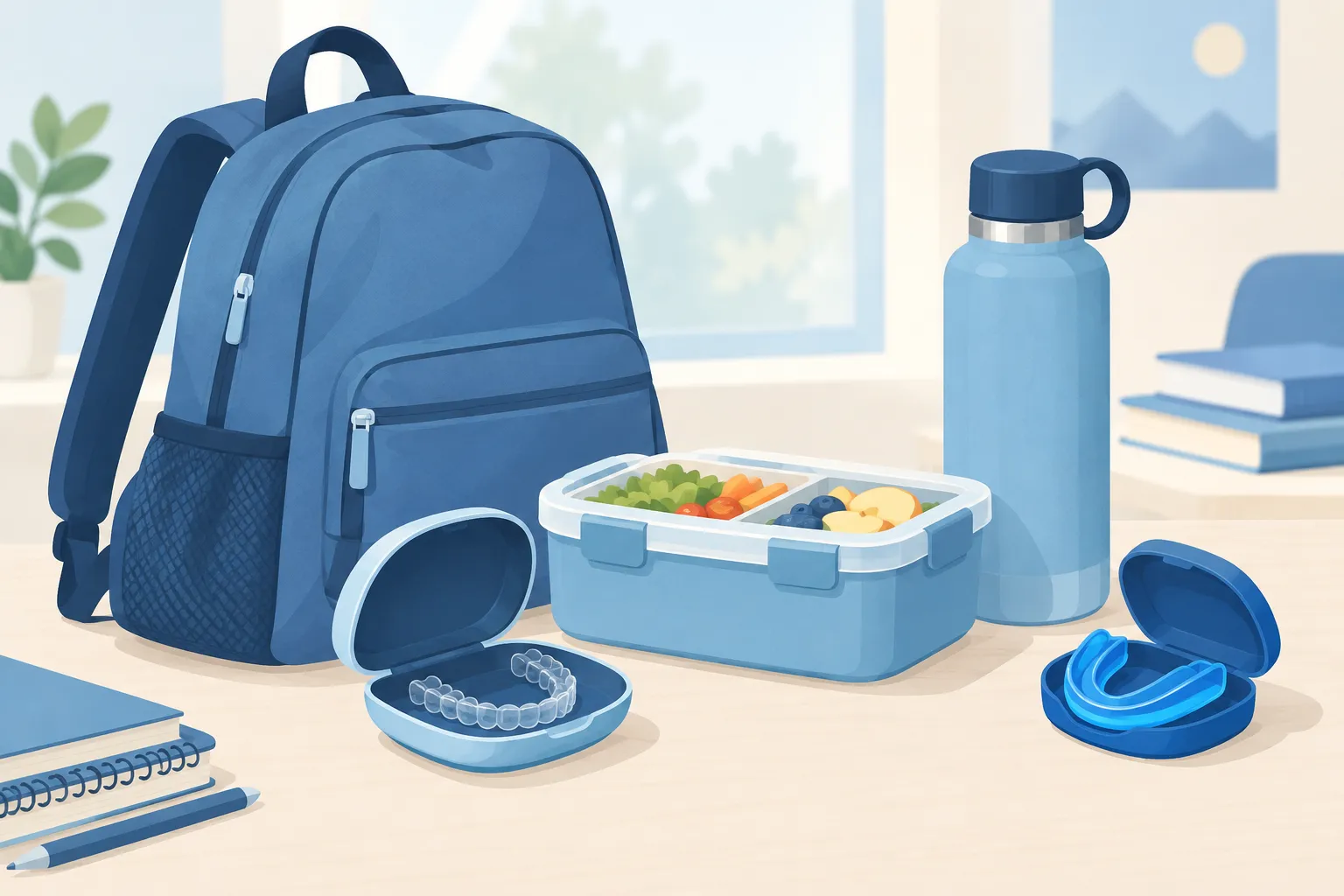
Pack an aligner case and travel toothbrush in your teen’s backpack. The case keeps trays out of napkins that are too easy to throw away at lunch. Talk through lunch, snacks and what your teen can do when brushing right away is not possible. Make sure they know whom to contact about a lost or damaged tray before they move to a new one on their own.
Tell the orthodontist about sports and music. A teen in a contact sport may need a separate protective mouth guard; an aligner is not a substitute. Wind instrument practice and performances may also affect time out of the trays, so agree on a routine. The same habit works at parties: use the case while eating, then put the trays back in.
If reminders about wear time become a daily argument, say so at the consultation. Fixed appliances stay in place after meals, though your teen will still need to clean around them and avoid certain foods.
How will you know treatment is on track?
Ask how often your teen will need office visits and what to do between them. A tray that no longer seats fully, a missing attachment, a lost aligner or missed wear can disrupt progress. Have the team show your teen what a well-seated tray looks like, and report a problem before the next scheduled visit.
At Eisenberger and Meister Orthodontics, your teen receives an individual treatment plan, and Dental Monitoring may make progress checks easier to manage with fewer disruptions to the school day. Ask what your teen would submit during check-ins, how the team responds and when you would still need to come in. Daily wear and aligner fit are useful compliance indicators to discuss, but remote check-ins cannot replace an in-person examination when a clinician needs to assess bite changes or other problems.
You do not need to police every hour. At bedtime, ask whether the trays are in, whether the current set fits and whether the case is in its usual spot. Those habits show compliance more clearly than a promise at the consultation. If the answer keeps being no, tell the orthodontic team before the lost wear time delays treatment.
Aligners or braces: which is the better match?
Appearance matters to teens. So does whether they can manage the appliance every day.
|
Consideration |
Removable clear aligners |
Fixed braces, including clear braces |
|---|---|---|
|
Appearance |
Clear aligners can look virtually invisible, though attachments may show. |
Clear brackets are less conspicuous than metal brackets, but remain visible. |
|
Responsibility |
The teen must wear, store and replace trays as instructed. |
The appliance stays on the teeth; hygiene still requires attention. |
|
Meals |
Trays come out for eating; your teen must return them afterward. |
Brackets stay in; food restrictions mean some foods need to be avoided. |
|
Sports |
Ask about removal and a suitable sports mouth guard. |
Ask about a braces-compatible sports mouth guard and what to do about broken brackets. |
|
Treatment planning |
Depends on the bite, tooth movement and follow-through. |
Can be a stronger practical choice when removable wear is unlikely. |
If your teen wants a less noticeable appliance but keeps forgetting removable trays, ask about fixed clear braces. You can look through the braces options for teens together, then discuss which one suits your teen’s bite.
What should parents ask at the consultation?
Bring your teen along. They can tell the orthodontist what lunch and practice are actually like and whether carrying a case feels manageable.
-
Is my teen clinically eligible for aligners now? Ask which bite and tooth movements the plan addresses, and whether growing or erupting teeth affect timing.
-
What would make you recommend braces instead? Ask whether aligners are enough for the planned movements, or whether attachments, other aids or braces would be more appropriate.
-
How will we monitor fit and progress? Ask when visits happen, whether remote monitoring is appropriate, and what to do about a lost or poorly fitting tray.
-
What does the full financial plan include? Ask for a written breakdown covering clear aligner treatment, appointments, replacement trays if applicable, retainers, how any dental insurance plans apply and financing. A monthly payment by itself does not tell you the total cost.
-
What happens if wear time slips? Ask how the team handles missed wear, changes in the projected timeline or a switch to another appliance.
At Eisenberger and Meister Orthodontics, a complimentary consultation gives your family time to discuss the treatment plan and financing options. Get the terms of any offer in writing before deciding.
For families around Passaic and North Jersey
If you live outside Passaic, allow for the trip from school or practice when considering office visits. North Jersey families from these nearby communities may weigh that travel differently; the list is geographic, not a list of office locations:
|
County |
Nearby towns and cities |
|---|---|
|
Passaic County |
Passaic, Clifton, Paterson, Haledon, Prospect Park, Totowa, Woodland Park, Little Falls, Wayne, Hawthorne, North Haledon, Pompton Lakes, Bloomingdale, Wanaque, Ringwood and West Milford |
|
Bergen County |
Garfield, Lodi, Wallington, Saddle Brook, Elmwood Park, Fair Lawn, Hasbrouck Heights, Wood-Ridge, Carlstadt, East Rutherford, Rutherford, Lyndhurst, Hackensack, Maywood, Rochelle Park, Paramus and Teaneck |
|
Essex County |
Nutley, Belleville, Bloomfield, Glen Ridge, Montclair, Verona, Cedar Grove, West Orange, Newark and East Orange |
|
Hudson County |
Kearny, Harrison, Secaucus, North Bergen, Hoboken and Jersey City |
|
Morris County |
Lincoln Park, Pequannock, Riverdale, Butler, Montville and Kinnelon |
For a North Jersey family, the number of office visits can influence which plan feels manageable. Ask about visits and remote progress checks while you discuss appliances.
The bottom line for parents
Aligners make sense when the orthodontist can use them to treat your teen’s teeth and bite and your teen can keep up with wear. If either part is doubtful, fixed braces may be the better choice. Bring those questions to Eisenberger and Meister Orthodontics in Passaic: its complimentary consultation lets your family compare personalized options before committing.
FAQ
Can a 14 year old wear aligners?
Yes, a 14-year-old may be a candidate. An orthodontist must assess tooth eruption, bite and planned movements, while the teen must be able to wear and care for removable trays as directed.
How much would Invisalign cost for a 14-year-old?
Age alone does not determine the price. Ask for a written estimate based on your teen’s treatment plan, including retainers, possible replacement trays, insurance handling and financing terms.
Can my 13 year old get Invisalign?
Possibly. The orthodontist needs to assess the teeth still coming in, the bite and the correction needed. Your 13-year-old also needs a reliable routine for wearing and storing trays.
Is Invisalign or braces better for a 14-year-old?
Neither is automatically better at 14. The right choice depends on clinical needs and whether your teen can consistently manage removable trays; fixed braces can be more practical when they cannot.