
If an upper tooth sits behind a lower tooth, or your child shifts their jaw sideways to bite, an orthodontic evaluation can tell you why. Crossbite correction Passaic NJ families seek may mean moving one tooth or widening a narrow upper jaw. For children, the treatment plan can take advantage of jaw growth. Teens and adults have orthodontic care options too.
At Eisenberger and Meister Orthodontics, we examine how the teeth meet before choosing an appliance. A tooth that grew into the wrong position needs a different approach from a mismatch between the jaws.
The demonstration below shows how an upper-jaw expander works. Your bite and growth stage determine whether expansion is appropriate.
How to recognize a crossbite
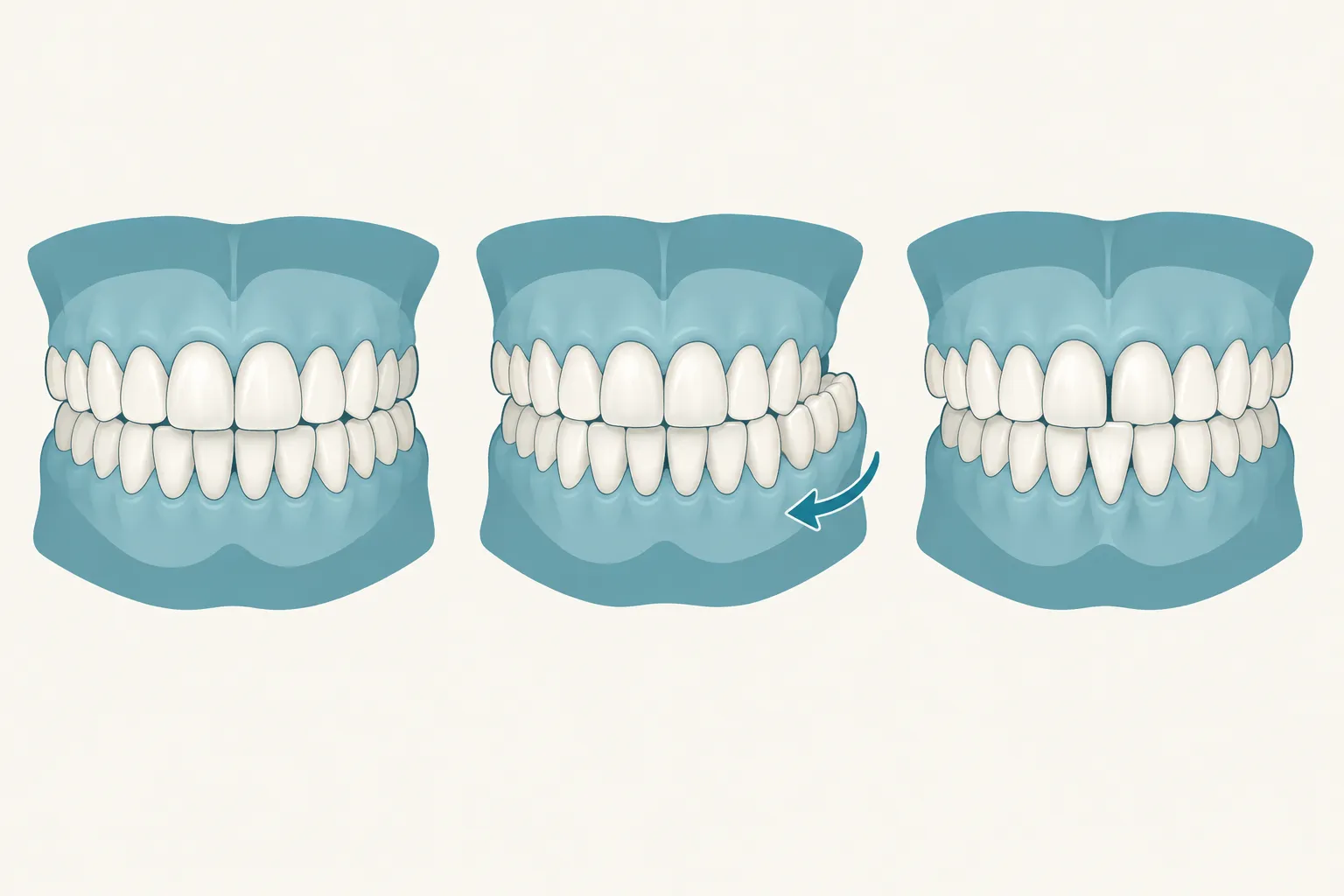
In a typical bite, the upper teeth sit slightly outside the lower teeth. A crossbite reverses that relationship for one or more teeth. You may see it in a mirror, though back-tooth crossbites can be hard to spot.
|
Type |
What you may see |
What the exam needs to establish |
|---|---|---|
|
Anterior crossbite |
One or more upper front teeth close behind the lower front teeth |
Is a tooth out of position, or is the underlying jaw relationship involved? |
|
Posterior crossbite |
Upper back teeth close inside the lower back teeth, on one or both sides |
Is the upper arch narrow, and does the lower jaw shift to find a comfortable bite? |
|
Single-tooth crossbite |
One upper tooth contacts on the wrong side of its lower counterpart |
Is there space to move that tooth safely without creating another interference? |
One upper front tooth behind a lower tooth does not necessarily mean your child has a jaw-related underbite. If the back teeth are in crossbite on one side, you may notice it only as your child bites down.
Watch the jaw as the teeth come together
Ask your child to close slowly without guiding their chin. If the jaw starts centered and slips sideways just before the teeth meet, mention it at the appointment. The lower jaw may be avoiding teeth that hit too early, a functional shift. The shift needs assessment, but it does not prove the jawbones have grown asymmetrically.
Book an evaluation if a front tooth is trapped behind its opposing tooth, your child chews mostly on one side, or you notice uneven tooth wear or irritated gums near the crossbite. Pain, clicking and headaches have several possible causes. A bite photo cannot diagnose them.
Why an early evaluation can matter, without assuming early treatment
If your growing child has a posterior crossbite and the jaw slides sideways, arrange an assessment. Over time, closing off-center may affect how the jaws grow and may be associated with asymmetric jaw growth in kids. We can tell whether the shift comes from the bite or an established difference in the jawbones. A front-tooth crossbite can also put extra force on a tooth and its gum.
“The American Association of Orthodontists recommends that children have their first check-up with an orthodontist when an orthodontic problem is first recognized and no later than age 7.” – American Association of Orthodontists, guidance on the first orthodontic visit
An early visit gives you a chance to act at the right time. The AAO explains that many children do not need treatment right away. We may recommend watching how the teeth erupt and the jaws grow. If your child has to slide their jaw to close, limited treatment may help before all the adult teeth come in. Some children still need a second phase later.
Adults can move teeth with braces or aligners, although a conventional tooth-borne expander does not usually widen a mature upper jaw as it would a child’s. For a substantial skeletal mismatch, we may need to discuss another expansion method or jaw surgery. Aligners alone may not correct the underlying problem.
Crossbite correction Passaic NJ: which treatment fits?
The first point of contact tells us a lot. We also look for a jaw shift and measure the room available to move teeth before recommending an appliance. A tooth out of place needs a different treatment plan from an upper jaw that is too narrow.
|
Approach |
May suit |
Important limitation |
|---|---|---|
|
Limited braces or a removable appliance |
An isolated front-tooth crossbite when there is room to move the tooth |
Moving the visible tooth alone will not resolve a narrow jaw or a larger bite problem. |
|
Palatal expander |
A growing child whose upper arch needs more width, often with a posterior crossbite |
Expansion does not automatically straighten every tooth; follow-up orthodontics may be needed. |
|
Braces, including clear or custom brackets |
Multiple teeth needing control, crowding or more involved bite correction |
Wearing braces may also involve elastics or another appliance. |
|
Clear aligners |
Selected dental crossbites, including some single-tooth crossbites |
Aligners cannot be assumed to correct a significant skeletal jaw-width problem by themselves. |
|
Surgical orthodontic planning |
Selected mature patients with a severe skeletal discrepancy |
This is not the usual treatment for an isolated tooth crossbite. |
Can aligners fix a single-tooth crossbite?
Yes, in selected cases. If an upper tooth is tipped inward and has enough room to move, aligners may bring it into position. Attachments or bite-opening measures may keep the opposing tooth out of its way. For a growing child with one front tooth in crossbite, limited braces or another early appliance may be a better fit. We use the scan and bite exam to decide.
At Eisenberger and Meister Orthodontics, you can discuss Invisalign and custom LightForce ceramic braces, along with other braces options. The practice’s Invisalign Sapphire Provider status places it among the top 0.5% of orthodontic specialists. That experience helps us discuss aligners, while your bite determines which appliance we recommend.
What to expect at a crossbite consultation in Passaic
At the consultation, we look at the bite with your mouth open and as you close your teeth together. We also assess crowding, jaw relationship and growth stage. When needed, digital imaging helps us examine the upper arch’s width and plan orthodontic treatment. The latest technology supports the exam, but your bite determines the recommendation.
By the end of the visit, you should know whether the problem lies with one tooth, several teeth or the jaws, and whether it needs treatment now. If we recommend a first phase, ask questions about later treatment, timing and retainers. A photo alone cannot tell you how long correction will take.
Consultations are complimentary. Before treatment begins, we can discuss financing, including 0% APR options and no hard credit checks. Dental Monitoring can add convenience for eligible patients alongside in-person visits. Our warm, spa-like office and efficient scheduling make appointments easier to fit into a busy North Jersey week.
Communities near Passaic, county by county
Our Passaic office welcomes patients from across North Jersey. The county lists below include communities roughly within 20 miles of Passaic. That is an approximate radius, not driving distance; outer-edge towns may be farther from your particular address. The office itself is in Passaic.
-
Passaic County: Passaic, Clifton, Paterson, Woodland Park, Little Falls, Totowa, Haledon, North Haledon, Prospect Park, Hawthorne, Wayne, Pompton Lakes, Bloomingdale and Wanaque.
-
Bergen County: Garfield, Lodi, Saddle Brook, Elmwood Park, Fair Lawn, Rutherford, East Rutherford, Wallington, Carlstadt, Wood-Ridge, Moonachie, Hasbrouck Heights, Teterboro, Maywood, Rochelle Park, Hackensack, South Hackensack, Paramus, Teaneck, Ridgefield Park, Ridgefield, Palisades Park, Fort Lee, Leonia, Englewood, Englewood Cliffs, Edgewater, Cliffside Park, Glen Rock, Ridgewood, Wyckoff, Bergenfield, Dumont, New Milford, River Edge, Oradell, Lyndhurst, North Arlington, Tenafly, Cresskill, Haworth, Demarest, Closter, Westwood, Hillsdale, Waldwick and Ho-Ho-Kus.
-
Essex County: Nutley, Belleville, Bloomfield, Glen Ridge, Montclair, Verona, Cedar Grove, Newark, East Orange, Orange, West Orange, South Orange, Maplewood, Livingston, Fairfield, North Caldwell, Caldwell, West Caldwell, Essex Fells, Roseland and Millburn.
-
Hudson County: Kearny, Harrison, Secaucus, North Bergen, Union City, Weehawken, West New York, Guttenberg, Hoboken, Jersey City, Bayonne and East Newark.
-
Morris County: Lincoln Park, Pequannock, Riverdale, Montville, Boonton, Parsippany-Troy Hills, East Hanover, Florham Park, Morris Plains and Morristown.
-
Union County: Hillside, Elizabeth, Union, Springfield, Summit, New Providence, Mountainside, Kenilworth, Roselle Park, Roselle, Cranford and Westfield.
If your town is near the outer edge, the Passaic office may still be convenient. At the visit, we can explain any bite shift and plan around what the exam shows.
Take the next step with a clear diagnosis
If a tooth closes on the wrong side or the jaw slips sideways, an exam can clarify what needs correcting. Children may benefit from growth-guided care. Adults also have options, although a skeletal discrepancy takes more planning. Schedule a complimentary consultation with Eisenberger and Meister Orthodontics in Passaic to learn whether treatment makes sense now and how to work toward a more aligned smile.
FAQ
What appliances are used to correct anterior crossbite?
An isolated front-tooth crossbite may be treated with limited braces or a removable appliance; aligners may work in selected cases with enough space. If the front-tooth position reflects a larger jaw discrepancy, the plan may need to address more than that tooth. An orthodontic exam determines which approach fits.