
Need a cleaning or help with a toothache? Call your general dentist. For crooked teeth, crowding, or a bite that feels off, book an orthodontic evaluation. The dentist and orthodontist difference comes down to scope and training: dentists look after overall oral health; orthodontists have additional specialty training in moving teeth and correcting bites. You can see both, and during orthodontic treatment, you should.
|
Question |
General dentist |
Orthodontist |
|---|---|---|
|
Main focus |
Preventing, diagnosing, and treating problems with teeth and gums |
Straightening teeth and correcting bite and jaw alignment |
|
Education |
Dental degree (DDS or DMD) |
Dental degree plus 2–3 years of orthodontic specialty training |
|
Common visits |
Exams, cleanings, fillings, crowns, gum assessments |
Alignment evaluations, braces or clear aligners, retainers |
|
Best first stop for |
Tooth pain, a suspected cavity, bleeding gums, routine care |
Crowding, spacing, an overbite or underbite, shifting teeth |
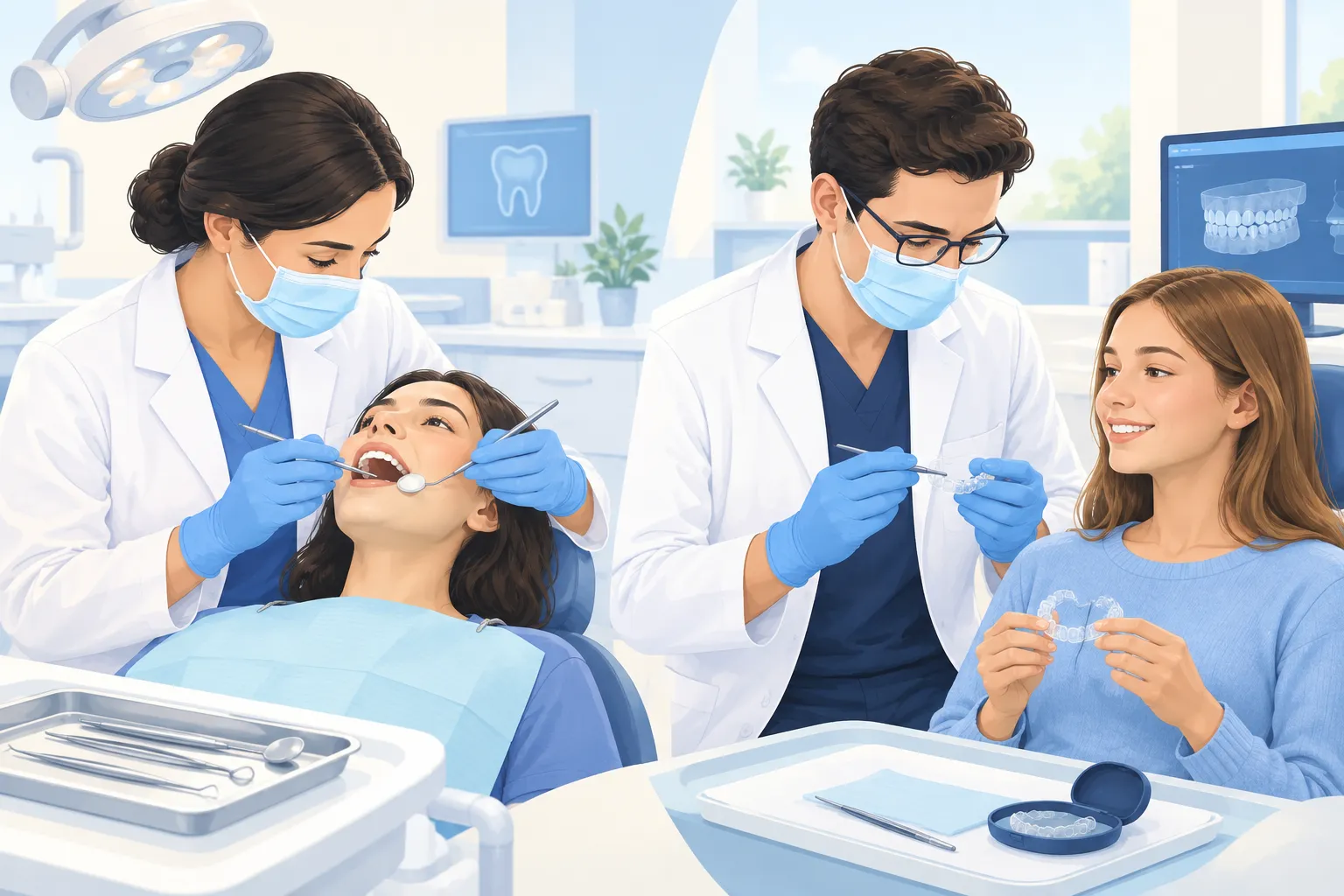
What does a general dentist do?
A general dentist looks after the health of your teeth and gums over time. At a checkup, the dentist looks for decay, gum disease, and other changes. A hygienist often handles the cleaning; the dentist examines your mouth and recommends any treatment you need.
General dental offices may also provide fillings, crowns, bridges, and root canal treatment, though services vary by practice. For lasting tooth pain, a broken tooth, or swelling, call your dentist rather than wait for an orthodontic visit. The dentist can find the cause and refer you to a specialist if needed.
Keep your dental appointments while you wear braces or aligners. You still need cleanings and care for cavities or gums.
What does an orthodontist do?
An orthodontist looks at how your teeth fit together and how your jaws develop. Orthodontic treatment can address crowding, gaps, overbites, underbites, and crossbites. Your orthodontist plans the tooth movement, follows changes in your bite, and uses retainers to help hold the result.
Options include metal braces, clear ceramic braces, clear aligners such as Invisalign, and palatal expanders. Which one makes sense depends on your teeth, bite, age, and preferences. The goal may include improving the way upper and lower teeth meet, as well as their appearance.
For cleanings and fillings, continue seeing your general dentist, even if you see an orthodontist often.
Dentist and orthodontist difference in training
Both providers complete dental school and earn a DDS (Doctor of Dental Surgery) or DMD (Doctor of Dental Medicine). The American Association of Orthodontists explains that orthodontists complete an additional two to three years in an accredited specialty residency. Orthodontists specialize in diagnosing and treating tooth and jaw alignment problems; general dentists focus on broader oral health needs. The extra training is the defining distinction, not a different dental degree.
Some general dentists offer braces or clear aligners as well. An orthodontist has completed the additional specialty residency. If you have a complex bite or jaw concern, ask who will diagnose it, plan your tooth movement, and follow your progress.
Dentist or orthodontist: who should you see first?
|
What is happening? |
Start with |
Why |
|---|---|---|
|
You are due for an exam or cleaning |
General dentist |
Routine prevention and evaluation are part of general dental care. |
|
A tooth hurts, a filling broke, or your gums are swollen |
General dentist |
The cause may require dental treatment before any alignment work. |
|
Teeth are crowded, spaced, or shifting |
Orthodontist |
You need an assessment of tooth position and bite. |
|
Your child has a developing bite concern |
Orthodontist |
An evaluation can identify whether to treat now or observe growth. |
|
A brace bracket or wire breaks during treatment |
Your orthodontic office |
The team managing the appliance can advise on repair. |
|
You are in aligners and suspect a cavity |
General dentist, then tell your orthodontist |
The dentist treats the dental problem; the orthodontist can adapt the treatment plan if needed. |
You can book an orthodontic consultation and keep your usual dentist. Your dentist may refer you to an orthodontist, but you do not need to switch providers to get an alignment assessment.
Should children see an orthodontist before all adult teeth come in?
Yes. An orthodontist can assess jaw growth, crowding, and emerging permanent teeth before a child has all their adult teeth. They may recommend treatment or watch how the bite develops. Your child’s dentist should continue regular exams and cleanings either way.
“A child’s first orthodontic check-up is recommended when a problem is first recognized, and no later than age 7.” – American Association of Orthodontists
How do dentists and orthodontists work together?
Before braces or aligners, your dentist can treat cavities or gum problems. Your orthodontist then plans how to move the teeth and correct the bite. If a crown or other dental work changes a tooth’s shape, the two offices may need to coordinate when that work happens.
While teeth move, your orthodontist adjusts the appliance and follows your progress. Your dentist continues exams, cleanings, and any needed dental treatment. Brackets and wires make some surfaces harder to clean; aligners sit over your teeth, so good brushing and regular dental visits remain important with either option.
Once active treatment ends, your orthodontist gives you a retention plan to help keep teeth in position. Your dentist continues preventive and restorative care. Tell both offices if teeth shift, a retainer stops fitting, or dental work changes your bite.
Orthodontic care for Passaic and nearby North Jersey communities
In Passaic, Eisenberger and Meister Orthodontics treats children, teens, and adults with options that include Invisalign, braces, and LightForce custom 3D-printed ceramic braces. The practice says it has 38 years of experience and has treated more than 15,000 smiles. Its Invisalign Sapphire Provider status places it in the top 0.5% of specialists. At a complimentary consultation, you can talk through your bite, treatment choices, and financing options, including available 0% APR plans. The practice offers Dental Monitoring for added convenience and a warm, spa-like office experience. Keep your general dentist for cleanings and restorative work.
Families across nearby North Jersey towns may be looking for orthodontic care in Passaic. The towns below are grouped by county to help you place the office geographically; they are not additional practice locations or estimates of travel time.
|
County |
Nearby cities, boroughs, and townships |
|---|---|
|
Passaic County |
Clifton, Paterson, Woodland Park, Little Falls, Totowa, Wayne, Haledon, North Haledon, Prospect Park, Hawthorne, and Pompton Lakes |
|
Bergen County |
Garfield, Lodi, Elmwood Park, Saddle Brook, Wallington, Rutherford, East Rutherford, Carlstadt, Wood-Ridge, Hasbrouck Heights, Lyndhurst, North Arlington, Maywood, Hackensack, Fair Lawn, Teaneck, South Hackensack, Teterboro, Ridgefield Park, and Bogota |
|
Essex County |
Nutley, Belleville, Bloomfield, Glen Ridge, Montclair, Newark, Cedar Grove, West Orange, East Orange, and Livingston |
|
Hudson County |
Secaucus, Kearny, Harrison, North Bergen, Union City, West New York, Weehawken, Guttenberg, Hoboken, and Jersey City |
Choose care that matches the problem
Your dentist keeps an eye on teeth and gums; your orthodontist manages alignment. For North Jersey families considering braces or Invisalign, both kinds of care belong in the plan. Eisenberger and Meister Orthodontics offers a complimentary consultation in Passaic where you can discuss a treatment approach for your bite, with your regular dentist still caring for your oral health.
FAQ
Why are orthodontics not covered by dental insurance?
Some plans cover orthodontic treatment, while others exclude it or limit who qualifies. Your plan may also have a lifetime maximum or waiting period. Ask for a written benefit breakdown so you know the remaining cost and payment options.
Are orthodontists more expensive than dentists?
A dental checkup and a full course of braces or aligners pay for different care, so their fees are not directly comparable. Orthodontic costs depend on your treatment plan; dental exams and restorative work remain separate.
Can an orthodontist do a root canal?
Orthodontists have dental degrees, but their practices focus on alignment rather than root canals. If you have tooth pain, your general dentist can assess it and treat you or refer you to an endodontist.
Is $6000 a lot for braces?
The value of a $6,000 estimate depends on your treatment plan, what is included, insurance benefits, and any financing charges. Compare written total fees, including whether visits and retainers are covered, before deciding.