
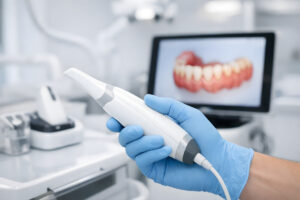
 If you’ve ever had a traditional dental impression taken, you likely remember it: a tray full of thick, chalky material pressed into your mouth and held there while you waited and tried not to gag. It’s uncomfortable, and for many patients, it creates real anxiety around orthodontic visits. The good news is the process has changed significantly, and understanding what digital impressions do can help you feel more informed and prepared before you ever sit in the chair.
At Eisenberger and Meister Orthodontics, we use digital impressions as a core part of how we diagnose, plan, and deliver treatment. Instead of traditional putty trays, a small handheld wand scans the inside of your mouth and generates a precise, three-dimensional model of your teeth and bite in real time. This shift isn’t just about comfort, though patients consistently prefer it. It’s about the accuracy and flexibility digital data provides throughout the entire course of treatment.
How Digital Impressions Work
The technology behind digital impressions is called intraoral scanning. The scanner captures thousands of images per second and stitches them together into a full 3D model you can view, rotate, and measure on screen. The process takes just a few minutes, and you can often see your own tooth model building in real time, which many patients find genuinely interesting.
An umbrella review published through the National Institutes of Health found intraoral scanners generally reduce procedural time and enhance patient comfort compared to traditional impression techniques, while supporting accurate treatment outcomes across orthodontic applications. That level of reliability matters because orthodontic treatment is highly detail-oriented. Small measurements drive significant decisions, from the placement of brackets to the sequencing of aligner trays.
The Role Digital Impressions Play in Treatment Planning
A digital scan gives us information that a plaster model simply cannot match in terms of speed or versatility. Once the scan is complete, the data integrates directly with treatment planning software. We can map out tooth movement, simulate how your bite will look at various stages of treatment, and select or design the appliances best suited to your specific anatomy.
For patients pursuing Invisalign, the digital scan feeds directly into the aligner design process. Every tray in your series is fabricated based on precise 3D data. For patients choosing clear braces, digital impressions allow for detailed bracket placement planning before a single appointment begins. This preparation contributes to more predictable outcomes and, in many cases, shorter overall treatment timelines.
Why Accuracy Matters More Than You Might Expect
It’s easy to think of an impression as just a starting point, but it’s the foundation for every clinical decision that follows. When impressions are inaccurate, it can mean ill-fitting aligners, brackets placed slightly off-target, or treatment plans built on measurements that don’t reflect actual anatomy. These issues compound over time.
Digital impressions reduce the margin for error significantly. There’s no distortion from material setting unevenly, no risk of the tray shifting, and no reliance on a physical model that can be damaged or lost. The data is stored digitally, which means it can be referenced, shared with specialists if needed, and revisited at any point during your treatment. At Eisenberger and Meister Orthodontics, this kind of precision is central to how we approach care.
What This Means for Your Experience
Beyond the clinical benefits, digital impressions make the process more comfortable and more transparent. You don’t need to hold your breath through a gag-inducing tray. You’re not waiting days for a plaster model to be fabricated. Because we can show you the 3D scan immediately, you have the opportunity to see exactly what we see, which supports better conversations about your treatment goals.
The technology also benefits patients who have previously avoided orthodontic consultations due to anxiety. Knowing the experience has changed can be the difference between putting off care and finally getting started. We take this seriously, and it’s one reason we’ve invested in tools that make a real difference in how patients feel from the very first visit.
Start Your Treatment at Eisenberger and Meister Orthodontics
At Eisenberger and Meister Orthodontics, we combine advanced technology with personalized, attentive care. Dr. Matthew Meister trained at NYU College of Dentistry, where he earned the prestigious Hyman J. Schorr Award and engaged in research recognized nationally and internationally. Our team brings a combined 35 years of experience to every consultation, and we approach each case with depth of knowledge behind every recommendation.
Digital impressions are just one part of how we deliver treatment built around precision and your comfort. If you’re ready to take the first step toward a healthier, better-aligned smile, contact our office to schedule your consultation.