
Does my child need Phase 1 treatment, or can we wait? Many children can wait while an orthodontist watches their bite and adult teeth come in. Early treatment is worth considering when a bite, jaw, or eruption problem would be safer or easier to address during growth. Ask what might happen if you postpone care.
What Phase 1 is meant to fix
Phase 1, also called interceptive treatment, takes place while a child has both baby and permanent teeth. An orthodontist may use it to widen a narrow upper jaw with a crossbite, create space for an incoming tooth, or reduce the injury risk to very prominent front teeth.
The appliance depends on the problem. An expander widens the upper arch, while a space maintainer holds a gap after early tooth loss. Other children may need habit appliances or braces on selected teeth. Crowding alone does not tell you which, if any, will help.
Phase 1 has a specific, limited goal. It cannot promise perfectly straight permanent teeth or rule out full braces later. Some bite problems need to wait until the permanent teeth erupt. Your orthodontist should explain the change they expect from treating early.
Does my child need Phase 1 treatment, or can we wait?
Two children the same age may have different treatment plans. These examples cannot diagnose your child.
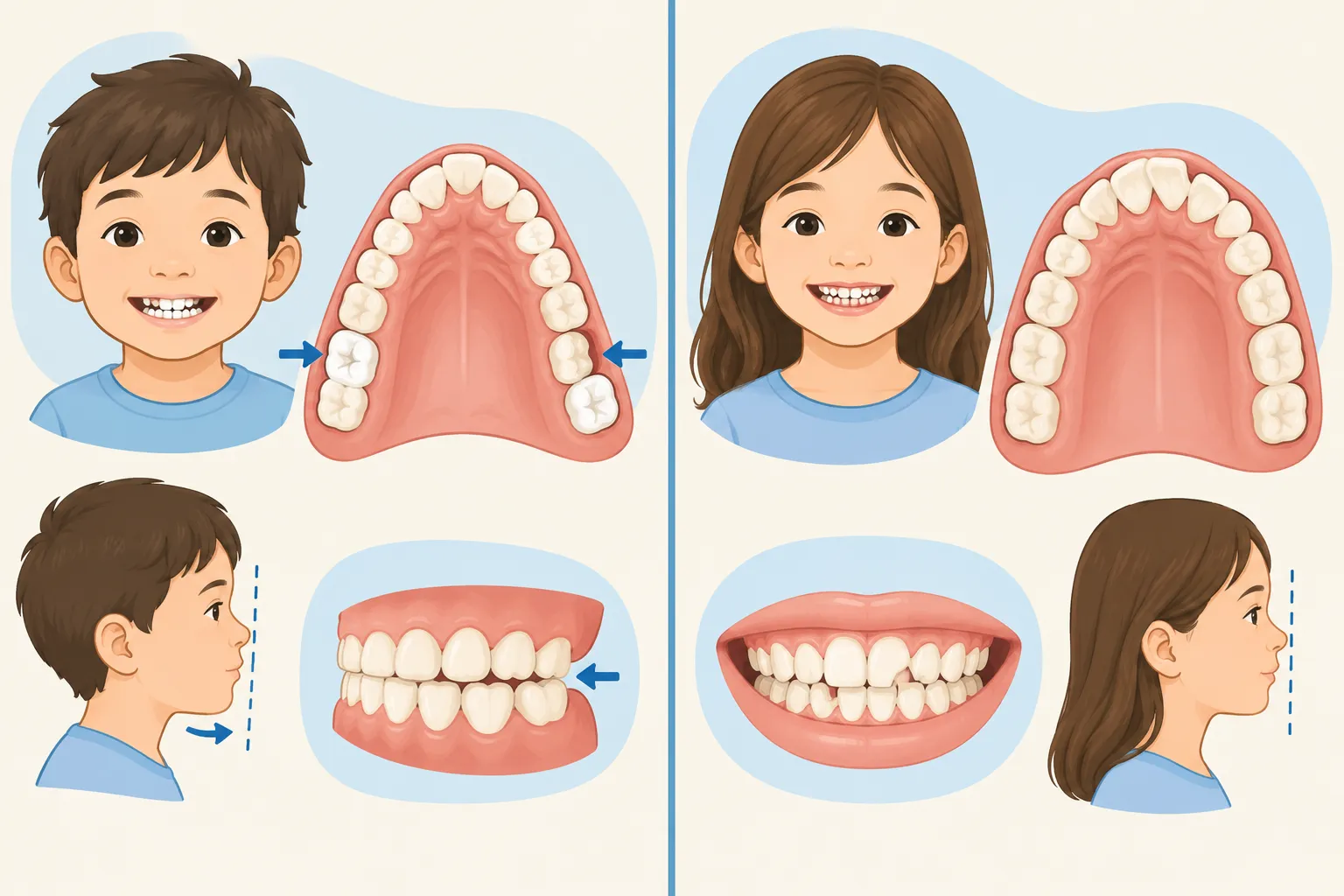
Signs that may call for treatment or monitoring
|
What you notice |
When early treatment might help |
When monitoring may be reasonable |
|---|---|---|
|
A back-tooth crossbite |
A child closes the jaw to one side to make the teeth fit, or a narrow upper arch leaves upper teeth biting inside the lower teeth. An orthodontist may consider expansion to correct the width and bite. |
A slightly uneven bite without a functional shift still needs examination, but it does not automatically call for an expander. |
|
Front teeth that stick out |
Front teeth are markedly prominent and exposed to injury. A targeted early correction may reduce that exposure. |
A small overjet with no particular injury concern can often be tracked as growth and eruption continue. |
|
Crowding or an adult tooth coming in off course |
There is inadequate space for a permanent tooth to erupt, or a tooth appears blocked. Space management may protect the eruption path. |
Mild overlap as front teeth arrive may not justify early braces if there is room for the remaining teeth and no blocked eruption. |
|
Early loss of a baby tooth |
Neighboring teeth are moving into the gap needed by its permanent successor. A space maintainer may be appropriate. |
A naturally loose baby tooth near its expected replacement may need observation rather than an appliance. |
|
Underbite or jaw mismatch |
A developing bite or jaw relationship suggests that a growth-stage intervention could be useful. The exact cause matters. |
A parent notices a chin shape or uneven teeth, but the bite and growth assessment do not show an immediate target for treatment. |
|
Thumb sucking or an open bite |
An ongoing habit is changing the bite, and behavior support alone has not stopped it. A habit appliance may be discussed. |
A habit has stopped and the bite is improving as new teeth erupt. |
When waiting may be the right choice
A crossbite that shifts the jaw deserves a different conversation from a slightly rotated front tooth. If you wait, agree on when to reassess growth and eruption. North Jersey parents can ask the orthodontist to point out the concern and explain whether waiting could cause problems.
“In children with prominent upper front teeth, Cochrane found that early treatment reduced new front-tooth injuries compared with treatment in adolescence: 19% versus 30% in trials of functional appliances.” – Cochrane
What an early evaluation can reveal
At the evaluation, an orthodontist checks how the jaws meet and whether your child shifts the bite when closing. They look at room for permanent teeth, how teeth are erupting, oral habits, and any baby teeth lost early. The orthodontist may recommend imaging when the examination leaves questions about eruption or the bite.
The American Association of Orthodontists recommends a first orthodontic checkup no later than age seven. That visit is a screening milestone, not a treatment start date. Seek an evaluation sooner for an obvious bite change, trouble biting, a tooth that seems unable to erupt, or a front tooth at risk of injury. Ohio State’s College of Dentistry explains why many children need only one phase of care.
Early orthodontic treatment may help with severe crowding that blocks an adult tooth, a crossbite that shifts the jaw, or an upper and lower jaw mismatch. Prolonged thumb sucking can also change the bite. Ask whether an appliance could guide jaw growth or help your child’s teeth erupt, given their development. If the concern is only a few crooked teeth, observation may be enough.
Questions to bring to the appointment
-
What specific problem are we trying to change now, and can you show it to me?
-
What is the expected benefit of treating it during growth instead of later?
-
If we wait, what signs would change the recommendation, and when should we reassess?
-
Will this appliance address only the early issue, or is a later comprehensive phase likely?
-
What is included in the proposed plan, and how would the costs of a later phase be handled?
If the goal or timing still seems unclear, seek a second opinion. You should understand the treatment proposal and the monitoring option before deciding.
If Phase 1 starts, what happens afterward?
If your child begins treatment, the orthodontist works on the specific problem found at the evaluation. After that, they watch as baby teeth fall out and permanent teeth arrive. Some children wear a retainer to hold the early result. Follow-up visits help determine whether another phase is needed.
Once most or all permanent teeth have arrived, Phase 2 can align them with braces or aligners and finish the bite. Phase 1 does not guarantee that this later phase will be shorter or unnecessary. Children who skip Phase 1 can often have one active course of comprehensive treatment later.
Phase 1 vs. Phase 2: key differences
Phase 1 addresses an early problem while baby teeth are falling out. Phase 2 aligns the adult teeth together and refines the bite. A period without active treatment may separate the two phases. Children who do not need early intervention can start comprehensive treatment later.
|
Decision |
Focus now |
What comes next |
|---|---|---|
|
Phase 1 |
Correct a specific early bite, growth, space, or eruption concern |
Observe development; consider Phase 2 for final alignment and bite if needed |
|
Phase 2 |
Align the permanent teeth and fine-tune the bite with full braces or clear aligners |
Wear retainers as prescribed to hold the result |
|
Monitor |
Track a concern that does not yet justify intervention |
Reassess as teeth erupt; start comprehensive treatment when appropriate |
Timing, cost, and family logistics
Treatment length and cost depend on the diagnosis, the appliance, and whether your child needs a later phase. Ask for the Phase 1 goal in writing, including what observation covers and how the practice would price any later treatment. You can then compare that proposal with a monitoring plan.
Eisenberger and Meister Orthodontics in Passaic offers a free consultation to discuss a child’s needs and financing options. The practice provides palatal expanders and early orthodontic care, along with braces and aligners for later treatment. The recommendation may be to monitor growth rather than start an appliance.
North Jersey communities near Passaic
Families travel to Passaic from across North Jersey. The county-by-county list includes communities in and around the roughly 20-mile Passaic area. Distance depends on your starting address and route; some addresses in these municipalities lie farther away.
|
County |
Nearby municipalities |
|---|---|
|
Passaic |
Passaic, Clifton, Paterson, Woodland Park, Little Falls, Totowa, Haledon, North Haledon, Prospect Park, Hawthorne, Wayne, Pompton Lakes, Bloomingdale, Wanaque, Ringwood |
|
Bergen |
Garfield, Wallington, Lodi, Saddle Brook, Elmwood Park, Fair Lawn, Glen Rock, Ridgewood, Paramus, Rochelle Park, Maywood, Hackensack, South Hackensack, Hasbrouck Heights, Wood-Ridge, Teterboro, Carlstadt, East Rutherford, Rutherford, Lyndhurst, North Arlington, Moonachie, Ridgefield Park, Ridgefield, Bogota, Teaneck, New Milford, River Edge, Oradell, Bergenfield, Dumont, Englewood, Leonia, Fort Lee, Palisades Park, Cliffside Park, Edgewater, Tenafly, Cresskill, Haworth, Wyckoff, Franklin Lakes, Oakland |
|
Essex |
Nutley, Belleville, Bloomfield, Glen Ridge, Montclair, Verona, Cedar Grove, West Orange, Orange, East Orange, Newark, Irvington, Livingston, Maplewood, South Orange, Millburn, Roseland, Fairfield, Caldwell, West Caldwell, North Caldwell, Essex Fells |
|
Hudson |
Kearny, Harrison, East Newark, Secaucus, North Bergen, Guttenberg, West New York, Union City, Weehawken, Hoboken, Jersey City, Bayonne |
|
Morris |
Lincoln Park, Pequannock, Riverdale, Butler, Kinnelon, Montville, Boonton, Boonton Township, Mountain Lakes, Denville, Parsippany-Troy Hills, East Hanover, Florham Park, Chatham, Madison |
|
Union |
Hillside, Elizabeth, Union, Roselle, Roselle Park, Kenilworth, Springfield, Summit, New Providence, Berkeley Heights, Cranford, Linden, Westfield |
A sensible next step
Arrange an evaluation if your child has a shifting bite, prominent front teeth, a blocked tooth, or early space loss. With mild crowding, you may leave with a plan to watch growth instead. Eisenberger and Meister Orthodontics offers North Jersey families a complimentary consultation in Passaic to decide whether treatment now or monitoring makes sense for their child.
FAQ
Can a 7-year-old get braces?
Yes, when braces on selected teeth would address a specific early problem. An evaluation at seven is recommended, but many children that age need monitoring rather than braces.
At what age should orthodontic treatment begin?
There is no single starting age for treatment. The recommended first checkup is by age seven; treatment starts only if the orthodontist finds an issue that benefits from care at that stage of growth.
How long is stage 1 of braces?
The length of Phase 1 depends on the problem and appliance, so a child-specific plan is more useful than a fixed estimate. After the early goal is reached, there is often a monitoring period before any later comprehensive treatment.