
Early Orthodontic Treatment for Growing Smiles
If you’re wondering whether your child should see an orthodontist now or wait until the teen years, you’re not alone. Many parents notice crowding, bite changes, mouth breathing, or baby teeth that seem to linger too long and aren’t sure if these are temporary phases or early signs of a bigger issue. The truth is that early orthodontic treatment can be incredibly helpful for some children – not because every child needs braces right away, but because the right evaluation at the right time can guide healthy growth and prevent more complex problems later.
At Eisenberger and Meister Orthodontics, families in Passaic and nearby communities often come to us looking for answers, reassurance, and a treatment plan that feels thoughtful rather than rushed. Our approach is highly personalized and conservative: we recommend care only when it truly benefits your child’s growth, bite, airway, and long-term smile health. With 38 years in practice, more than 15,000 smiles treated, advanced orthodontic technology, and a warm, spa-like office environment, we help children, teens, and adults feel cared for from the first visit forward.
For families across Passaic County and surrounding areas – including Clifton, Garfield, Paterson, Wallington, Rutherford, East Rutherford, Carlstadt, Wood-Ridge, Hasbrouck Heights, Lodi, Hackensack, Little Falls, Woodland Park, Elmwood Park, Fair Lawn, Lyndhurst, Nutley, Bloomfield, Montclair, Verona, Cedar Grove, Wayne, Totowa, North Arlington, Kearny, Belleville, Secaucus, Jersey City, Hoboken, Newark, and other nearby New Jersey towns – this guide explains what early treatment orthodontics means, when children should be evaluated, the signs to watch for, and what to expect during a consultation.
What Early Orthodontic Treatment Really Means
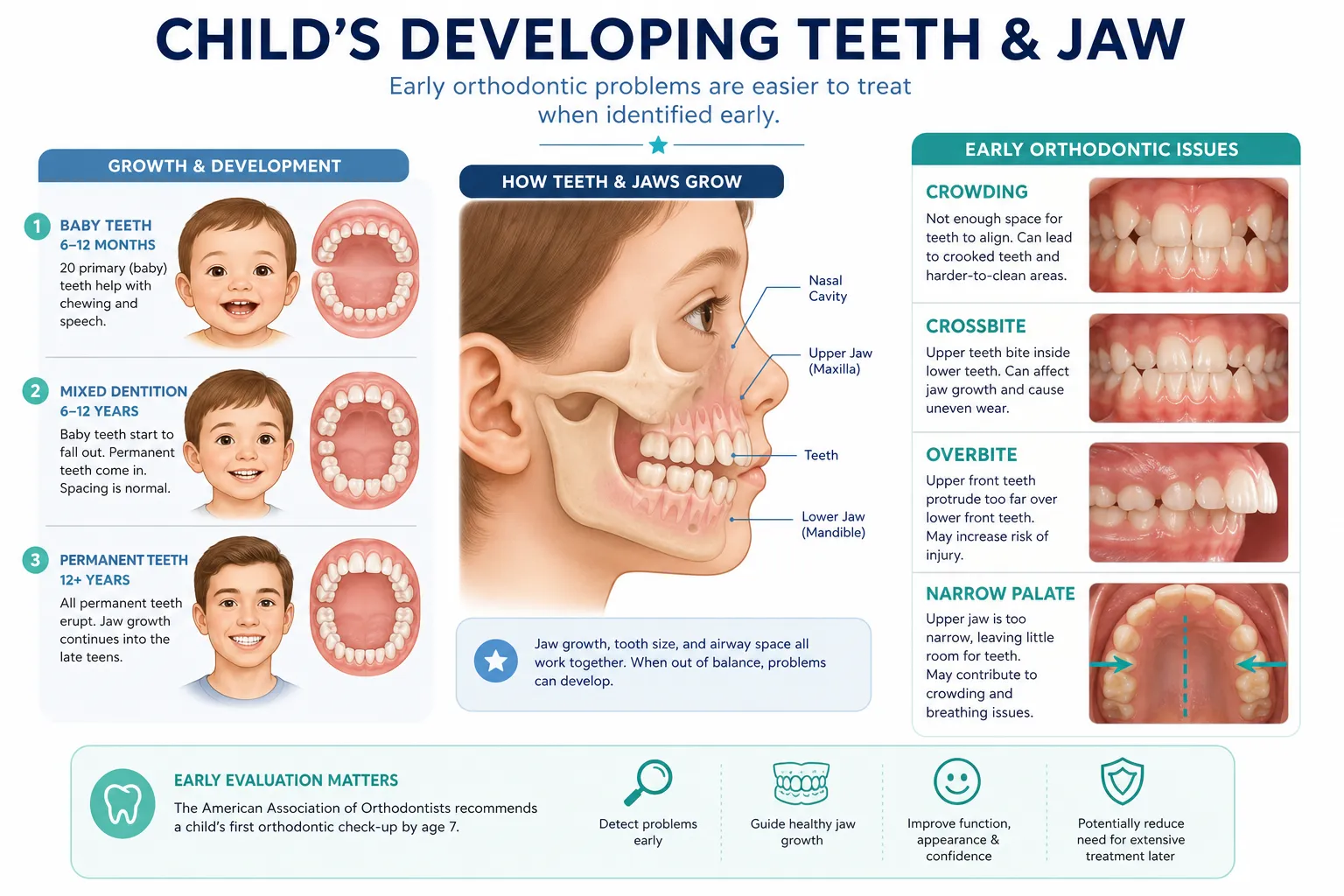
Early orthodontic treatment, sometimes called interceptive orthodontics or Phase 1 treatment, is orthodontic care provided while a child is still growing. The goal is not always to make every tooth perfectly straight at a young age. Instead, it is to improve jaw development, create room for incoming permanent teeth, correct harmful bite patterns, and reduce the risk that a developing problem becomes more serious.
This is one of the most important content gaps in many articles on the topic: early care is not simply “braces earlier.” In reality, it is growth-guided treatment. Because the jaws are still developing, orthodontists can sometimes influence how the upper and lower arches relate to each other in ways that are harder to achieve later.
That matters when a child has issues such as:
-
A crossbite
-
A narrow upper jaw
-
Significant crowding
-
Protruding front teeth
-
Early loss of baby teeth
-
Blocked-out permanent teeth
-
A developing underbite or severe overbite
-
Habits affecting jaw growth, such as prolonged thumb sucking
For some children, monitoring is the best choice. For others, a timely intervention can make a lasting difference.
When Should a Child First See an Orthodontist?
A child does not need to have all permanent teeth before seeing an orthodontist. In fact, many growth-related concerns are best identified much earlier.
Most children should have an orthodontic evaluation around age 7. At this age, enough adult teeth have usually erupted to assess how the bite is forming, while enough growth remains to guide development when necessary.
A consultation at this stage does not mean treatment will begin immediately. Often, it simply gives parents peace of mind and a roadmap for monitoring.
Why Timing Matters More Than Starting Early
One of the biggest misconceptions parents have is that earlier is always better. More accurately, timely treatment is better.
Starting too soon can lead to unnecessary treatment time. Starting too late can mean missing a window when jaw growth could have been guided more efficiently. That is why an experienced orthodontist evaluates not just the teeth, but also:
-
Facial growth
-
Jaw relationship
-
Airway patterns
-
Eruption timing
-
Oral habits
-
Functional concerns such as chewing and speech
At Eisenberger and Meister Orthodontics, every recommendation is built around the individual child. Our team uses advanced imaging, detailed diagnostics, and personalized treatment planning to determine whether your child needs treatment now, later, or simply periodic observation.
Common Signs Your Child May Benefit From Early Treatment Orthodontics
Parents are often the first to notice subtle signs. If any of the following sound familiar, it may be time to schedule a complimentary consultation.
Bite Problems
A child may have an overbite, underbite, open bite, or crossbite. These issues can affect more than appearance – they may influence chewing, speech, tooth wear, and jaw development.
Crowding or Lack of Space
If permanent teeth are erupting crooked, overlapping, or behind existing teeth, crowding may already be developing. Early intervention may help preserve or create space.
Protruding Front Teeth
Front teeth that stick out are more vulnerable to injury, especially during sports or active play.
Early or Delayed Loss of Baby Teeth
Baby teeth that fall out too soon – or stay in place too long – can disrupt the path of permanent teeth.
Mouth Breathing or Snoring
Many competitor pages mention crowding and bite problems but gloss over airway concerns. Mouth breathing, snoring, restless sleep, and narrow jaw development can sometimes overlap, and these patterns deserve orthodontic evaluation as part of a complete growth picture.
Thumb Sucking or Tongue Thrust
Persistent oral habits can affect jaw growth, palate width, and tooth position.
Difficulty Chewing or Speech Concerns
If your child avoids certain foods, bites awkwardly, or struggles with certain sounds, the bite may be contributing.
Conditions Early Orthodontic Treatment Can Help Address
Not every child with crooked teeth needs treatment right away, but several developing issues are especially worth evaluating early.
Crossbite
A crossbite occurs when some upper teeth fit inside the lower teeth rather than outside them. Left untreated, this can contribute to uneven jaw growth, tooth wear, or shifting of the jaw when biting.
Narrow Upper Jaw
A narrow upper arch can limit space for permanent teeth and affect bite relationship. In some children, palatal expansion may help widen the arch during a favorable stage of growth.
Severe Crowding
When there is not enough room for permanent teeth, early guidance may reduce impaction risk and improve eruption patterns.
Underbite
If the lower jaw or lower teeth are positioned too far forward, early evaluation is especially important because growth modification may be possible while a child is still developing.
Deep Overbite or Open Bite
These vertical bite concerns can affect function, comfort, and future wear on the teeth.
Impacted or Ectopically Erupting Teeth
Some permanent teeth begin erupting in the wrong position. Early identification can prevent more complex treatment later.
Benefits of Early Orthodontic Treatment
The best early orthodontic treatment is purposeful, efficient, and tailored to growth. When indicated, it can offer meaningful short- and long-term benefits.
Guides Jaw Growth
Because children are still growing, orthodontic treatment can sometimes influence the development of the upper and lower jaws in a favorable direction.
Improves Bite Function
A better bite can support easier chewing, clearer speech, and more balanced jaw movement.
Creates Space for Permanent Teeth
Selective early treatment may help reduce severe crowding and improve how incoming teeth erupt.
Lowers Risk of Trauma
Correcting protrusive front teeth can reduce the chance of fractures during sports and everyday activity.
May Reduce Complexity of Future Treatment
Another content gap in many competitor articles is nuance: early treatment does not always eliminate the need for braces later, but it may make future treatment shorter, simpler, or less invasive.
Supports Confidence
Children become aware of their smiles earlier than many adults realize. Addressing visible bite issues or severe crowding can help some kids feel more comfortable socially.
Does Early Treatment Mean My Child Won’t Need Braces Later?
Not necessarily.
This is one of the most important things parents should understand. Early orthodontic treatment often happens in two phases:
|
Phase |
Purpose |
Typical Timing |
|---|---|---|
|
Phase 1 |
Guide growth, correct specific developing issues, create space, improve bite |
Usually during mixed dentition |
|
Phase 2 |
Fine-tune alignment and bite once most or all permanent teeth are in |
Often during the teen years |
Sometimes Phase 1 reduces the need for extractions, lowers treatment complexity, or improves growth outcomes. Sometimes it prevents a problem from worsening. But many children still benefit from a second phase later to fully align the teeth.
A trustworthy orthodontic practice will explain this clearly. At Eisenberger and Meister Orthodontics, we believe in transparent recommendations, realistic expectations, and treatment only when it adds real value.
What Types of Early Orthodontic Appliances Might Be Used?
Treatment varies by child, but several options are commonly used during growth.
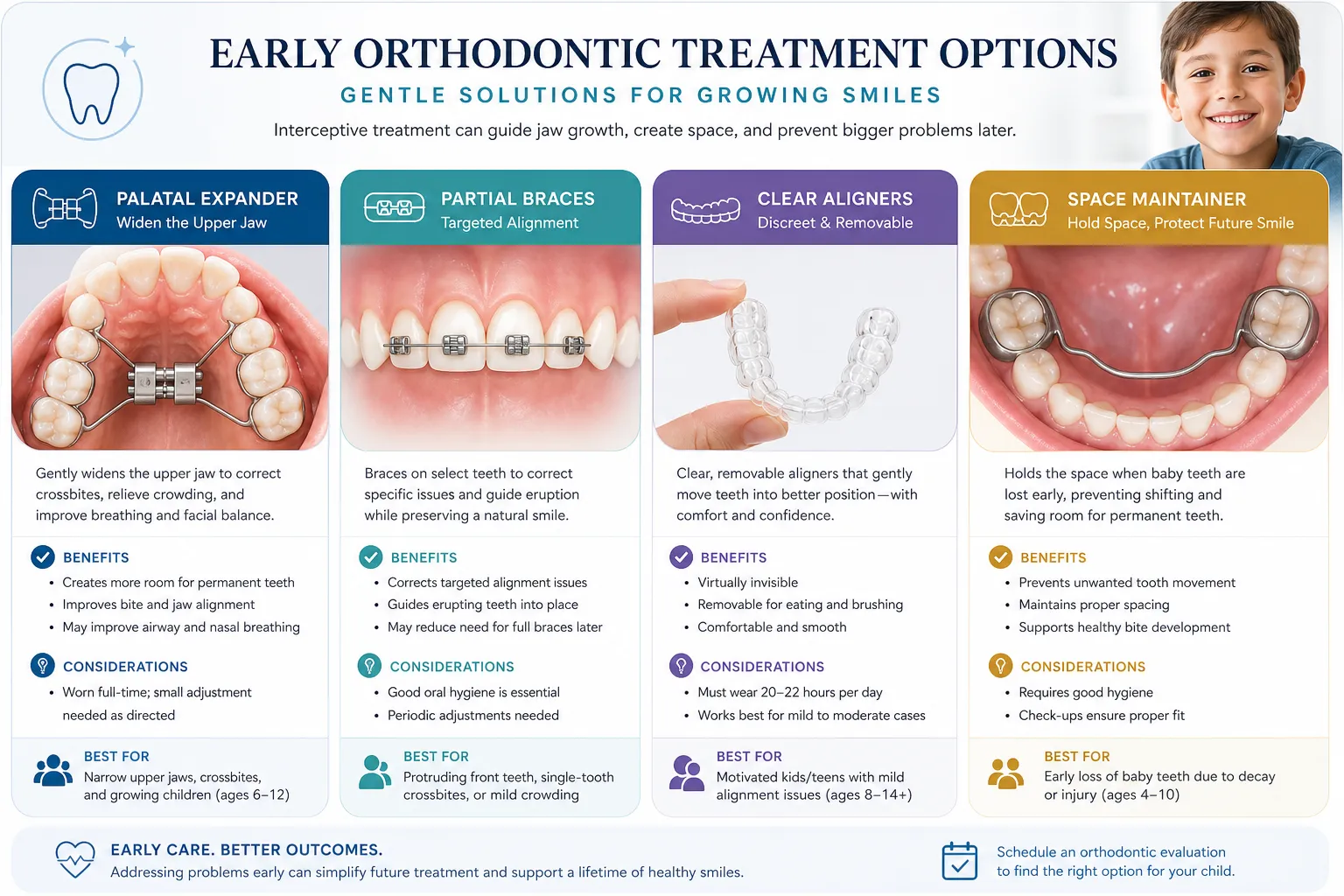
Palatal Expanders
Palatal expanders are used to widen a narrow upper jaw. They may help address crossbites, create arch space, and improve how the upper and lower teeth fit together.
Partial Braces
Sometimes only a limited set of braces is needed to move a few teeth, correct a crossbite, or guide eruption.
Space Maintainers
If a baby tooth is lost too early, a space maintainer can help preserve room for the permanent tooth.
Habit Appliances
These may be recommended when thumb sucking, tongue thrust, or similar habits are affecting development.
Clear Aligners for Select Younger Patients
Depending on the child’s age, compliance, and orthodontic needs, aligner-based treatment may be appropriate in some cases.
At Eisenberger and Meister Orthodontics, treatment recommendations are based on precision, comfort, and efficiency. For older children, teens, and adults who need comprehensive treatment, we also offer advanced options such as LightForce custom 3D-printed braces and Invisalign from a Sapphire Provider in the top 0.5% of specialists.
Early Orthodontics vs. Waiting: A Practical Comparison
|
Question |
Early Evaluation / Treatment |
Waiting Until All Permanent Teeth Erupt |
|---|---|---|
|
Can jaw growth be guided? |
Often, yes |
Much less often |
|
Can a crossbite or narrow palate be addressed during development? |
Often more effectively |
May become more complex |
|
Will every child need treatment right away? |
No |
Not applicable |
|
Can future treatment still be needed? |
Yes, sometimes |
Yes |
|
Main advantage |
Timely intervention during growth |
Simpler if no early issues exist |
What Happens During an Orthodontic Consultation for a Child?
Parents often expect an overwhelming or sales-driven experience. A high-quality orthodontic consultation should feel the opposite: clear, educational, and pressure-free.
At Eisenberger and Meister Orthodontics, complimentary consultations are designed to help families understand what is happening, what is not happening, and what makes sense next.
Step 1: Review of Growth and Dental Development
We assess how the teeth are erupting, how the jaws are growing, and whether there are signs of crowding, asymmetry, bite problems, or airway-related concerns.
Step 2: Diagnostic Records
Advanced orthodontic technology may include digital scans, photographs, and imaging to evaluate the bite and underlying structures more precisely.
Step 3: Personalized Findings
You’ll learn whether your child needs treatment now, should be monitored, or would be better served by waiting. We explain why in practical terms.
Step 4: Treatment Discussion
If treatment is recommended, we review the goals, appliance options, timeline, expected benefits, and how we’ll make the process convenient for your family.
Step 5: Financial Guidance
Families deserve clarity here too. We offer flexible financing, including 0% APR options and no hard credit checks, so parents can make confident decisions without added stress.
The Overlooked Connection Between Orthodontics, Airway, and Growth
A major gap in many competing articles is the limited discussion of function beyond tooth alignment. Early orthodontic treatment can intersect with broader developmental concerns, especially when a child has:
-
Chronic mouth breathing
-
Snoring
-
Restless sleep
-
Narrow arches
-
Long facial growth patterns
-
Difficulty keeping lips comfortably closed
This does not mean every child with these symptoms needs orthodontic intervention. It does mean they deserve a careful evaluation from a provider who understands growing smiles as part of a bigger functional picture.
Because Eisenberger and Meister Orthodontics offers airway orthodontic insight alongside traditional bite and alignment treatment, families can receive a more comprehensive assessment of what may be influencing their child’s growth.
How Early Orthodontic Treatment Fits Into Long-Term Smile Planning
Early treatment is not a standalone event – it is part of a larger strategy for lifelong oral health.
A well-timed intervention may:
-
Help permanent teeth erupt more favorably
-
Support a healthier bite
-
Reduce strain on certain teeth
-
Minimize risk of trauma
-
Make teen orthodontic treatment more efficient
-
Improve comfort and confidence during key developmental years
And when later treatment is needed, having access to advanced options matters. Our practice offers care for children, teens, and adults, including aesthetic solutions and technology-forward systems that fit busy family life.
Why Families in Passaic Choose Eisenberger and Meister Orthodontics
Parents today want more than clinical skill. They want accuracy, convenience, warmth, and confidence that recommendations are truly in their child’s best interest.
That is where Eisenberger and Meister Orthodontics stands apart.
Advanced Technology and Modern Treatment Planning
We use cutting-edge orthodontic tools to improve precision, comfort, and communication throughout treatment.
High-Level Invisalign Expertise
As an Invisalign Sapphire Provider in the top 0.5% of specialists, our team offers rare depth of experience with clear aligner therapy for appropriate candidates.
Custom LightForce Braces
For patients who need braces, LightForce custom 3D-printed ceramic braces offer a more individualized approach, with the potential for faster treatment and fewer appointments.
Dental Monitoring for Convenience
Busy families appreciate Dental Monitoring, which can reduce unnecessary office visits and make progress checks easier with less disruption to work, school, and activities.
A Luxurious, Spa-Like Office Experience
Orthodontic care should feel comfortable and welcoming. Our office is designed to feel warm, elevated, and reassuring rather than clinical or rushed.
Efficient Scheduling and Less Waiting
Families value their time. We focus on efficient appointment scheduling and smoother visits with less hassle.
Experience You Can Trust
With 38 years in practice and 15,000+ smiles treated, our team brings long-standing expertise while continuing to invest in the most current treatment options.

Is Early Orthodontic Treatment Right for Every Child?
No – and that’s exactly why expert evaluation matters.
Some children benefit tremendously from early care. Others do best with observation and periodic check-ins. The goal is never to start treatment for the sake of starting treatment. The goal is to protect healthy development and intervene only when doing so offers a clear advantage.
That kind of judgment comes from experience, modern diagnostics, and a truly personalized philosophy.
Final Thoughts for Parents
If you have noticed crowding, bite changes, mouth breathing, or other developmental concerns, an early orthodontic evaluation can provide clarity and peace of mind. In many cases, the most valuable outcome is simply knowing your child is developing normally. In other cases, timely treatment can guide growth in ways that are harder to achieve later.
For families in Passaic, Clifton, Garfield, Paterson, Wallington, Rutherford, East Rutherford, Carlstadt, Wood-Ridge, Hasbrouck Heights, Lodi, Hackensack, Little Falls, Woodland Park, Elmwood Park, Fair Lawn, Lyndhurst, Nutley, Bloomfield, Montclair, Verona, Cedar Grove, Wayne, Totowa, North Arlington, Kearny, Belleville, Secaucus, Jersey City, Hoboken, Newark, and surrounding New Jersey communities, Eisenberger and Meister Orthodontics offers a rare combination of advanced technology, premium comfort, trusted experience, and truly individualized care.
If you want a team that combines modern orthodontic expertise with honest guidance, complimentary consultations, flexible financing, and an exceptional patient experience, Eisenberger and Meister Orthodontics is ready to help your child grow into a healthier, more confident smile.
FAQ
What is early orthodontic treatment?
Early orthodontic treatment is care provided while a child is still growing to guide jaw development, improve bite function, and make room for permanent teeth. It is often used to address issues like crossbites, crowding, or a narrow palate before they become more complex.
What are the pros and cons of early orthodontic treatment?
The main benefits include guiding jaw growth, improving bite problems early, reducing injury risk to protruding teeth, and sometimes making later treatment simpler. The main limitation is that some children may still need a second phase of braces or aligners later, so early treatment is most helpful when timing and diagnosis are truly appropriate.
Do palate expanders change face shape?
Palate expanders can influence how the upper jaw develops, which may subtly improve facial balance as a child grows. Their main purpose is to widen a narrow upper arch and improve bite function, not to dramatically change appearance.
When is it too late for a palate expander?
Palatal expansion is typically most effective while a child is still growing, which is why early evaluation matters. It may still be possible later in some cases, but once growth is more advanced, treatment can become more limited or require different approaches.