
If you have a front-tooth gap, deciding on a frenectomy before or after braces starts with finding out why the teeth are apart. Braces or clear aligners move the teeth; a labial frenectomy releases tissue under the upper lip if it contributes to the space. Your orthodontist may recommend it before, during or after gap closure, or not at all.
What is a frenectomy, and why might it be needed?
Lift your upper lip and you can see the connective tissue joining it to the gum above the two front teeth. This is the upper labial frenum, commonly referred to as a frenulum. A labial frenectomy releases it. A lingual frenectomy treats the lingual frenum beneath the tongue, not the tissue involved in this front-tooth gap.
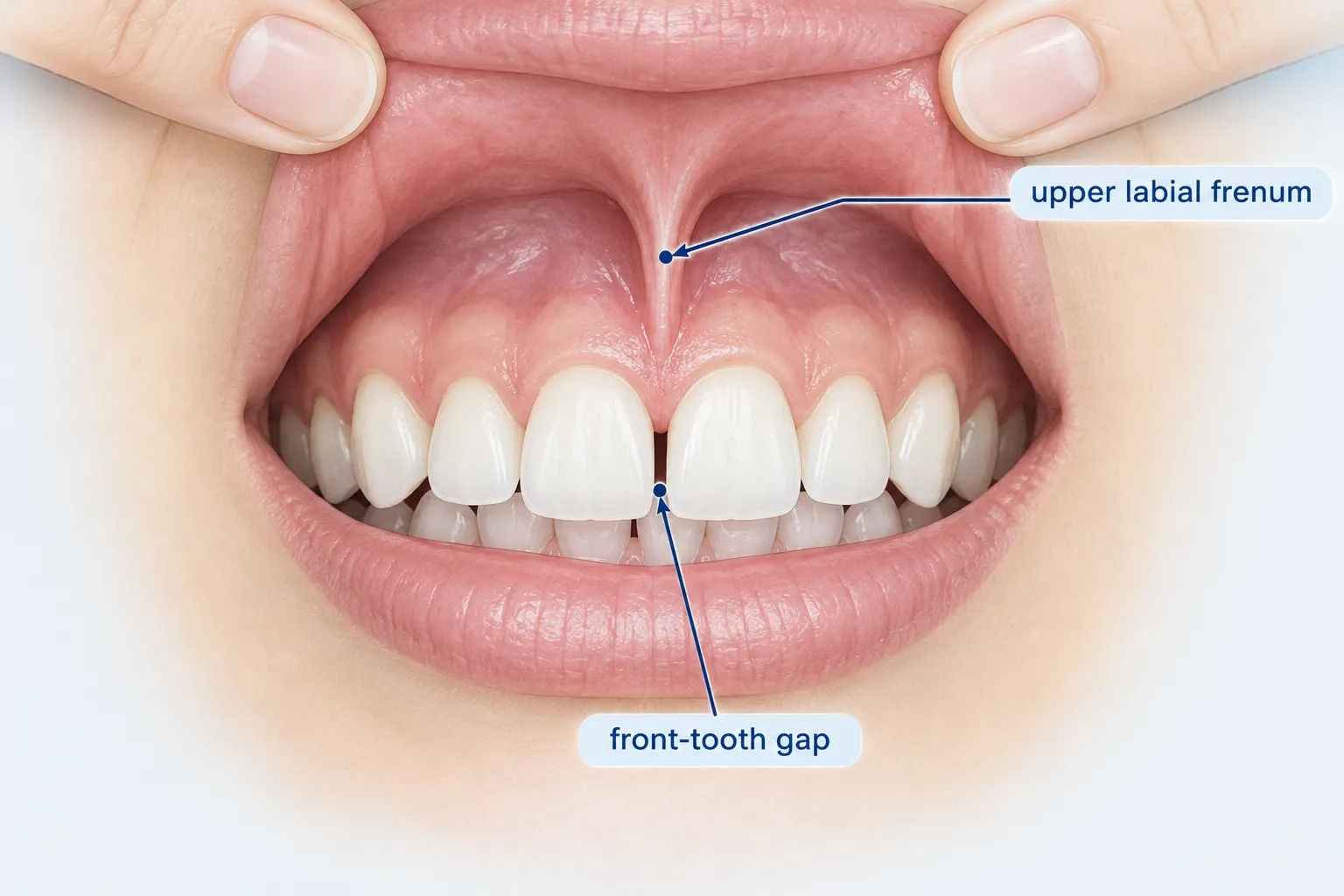
A thick upper frenum, or one that attaches low between the two front teeth, can contribute to a midline diastema, the clinical name for the gap. Treatment may also make sense if the tissue pulls on the gums, contributes to gum recession or restricts lip movement. Your orthodontist examines the attachment to tell whether it plays a role.
A frenectomy does not move teeth together. Braces or aligners do that. The procedure addresses tissue that could obstruct closure or make the gap harder to keep closed.
Potential benefits of a labial frenectomy
If the tissue is restrictive, releasing it may ease the pull on the gums and improve lip movement. The likely benefit depends on the attachment, not simply the gap’s width.
Why is there a gap between the front teeth?
A child’s gap may change as permanent teeth erupt. In teens and adults, the size or position of teeth, missing teeth, the bite, gum health or the frenum may contribute to spacing. The cause matters when planning how to close the space.
Your orthodontist checks the gap, frenum attachment, eruption and bite. Gum disease or other dental concerns may need attention before orthodontic treatment. This assessment helps you make informed decisions about timing.
|
Finding |
What it can mean for treatment |
|---|---|
|
A gap in a child whose permanent teeth are still erupting |
Observation may be appropriate before deciding on surgery or orthodontic closure. |
|
Spacing tied chiefly to tooth position or bite |
Braces or aligners may close the gap without a frenectomy. |
|
A substantial frenum that resists tooth movement |
A release may be planned before or while the space is being closed. |
|
A gap that closes but seems prone to reopening because of tissue tension |
The clinician may recommend a frenectomy after closure, together with a retention plan. |
Frenectomy before or after braces: which comes first?
Your orthodontist plans around both space closure and keeping the gap closed.
“In a survey of 353 UK orthodontists, 42.5% of those considering a frenectomy preferred it after the gap was closed; there was no consensus on timing.” – Ahn and colleagues, The Angle Orthodontist
The survey records preferences, not outcomes. After space closure may mean while braces are still on, not after they are removed.
Before braces: when tissue obstructs the plan
If a restrictive frenum obstructs closure or causes a separate gum concern, your orthodontist may suggest treating it first. The area can heal before tooth movement begins; braces or aligners may still be needed.
During braces: when the response becomes clear
Sometimes it makes sense to start closing the gap and see whether the frenum interferes. If it does, a dentist or specialist can release it during treatment.
After braces close the gap: when stability is the concern
The orthodontist may close the gap before deciding on release, often with braces still in place. Seeing the frenum against the closed space helps assess its attachment. You will still need a retainer.
|
Timing |
Potential reason |
Key limitation |
|---|---|---|
|
Before orthodontic closure |
Tissue is clearly obstructing the proposed movement or needs treatment for another reason. |
Surgery alone usually does not bring the teeth together. |
|
During orthodontics |
Tissue resistance becomes apparent while the gap is closing. |
Requires coordination with the clinician performing the procedure. |
|
After closure |
The concern is tissue tension and keeping the space closed. |
A retainer is still needed to maintain the result. |
|
No frenectomy |
The frenum is not a meaningful cause of the gap. |
Another cause of spacing must still be addressed if treatment is desired. |
What happens at a labial frenectomy?
The clinician examines the attachment and explains the frenectomy procedure, a dental procedure that releases the tissue. They numb the area as needed and may use a surgical instrument or soft-tissue laser. A laser frenectomy is one option, but do not assume it means faster healing. Your orthodontist may coordinate care with a dentist or gum specialist.
Mild soreness, swelling or minor bleeding can follow. During the healing process, follow your clinician’s aftercare instructions on cleaning, any recommended stretches and soft foods, such as mashed potatoes. Ask whether to avoid hot foods and what over-the-counter pain relief is appropriate for you. Call if bleeding persists, pain worsens or healing seems delayed.
Can the gap reopen?
Yes. Teeth can shift after closure. Release may remove one source of tension, but retention is still part of the plan. Your orthodontist will recommend a retainer for better long-term stability; if the gap returns, an examination can identify why.
Front-tooth gap care in Passaic and North Jersey
Eisenberger and Meister Orthodontics in Passaic begins with an individual assessment. Children, teens and adults can discuss whether the space may change as teeth develop, whether braces or Invisalign can close it, and whether a labial frenectomy referral makes sense. The practice offers complimentary consultations and individualized treatment plans.
Nearby communities, county by county
Families come to Passaic from across North Jersey. The towns below include nearby communities and others toward the 20-mile mark. Your route and starting address determine the actual distance; the list is not a measured radius or a limit on who can request care.
|
County |
Nearby New Jersey municipalities |
|---|---|
|
Passaic |
Passaic, Clifton, Paterson, Haledon, North Haledon, Prospect Park, Hawthorne, Totowa, Woodland Park, Little Falls, Wayne, Pompton Lakes, Bloomingdale and Wanaque. |
|
Bergen |
Garfield, Lodi, Wallington, East Rutherford, Rutherford, Carlstadt, Wood-Ridge, Moonachie, Hasbrouck Heights, Teterboro, South Hackensack, Hackensack, Maywood, Rochelle Park, Saddle Brook, Elmwood Park, Fair Lawn, Glen Rock, Ridgewood, Paramus, River Edge, New Milford, Teaneck, Bogota, Englewood, Englewood Cliffs, Fort Lee, Leonia, Palisades Park, Cliffside Park, Edgewater, Ridgefield, Ridgefield Park, Little Ferry, Lyndhurst, North Arlington, Bergenfield, Dumont, Tenafly, Cresskill, Demarest, Haworth, Oradell, Emerson, Westwood, Hillsdale, River Vale, Park Ridge, Woodcliff Lake, Wyckoff, Franklin Lakes, Oakland, Ramsey, Allendale, Ho-Ho-Kus, Midland Park, Saddle River, Upper Saddle River and Waldwick. |
|
Essex |
Nutley, Belleville, Bloomfield, Glen Ridge, Montclair, Verona, Cedar Grove, West Orange, Orange, East Orange, Newark, North Caldwell, Caldwell, West Caldwell, Roseland, Livingston, Maplewood, South Orange, Millburn, Irvington, Fairfield and Essex Fells. |
|
Hudson |
Secaucus, Kearny, Harrison, East Newark, North Bergen, Union City, West New York, Guttenberg, Weehawken, Hoboken, Jersey City and Bayonne. |
|
Morris |
Lincoln Park, Pequannock, Riverdale, Butler, Kinnelon, Montville, Boonton, Boonton Township, Mountain Lakes, Parsippany-Troy Hills, East Hanover, Florham Park, Hanover, Morris Plains, Morristown, Denville, Rockaway, Rockaway Township, Chatham and Chatham Township. |
|
Union |
Hillside, Elizabeth, Union, Kenilworth, Roselle Park, Roselle, Linden, Springfield, Summit, New Providence, Berkeley Heights, Cranford, Garwood and Westfield. |
Across North Jersey, the treatment sequence depends on the cause of your gap and the position of your teeth.
If you or your child wants to address a front-tooth gap, book a complimentary consultation with Eisenberger and Meister Orthodontics. An individual assessment can show whether observation, orthodontic treatment, a frenectomy referral or a combination makes sense, along with how to retain the result.
FAQ
How long do braces take to close a gap?
The time depends on the size of the space, the bite and whether other teeth need movement. An orthodontist can give a meaningful estimate after examining the teeth; closing the visible gap is not always the end of treatment.
Does your smile change after a frenectomy?
Releasing a tight upper-lip attachment may change how the lip and gum tissue move, but a frenectomy does not itself position the front teeth. If the goal is to close a gap, orthodontic movement may also be needed.
Should there be a gap between two front teeth?
A gap can occur while a child’s permanent teeth are developing, and some people have one into adulthood. Whether it warrants treatment depends on its cause, the stage of dental development, oral health and the person’s goals.