
An impacted canine is an adult eye tooth that has not come into its normal position. Braces can make room for it. If it remains trapped, an oral surgeon can expose the tooth so the orthodontist can guide it into the arch. For a child, teen, or adult in North Jersey, the plan starts with an exam of the canine’s position, the nearby roots, and the space available.
Searching for impacted canine braces treatment NJ? You can discuss surgery after you know where the tooth sits. A developing canine may need space and observation; a tooth that remains trapped may need both orthodontic and surgical care.
What is an impacted canine, and why does it matter?
Canines are the pointed teeth between the front teeth and premolars. An upper canine can stay behind the gum, sit toward the palate, or be displaced toward the cheek. A baby canine that stays in place, an adult canine that does not appear while the other side does, or a tooth emerging high in the gum can prompt an evaluation. You might feel no pain.
A displaced canine may lie close to the roots of adjacent teeth, even if the only visible sign is a gap. Its position affects how the orthodontist finishes the bite and smile. Imaging helps distinguish a delayed tooth with a clear route from one that is blocked or pointed in the wrong direction. The American Association of Orthodontists’ guidance on impacted teeth advises an orthodontic assessment when a tooth does not come in as expected.
How does an orthodontist diagnose an impacted canine?
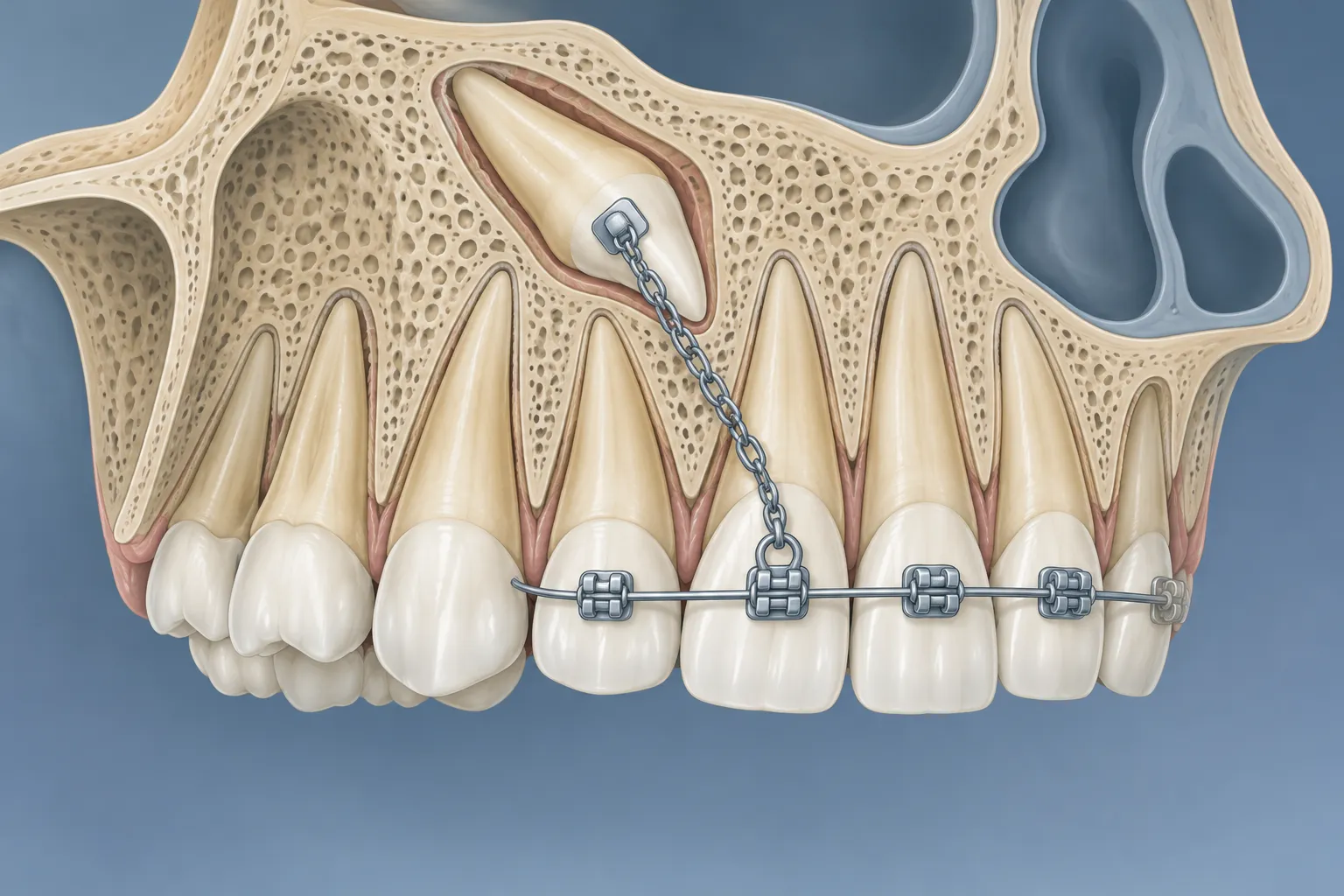
At the exam, the orthodontist looks at how the teeth are coming in, the space available, any retained baby canine, and the neighboring teeth. A panoramic X-ray shows the canine’s general position and direction. If its relationship to adjacent roots remains unclear, other images may help. A three-dimensional cone-beam CT scan is an option for selected cases, not a routine requirement for everyone.
The orthodontist needs to establish whether the adult tooth is present, whether crowding or another obstacle blocks its path, and how close it lies to an incisor root. Creating space might let it erupt without surgical traction. Age alone does not settle these questions. Children with an eruption concern and adults with an unerupted canine can both be assessed.
“The American Association of Orthodontists recommends a child’s first orthodontic check-up when a problem is first recognized, and no later than age 7.” – American Association of Orthodontists
An age-seven check is an evaluation; it does not mean every child needs braces. It gives the orthodontist a chance to watch the eruption path or address an obstacle before the canine becomes harder to guide.
Impacted canine braces treatment NJ: when can braces help?
Braces move neighboring teeth apart to make room for the canine and provide support for controlled movement. The orthodontist also needs a safe path for a buried tooth. If it cannot emerge, an oral surgeon may uncover part of it and attach a small bracket and chain. The orthodontist then uses light, directed force to move it.
|
Finding at the exam |
Possible next step |
What braces contribute |
|---|---|---|
|
Developing canine has room to emerge |
Make space and observe eruption |
Open and preserve the space |
|
Canine is blocked or remains buried |
Plan exposure with an oral surgeon, then guided movement |
Provide an anchor and controlled traction |
|
Canine cannot safely be moved or does not respond |
Discuss other tooth and bite options |
Position the remaining teeth for the chosen plan |
The exam decides which path applies. Clear aligners can help arrange teeth in some treatment plans, though a buried canine may still need a bonded attachment and a way to anchor traction. Ask which appliance will control the canine in your case.
The stages of impacted canine braces treatment in NJ
1. Map the tooth and prepare space
The orthodontist maps the tooth’s angle, its distance from adjacent roots, and the room it needs. Braces can create that space before an exposure appointment. For a younger patient, removing a retained baby canine or another obstruction may give the adult tooth a chance to erupt on its own.
2. Expose the canine if it remains trapped
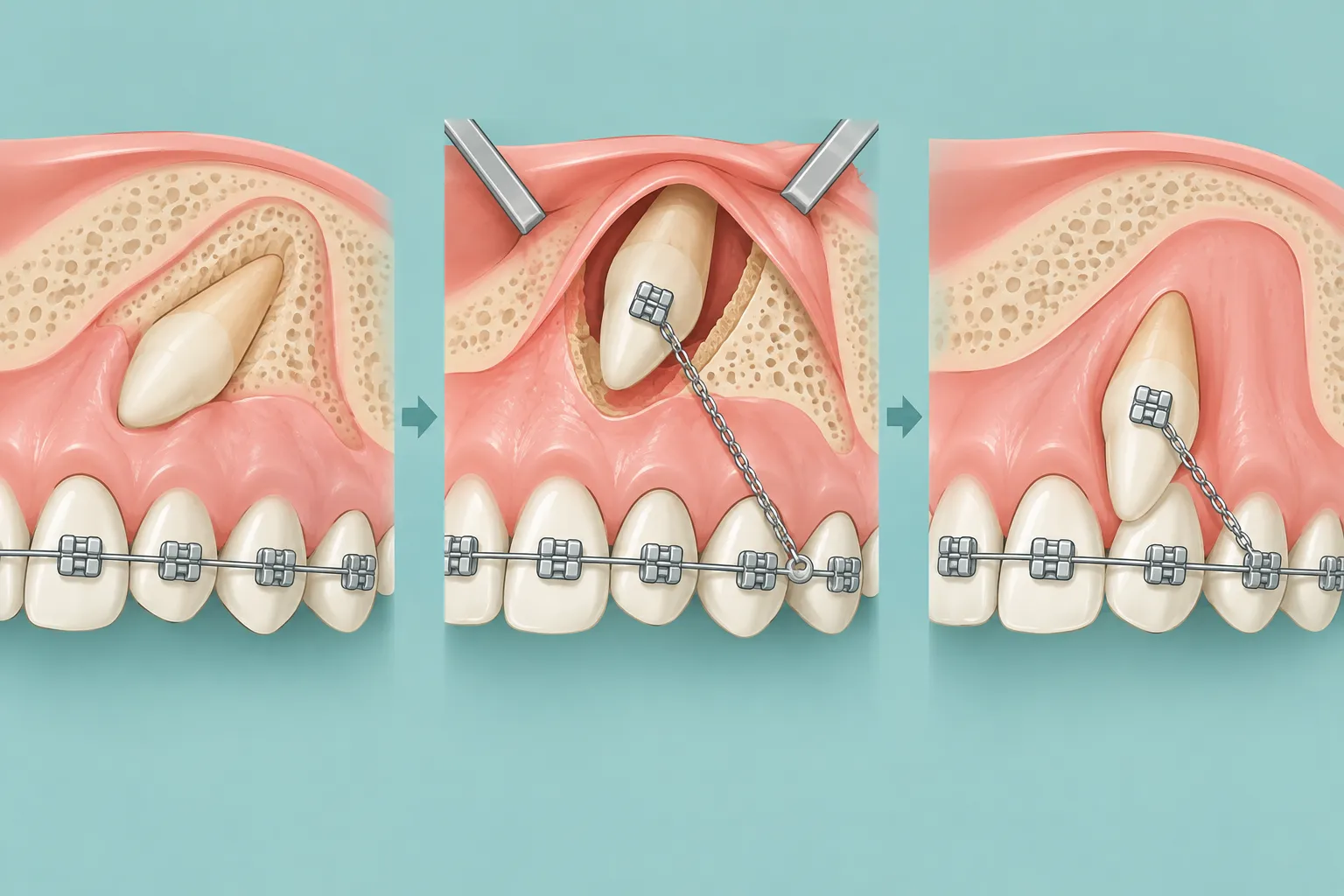
If the tooth stays trapped after space is prepared, an oral surgeon uncovers it. The surgeon may leave a portion visible or return the gum over the tooth with a small chain extending out, depending on its position and the surrounding tissue. The surgeon and orthodontist agree on the attachment and direction of movement. The tooth remains in place during exposure.
3. Guide the tooth with light force
At follow-up visits, the orthodontist connects the attachment to the braces, sometimes with a small rubber band. As the canine moves toward its proper position, adjustments keep the traction gentle and directed. The team also watches adjacent teeth and gums. Do not tug on the chain yourself; contact your treating team if the attachment comes loose.
4. Finish the bite and retain the result
Once the canine reaches the arch, the orthodontist aligns its crown and root with the other teeth to bring it into its proper position and settles the bite. The team also evaluates the gum around it. Retainers help maintain the result after treatment. Preparation, movement, finishing, and retention each take time beyond the day of exposure.
Recovery, timing, and possible setbacks
Exposure of an impacted tooth is generally an outpatient surgical procedure. The orthodontist and oral surgeon work together on the timing and direction of movement. Follow the surgeon’s instructions for eating, oral hygiene, and discomfort management after surgery; avoid hard foods that could disturb the site or attachment during early healing. The orthodontic part usually takes much longer than the surgical appointment because tooth movement must be controlled over repeated visits.
A description of the tooth cannot give you a reliable timeline. Depth and angle, available space, root proximity, age, gum condition, and the tooth’s response to traction all matter. A tooth fused to bone may not move. Discuss effects on adjacent roots, gum support, and the chance that an attachment may need rebonding. Your orthodontist and surgeon can explain how they will monitor these concerns and what they would do if traction fails.
Questions to bring to your consultation
Bring recent dental images if you have them. These questions will help you understand the proposed plan, the uncertainties, and who handles each step:
-
Where is the canine in relation to the neighboring roots, and do we need any additional imaging?
-
Is there a realistic chance it will erupt after space is made, or is exposure likely?
-
Will braces go on before the surgical visit, and what needs to happen before traction begins?
-
Who will perform the exposure and coordinate the follow-up?
-
How will you tell whether the tooth is moving safely, and what is the backup plan if it does not?
-
What will the full treatment plan, appointment schedule, retention, and financial arrangements involve?
Passaic and nearby North Jersey communities
Eisenberger and Meister Orthodontics is based in Passaic, NJ. Families from nearby North Jersey towns may be weighing an impacted-canine consultation. The county-by-county list below covers communities around Passaic, though some parts of a municipality may lie beyond a 20-mile travel radius.
|
County |
Communities around Passaic |
|---|---|
|
Passaic |
Clifton, Paterson, Little Falls, Woodland Park, Totowa, Wayne, Haledon, North Haledon, Prospect Park, Hawthorne, Pompton Lakes, Wanaque, Ringwood, West Milford, Bloomingdale |
|
Bergen |
Garfield, Lodi, Wallington, East Rutherford, Rutherford, Lyndhurst, North Arlington, Carlstadt, Hasbrouck Heights, Wood-Ridge, Moonachie, Teterboro, South Hackensack, Hackensack, Maywood, Rochelle Park, Saddle Brook, Elmwood Park, Fair Lawn, Glen Rock, Ridgewood, Paramus, River Edge, New Milford, Teaneck, Bogota, Bergenfield, Englewood, Fort Lee, Leonia, Palisades Park |
|
Essex |
Nutley, Belleville, Bloomfield, Glen Ridge, Montclair, Verona, Cedar Grove, West Orange, Orange, East Orange, Newark, North Caldwell, Caldwell, West Caldwell, Fairfield, Livingston, Maplewood, South Orange, Millburn |
|
Hudson |
Secaucus, Kearny, Harrison, North Bergen, Union City, Weehawken, West New York, Guttenberg, Hoboken, Jersey City, Bayonne |
|
Morris |
Lincoln Park, Pequannock, Riverdale, Montville, Parsippany-Troy Hills, East Hanover, Hanover, Florham Park, Boonton, Boonton Township, Mountain Lakes, Denville, Rockaway |
|
Union |
Hillside, Elizabeth, Union, Springfield, Kenilworth, Roselle Park, Roselle, Linden, Summit, New Providence |
A treatment plan that respects the tooth and the patient
For a blocked canine, the goal is a safe route into a healthy place in the bite, with nearby teeth protected along the way. Braces often make that possible, with surgical exposure in some cases and space-making alone in others. The individual exam decides which route is appropriate.
If you or your child has a retained baby canine or an adult tooth that has not appeared, arrange a consultation with Eisenberger and Meister Orthodontics in Passaic. You can leave with a plan tailored to that tooth: observation, braces, coordinated exposure, or another approach if moving it is not appropriate.