
Invisalign lisp: how long does it last? For many people, a slight lisp is strongest in the first few days, improves during the first week, and is barely noticeable within one to two weeks. Call your orthodontist if it gets worse, does not ease, or begins with a tray that will not sit properly.
If you speak for work or school, even a slight change can be distracting. Wear aligners as directed while you practice so your mouth can adapt. A tray that seems to fit poorly is worth a call.
Invisalign lisp: how long does it last?
You might notice no change at all. If you do, the adjustment period may take a few days or a couple of weeks, even with well-fitting trays. Some people adjust quickly; others need more time. The times below are a guide, not a deadline.
|
When |
What you may notice |
What to do |
|---|---|---|
|
First day or two |
“S,” “Z,” or “SH” sounds may seem less crisp. |
Talk normally with the trays in and practice a few difficult words. |
|
Rest of the first week |
Speech often becomes clearer as the tongue learns the new surfaces. |
Keep to your prescribed wear schedule; read aloud for a few minutes each day. |
|
By one to two weeks |
Many patients have little or no noticeable lisp. |
If your speech is not improving, or the tray looks loose or damaged, contact your orthodontist. |
|
After a new set of trays |
A brief change may return, but it may pass faster once you are accustomed to aligners. |
Note whether the new tray is seated and whether the change improves. |
These time frames concern a new aligner-related lisp. Tell your orthodontist if your speech sounded different before treatment.
A small prospective study measured the speech of adults using Invisalign before treatment, just after starting, and two months later. The researchers found measurable differences even after patients had time to adapt:
“Invisalign treatment significantly affected speech, and although patients experience some level of adaptation, speech does not return to normal after 2 months of treatment.” – The Angle Orthodontist
The study followed 24 Invisalign users and measured speech changes, which are not necessarily lisps a listener would hear. There is no reason to wait two months to raise a concern.
Why Invisalign can change your speech
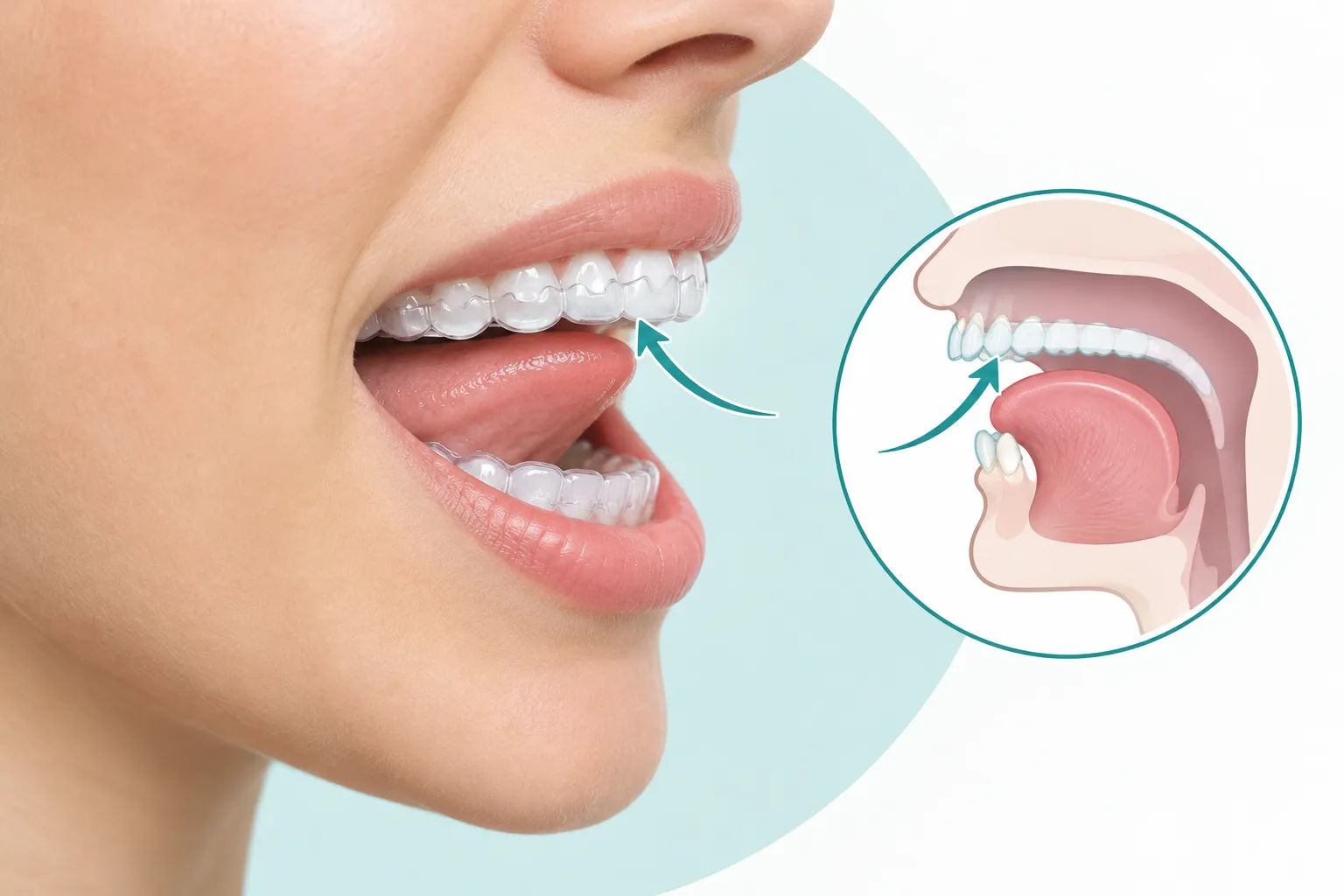
Invisalign trays add a thin layer of plastic over your teeth. When your tongue meets that new surface, forming sounds such as “S,” “Z,” and “SH” may feel different, and certain words may come out softer or with a faint whistle. Extra saliva when you first wear the trays can change how words feel, too.
You may notice a change that other people do not hear. If the difference between talking with and without the trays is clear to you, describe it to your orthodontist. Keep wearing the aligners as directed instead of removing them for each conversation.
How to speak more clearly with aligners
Focus on problem sounds

With your trays in, practice difficult words such as “success,” “zebra,” and “shoes” slowly, then use each word in a sentence. Regular practice may help you adapt faster, but there is no need to force the sound or speak quickly.
-
Read a familiar paragraph aloud with the trays in. Everyday conversation gives you practice as well.
-
During a presentation or phone call, slow down if you start tripping over a sound. You can speak clearly without trying to rush the adjustment.
-
Record the same short sentence on different days. You may hear progress in the recordings before you notice it in conversation.
-
Wear your aligners as directed. Taking them out to speak leaves you less time to become comfortable talking with them. Remove them for eating and drinking as your orthodontist directs, then put them back in.
Leave any trimming or reshaping to your orthodontist. If an edge bothers your tongue or a tray seems off, ask the team to assess it.
When to contact your orthodontist
If your lisp persists beyond roughly two weeks without improving, tell your orthodontist. Call sooner for a tray that will not seat, lifts away from your teeth, has a sharp or cracked edge, or makes speaking much harder after a change. Your orthodontist can assess aligner fit and discuss other possible causes.
Speech difficulty that continues when your aligners are out is also worth discussing with a clinician. Seek urgent medical care for sudden trouble speaking accompanied by other new symptoms.
Will every new aligner bring the lisp back?
A new tray can briefly change how you sound. Once you are used to talking with aligners, that change may be easier to manage. If one tray causes far more trouble than the last, especially if the change persists, let your orthodontist know.
Can Invisalign fix an existing lisp?
Better alignment may affect where your tongue lands, but Invisalign cannot promise to correct a lisp you already have. Bring it up at your consultation. Your orthodontist can discuss the role of tooth position and whether a speech-language professional could help.
Invisalign care in Passaic and nearby communities
At Eisenberger and Meister Orthodontics in Passaic, New Jersey, children, teens, and adults receive individualized treatment. The practice identifies itself as an Invisalign Sapphire Provider in the top 0.5% of orthodontic specialists and offers complimentary consultations. If speaking clearly matters to your work or daily life, say so at your visit. The team can discuss what to do if a tray affects your pronunciation; the practice also offers Dental Monitoring for added convenience.
North Jersey families come to Passaic from communities in several nearby counties. The towns below span the area in all directions, generally within about 20 miles of the city. Municipal boundaries and travel distances vary; the practice has its office in Passaic.
New Jersey counties
|
County |
Nearby towns and communities |
|---|---|
|
Passaic County, NJ |
Passaic, Clifton, Paterson, Prospect Park, Haledon, North Haledon, Hawthorne, Woodland Park, Little Falls, Totowa, Wayne, Pompton Lakes, Bloomingdale, and Wanaque. |
|
Bergen County, NJ |
Garfield, Lodi, Wallington, East Rutherford, Rutherford, Carlstadt, Wood-Ridge, Hasbrouck Heights, Teterboro, Moonachie, Little Ferry, South Hackensack, Hackensack, Maywood, Rochelle Park, Saddle Brook, Elmwood Park, Fair Lawn, Glen Rock, Ridgewood, Paramus, Oradell, River Edge, New Milford, Teaneck, Bogota, Englewood, Leonia, Fort Lee, Palisades Park, Ridgefield, Ridgefield Park, Cliffside Park, Edgewater, Fairview, Bergenfield, Dumont, Tenafly, Cresskill, Alpine, Allendale, Wyckoff, Franklin Lakes, Oakland, Waldwick, Ho-Ho-Kus, Hillsdale, Westwood, Emerson, Woodcliff Lake, Washington Township, and Lyndhurst. |
|
Essex County, NJ |
Nutley, Belleville, Bloomfield, Glen Ridge, Montclair, Verona, Cedar Grove, West Orange, Orange, East Orange, Newark, Irvington, South Orange, Maplewood, Millburn, Livingston, Roseland, Fairfield, North Caldwell, Caldwell, Essex Fells, and West Caldwell. |
|
Hudson County, NJ |
Secaucus, North Bergen, Union City, Weehawken, West New York, Guttenberg, Hoboken, Jersey City, Kearny, Harrison, East Newark, and Bayonne. |
|
Morris County, NJ |
Lincoln Park, Pequannock, Riverdale, Montville, Boonton, Boonton Township, Mountain Lakes, Parsippany-Troy Hills, East Hanover, Hanover, and Florham Park. |
|
Union County, NJ |
Hillside, Elizabeth, Union, Roselle Park, Roselle, Kenilworth, Springfield, Summit, and New Providence. |
Southern Rockland County, New York
|
County |
Nearby towns and communities |
|---|---|
|
Rockland County, NY |
Tappan, Sparkill, Piermont, Nyack, South Nyack, Orangeburg, Blauvelt, Pearl River, and Nanuet. |
If a new lisp is bothering you, or you want to talk about speaking with Invisalign before you start, schedule a complimentary consultation with Eisenberger and Meister Orthodontics. You can ask how your treatment plan fits your routine and what to do if speech changes.
FAQ
Does Invisalign fix a lisp?
Invisalign changes tooth position, but it is not a guaranteed fix for an existing lisp. Tell your orthodontist if the speech difference started before treatment so you can discuss whether another evaluation would help.
How to not lisp with Invisalign?
Practice talking and reading aloud with your aligners in, especially words with “S,” “Z,” and “SH” sounds. Speak a little more slowly at first and follow your prescribed wear schedule. Contact your orthodontist if the tray does not fit or the lisp does not improve.
Why is my Invisalign giving me a lisp?
The aligners put a new surface over your teeth, so your tongue has to adjust how it forms certain sounds. A mild change at the start is usually temporary; a sharp, loose, or poorly seated tray should be assessed by your orthodontist.