
If you’re looking for Invisalign Newark NJ options, compare the treatment plan and the clinician who will oversee it before choosing an office. You’ll return for check-ins, so the trip has to work beyond the first appointment. Eisenberger and Meister Orthodontics is in Passaic, not Newark; it may be worth considering if the route fits your schedule.
Start with the right geography
“Invisalign Newark” can bring up offices in Newark, DE. Make sure the address is in New Jersey. An office in South Jersey may be a poor fit for regular appointments if you live or work near Newark.
If you travel between Newark and Passaic, these nearby communities across county lines may be useful starting points when comparing routes:
-
Passaic County: Passaic, Clifton, Paterson, and Woodland Park.
-
Bergen County: Garfield, Wallington, Rutherford, East Rutherford, Carlstadt, Wood-Ridge, Hasbrouck Heights, Lodi, Elmwood Park, and Lyndhurst.
-
Essex County: Newark, Belleville, Nutley, Bloomfield, and Montclair.
-
Hudson County: Harrison, Kearny, and Secaucus.
This is not a service-area boundary or a promise of a short trip. Check the route from your home, work, or school at the time you would book appointments.
Invisalign Newark NJ: how to compare treatment providers
Look beyond the Invisalign badge
Who diagnoses your bite, and who sees you when treatment needs an adjustment? Orthodontists have specialty training in moving teeth and managing bite relationships; dentists may also offer aligners. The American Association of Orthodontists explains why professional supervision matters during clear-aligner treatment. A provider designation tells you about experience with the system, while the proposed plan tells you how that clinician would treat you. Ask about cases like yours if you have a crossbite, crowded teeth, previous orthodontic work, or trouble chewing properly.
Ask how the plan is built and adjusted
A consultation should look at your bite and gum health, even if the front teeth are what brought you in. The American Association of Orthodontists recommends a dental check-up and cleaning before clear aligners. The clinician may use advanced digital imaging or a 3D scan to plan the movements. Ask whether your custom treatment plan includes attachments, elastics, space-making between teeth, or refinement aligners. A digital preview gives you a clearer picture of the intended movement; it cannot promise the final result.
You should know who will spot a tooth that is not moving as planned and what the team will do about it. Remote monitoring can spare you some routine trips, although certain concerns still call for an office visit. Discuss retainers before you start so the plan extends beyond your last tray.
|
What to compare |
Ask at each consultation |
Why it matters |
|---|---|---|
|
Clinical oversight |
Who diagnoses, plans, and reviews my case? |
You should know which clinician is responsible throughout treatment. |
|
Treatment fit |
What bite or tooth movements are the hardest in my case? |
The answer should be specific to your mouth, not a generic smile simulation. |
|
Changes to the plan |
What happens if teeth do not track as expected? |
Additional scans or refinements can affect time and appointments. |
|
Retention |
Which retainer is planned and what does it cost? |
You need a way to maintain tooth position after aligners. |
|
Logistics |
How often are office visits expected and what can be done remotely? |
The practical cost of treatment includes trips and time away from work or school. |
Invisalign or another treatment?
Clear aligners are less noticeable and come out for eating, drinking, and brushing, which appeals to many adults and teens. You still have to wear them consistently and keep track of them. Braces stay put and may be best suited to some complex cases or bite corrections. Clear braces offer a less visible fixed option. A younger child may need an orthodontic assessment before anyone recommends aligners.
“For best results, it’s critical to wear your aligners for 20-22 hours per day or as prescribed by your orthodontist.” – American Association of Orthodontists
|
Option |
Practical benefit |
Trade-off to discuss |
|---|---|---|
|
Invisalign clear aligners |
Removable for eating and cleaning |
Requires consistent wear and safe storage |
|
Metal braces |
Fixed appliance, no tray-removal routine |
More visible; cleaning around brackets takes care |
|
Clear or custom ceramic braces |
Fixed treatment with a lower-profile look |
Still involves brackets and in-office adjustments |
If your clinician recommends braces instead of Invisalign, ask which alignment issues led to that choice. You can also ask whether an aligner plan would work for your case.
Improved comfort in everyday life
Invisalign aligners straighten teeth without fixed brackets. A new tray can feel snug, though, and attachments may rub at first. Remove trays for eating and drinking anything other than water, then clean your teeth before putting them back in. If that routine or the wear schedule sounds difficult, tell the clinician. Your orthodontic treatment needs to fit your daily habits and support a healthy smile.
Make the consultation count
Mention crowding, gaps, chewing problems, previous treatment, and any schedule constraints for your child. Then ask the same questions at each consultation:
-
What exactly needs to change in my bite as well as the appearance of my teeth?
-
Am I a good candidate for Invisalign, or would braces give you more control over this case?
-
What records do you need before planning, and who will review them?
-
How often might I need to come in, and what happens if a tray does not fit?
-
Are refinements, replacement trays, and retainers included in the written fee?
-
What is the total estimated cost, and how do payment plans, insurance benefits, and any financing terms apply?
Request a written fee with the included services spelled out. Ask how your dental insurance plan handles orthodontic benefits and whether the office submits claims. Compare the full fee and financing options rather than the initial payment. A complimentary consultation does not make treatment, retainers, or replacement aligners free.
Factor in travel and scheduling
Passaic is a trip out of town if you’re coming from Newark. Estimate it from home, work, or school at the hour you would book an appointment. Add parking or transit connections and the time you’ll spend in the office. If an attachment comes off, you’ll want to know whether an extra visit fits your week.
The number of visits depends on your case, so ask for an estimate. Remote check-ins may replace some adjustment appointments, but ask which ones still require you to come in. Consider the trip as a recurring part of treatment rather than a one-time consultation.
A Passaic option: Eisenberger and Meister Orthodontics
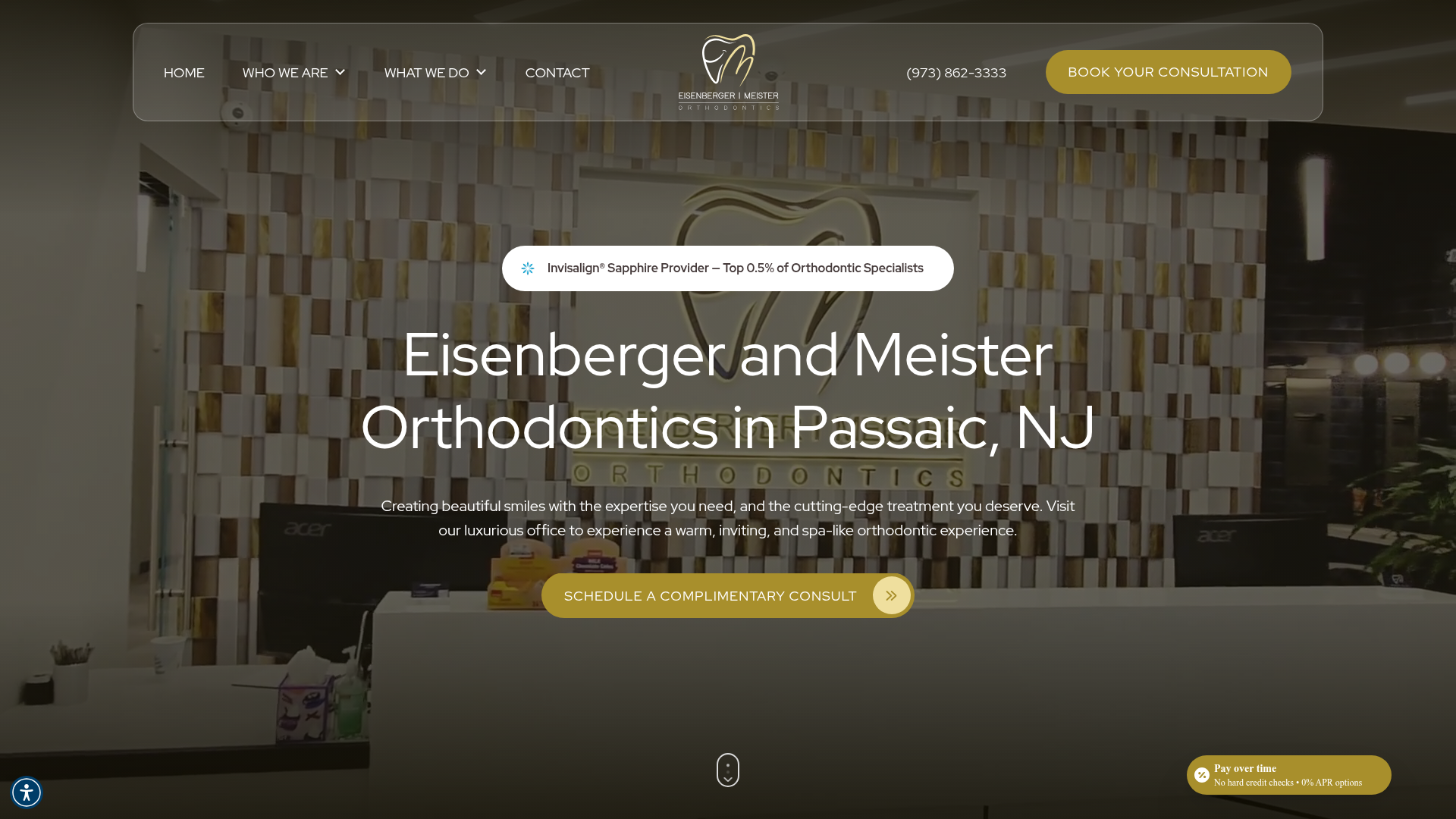
Eisenberger and Meister Orthodontics sees children, teens, and adults in Passaic. Alongside Invisalign in Passaic, the practice offers metal braces, clear braces, custom LightForce ceramic braces, and other orthodontic care. Treatment is individualized, and the office has a warm, spa-like setting. According to the practice, its team has a combined 38 years in practice, has treated more than 15,000 smiles, and holds Invisalign Sapphire Provider status, which it describes as the top 0.5% of orthodontic specialists.
The practice offers Dental Monitoring and schedules appointments with waiting time in mind. Its Invisalign page describes routine office check-ins about every 6 to 8 weeks and a typical treatment range of $4,000 to $8,500, depending on complexity. Consultations are complimentary, and financing support includes 0% APR options and no hard credit checks. Ask which terms apply to you and get the full fee in writing. For someone based in Newark, the drawback is the recurring trip to Passaic.
Choosing your next step
The right provider can explain your bite and how treatment will be supervised, give you a full written cost, and offer appointments you can reach. If Passaic fits your routine, book a complimentary consultation at Eisenberger and Meister Orthodontics to discuss Invisalign and other options before committing.
FAQ
How much does 12 months of Invisalign cost?
Duration alone does not set the fee. Eisenberger and Meister Orthodontics lists $4,000 to $8,500 for Invisalign treatment in Passaic, depending on complexity; ask for a written total that explains refinements, replacements, retainers, and payment terms.
What are the disadvantages of Invisalign?
Aligners depend on consistent wear, must be removed and stored for meals, and may require attachments or refinements. Some bite problems may be better suited to braces or a different plan, which your clinician can explain at a consultation.
Can a 50-year-old get Invisalign?
Age alone does not decide eligibility. A clinician needs to assess your teeth, gums, bite, and any existing dental work before recommending aligners or another treatment.