
Invisalign Mandibular Advancement NJ offers growing teens a possible way to straighten teeth and address a Class II bite without headgear. Whether the precision wings fit your teen depends on jaw position, growth, tooth eruption, and consistent aligner wear.
At Eisenberger and Meister Orthodontics in Passaic, an evaluation helps families compare treatment options for their child’s bite.
What Invisalign mandibular advancement actually does
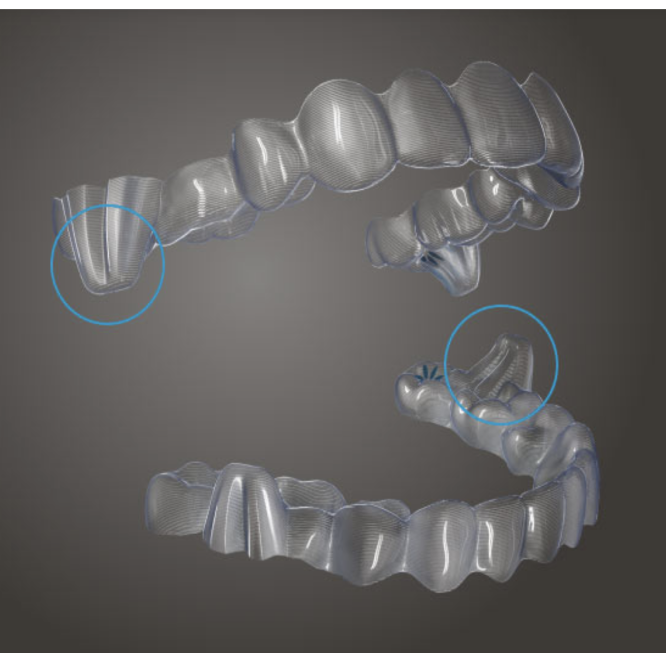
Regular Invisalign aligners move teeth. Invisalign with mandibular advancement (MA) adds precision wings to upper and lower aligners. When the teen bites down, the wings engage and posture the lower jaw forward while teeth move. MA is designed for growing patients with a retrognathic Class II bite, where the lower jaw sits farther back relative to the upper jaw.
Parents may call upper teeth that project forward an overbite, but orthodontists distinguish:
|
Term |
What you can see |
Why it matters |
|---|---|---|
|
Overjet |
Upper front teeth project forward horizontally |
A recessed lower jaw can contribute to a large overjet. |
|
Overbite |
Upper front teeth cover lower front teeth vertically |
A deep bite may affect treatment planning. |
A teen can have both. A large overjet alone does not mean the lower jaw needs advancing. The balance of tooth movement and skeletal change varies; no aligner guarantees extra jaw growth.
Is your teen a candidate for precision wings?
A growing preteen or teen with a recessed lower jaw and Class II bite may qualify. Invisalign’s guidance specifies permanent teeth or stable late mixed dentition; some baby teeth can remain if eruption allows the wings to fit. Age alone cannot establish the growth window.
“Treatment before puberty produced primarily dentoalveolar effects, while treatment during the pubertal growth spurt produced skeletal effects.” – European Journal of Paediatric Dentistry
The study of 40 growing patients underscores why growth stage matters more than a fixed age cutoff.
A consultation makes sense if upper teeth project forward, front teeth have trouble meeting, or the chin looks set back. These are reasons for an exam, not a diagnosis at home.
The orthodontist will also weigh:
-
Growth and eruption: Timing may favor observation, a first phase, or another approach.
-
Bite shape: A deep bite or certain tooth positions may need preliminary movement before the wings engage.
-
Wear habits: If a teen often leaves trays out, fixed hardware may work better.
-
Other needs: Crowding, jaw asymmetry, and the size of the discrepancy affect the plan.
Invisalign for teens can straighten teeth without wings. Ask whether your teen’s plan includes MA and why.
Can it replace headgear or a Herbst appliance?
For a suitable growing patient, MA is a headgear-free Herbst appliance alternative. Fixed hardware stays in place; removable aligners make meals and brushing simpler but require consistent wear.
|
Option |
How it approaches the bite |
Practical trade-off |
|---|---|---|
|
Invisalign with mandibular advancement |
Wings posture the jaw forward while aligners move teeth |
Discreet and removable; needs consistent wear and suitable growth. |
|
Herbst or another fixed functional appliance |
Holds the lower jaw forward |
Less dependent on cooperation; stays in during meals. |
|
Braces with bite-correction mechanics |
Align teeth using case-specific mechanics |
Fixed tooth control; braces alone do not resolve every jaw discrepancy. |
|
Standard clear aligners |
Move teeth without wings |
May suit a primarily dental discrepancy, not the same as MA. |
Headgear remains an option, but a Class II diagnosis alone does not make it necessary.
Invisalign Mandibular Advancement NJ: your Passaic evaluation
The evaluation establishes what causes the bite and whether MA fits your teen’s growth stage.
The orthodontist reviews wear habits, overjet, overbite, jaw relationship, crowding, and tooth eruption. Photos, a digital scan, and imaging when appropriate inform whether to treat now, observe, or choose another appliance.
How the orthodontist customizes the Invisalign treatment plan
Personalized care means planning for both tooth position and jaw relationship. Forward-tipped upper teeth and a recessed lower jaw need different approaches; sometimes both contribute. The team considers whether aligners offer enough control or fixed mechanics suit the case better.
Some bites need preliminary tooth movement before the wings can engage. Finishing aligners may help teeth fit together; retainers follow treatment. A digital setup shows planned movements, not a guaranteed final jaw position.
Eisenberger and Meister Orthodontics offers complimentary consultations in Passaic. Its orthodontists are Invisalign Sapphire Providers in the top 0.5% of specialists; the practice reports a combined 38 years of experience and 15,000+ smiles. Ask about Dental Monitoring, 0% APR financing with no hard credit checks, and a written plan for your teen.
What daily treatment looks like
Remove aligners for meals and cleaning, then replace them as prescribed. Brushing is simpler without fixed hardware, but daily oral care still matters. Some adjustment to the wings is expected; call the team for persistent pain, a tray that will not seat, or wings that do not meet properly.
At follow-ups, the orthodontist checks fit and bite as teeth move. The sequence may include setup, advancement, finishing, and retention; not every teen needs every phase. Ask how often trays change and visits occur rather than assuming a two-week or six-week schedule.
If your teen’s lower jaw looks recessed or upper teeth project forward, a Passaic consultation can clarify whether MA, a fixed appliance, or another teen orthodontics option fits. The right choice depends on the bite, growth, and wear habits, not appearance alone.
|
County |
Nearby and wider-area communities |
|---|---|
|
Passaic County |
Passaic, Clifton, Paterson, Wayne, Little Falls, Woodland Park, Totowa, Haledon, North Haledon, Hawthorne, Prospect Park, Pompton Lakes, Bloomingdale, Wanaque, Ringwood, West Milford |
|
Bergen County |
Garfield, Lodi, Wallington, East Rutherford, Rutherford, Carlstadt, Hasbrouck Heights, Wood-Ridge, Moonachie, Teterboro, Saddle Brook, Elmwood Park, Fair Lawn, Paramus, Hackensack, Maywood, Rochelle Park, South Hackensack, Teaneck, Bergenfield, Ridgewood, Glen Rock, Wyckoff, Franklin Lakes |
|
Essex County |
Nutley, Belleville, Bloomfield, Montclair, Glen Ridge, Cedar Grove, Verona, West Orange, East Orange, Newark, North Caldwell, Caldwell, Roseland, Fairfield |
|
Hudson County |
Secaucus, Kearny, Harrison, North Bergen, Union City, Weehawken, Hoboken, Jersey City, Bayonne |
|
Morris County |
Lincoln Park, Pequannock Township, Riverdale, Montville, Boonton, Parsippany-Troy Hills, Denville, Morristown |
|
Union County |
Elizabeth, Hillside, Union, Springfield, Cranford, Roselle Park |
For a teen in Clifton or farther across North Jersey, the bite pattern and growth stage matter more than the distance to Passaic.
A sensible next step for your teen
If the lower jaw looks recessed or the upper teeth project forward, schedule an evaluation while your child is still growing. Invisalign MA offers a discreet, headgear-free option for a suitable Class II bite. A fixed appliance or another plan may work better when the bite or aligner habits call for it. At a complimentary consultation in Passaic, Eisenberger and Meister Orthodontics can explain your teen’s bite, the options, and the expected treatment sequence.
FAQ
Can Invisalign fix a minor overbite?
Invisalign may correct a minor vertical overbite by moving teeth, depending on the bite and treatment plan. Mandibular advancement is a separate feature intended for certain growing patients with a recessed lower jaw and a Class II bite; a small overbite alone does not mean a teen needs precision wings. An orthodontic exam distinguishes vertical overbite from horizontal overjet and identifies which approach fits.