
For missing lateral incisors, braces in NJ can close the gaps or create room for replacement teeth. Your orthodontist will look at the bite, the shape of the canine teeth, and whether you or your child is still growing. Your preferences about future dental work matter too. A peg-shaped lateral incisor calls for a different plan because the tooth is there, though small.
The goal for North Jersey patients is a smile that looks good and a bite that works when treatment ends.
What is a missing or peg-shaped lateral incisor?
Upper lateral incisors sit between the two large front teeth and the pointed canines. A congenitally missing lateral incisor never developed; one or both may be absent. A baby tooth may remain in its place, or the canine may drift forward. An exam and dental imaging show whether the permanent tooth is missing or has yet to erupt.
A peg lateral is a permanent lateral incisor with an unusually small, tapered crown. It can leave uneven gaps or make the smile look lopsided. The tooth may stay, with orthodontics making the right amount of room for bonding or another restoration. Its position and the space around it determine which approach is practical.
Missing lateral incisors: braces in NJ to close or open the space?
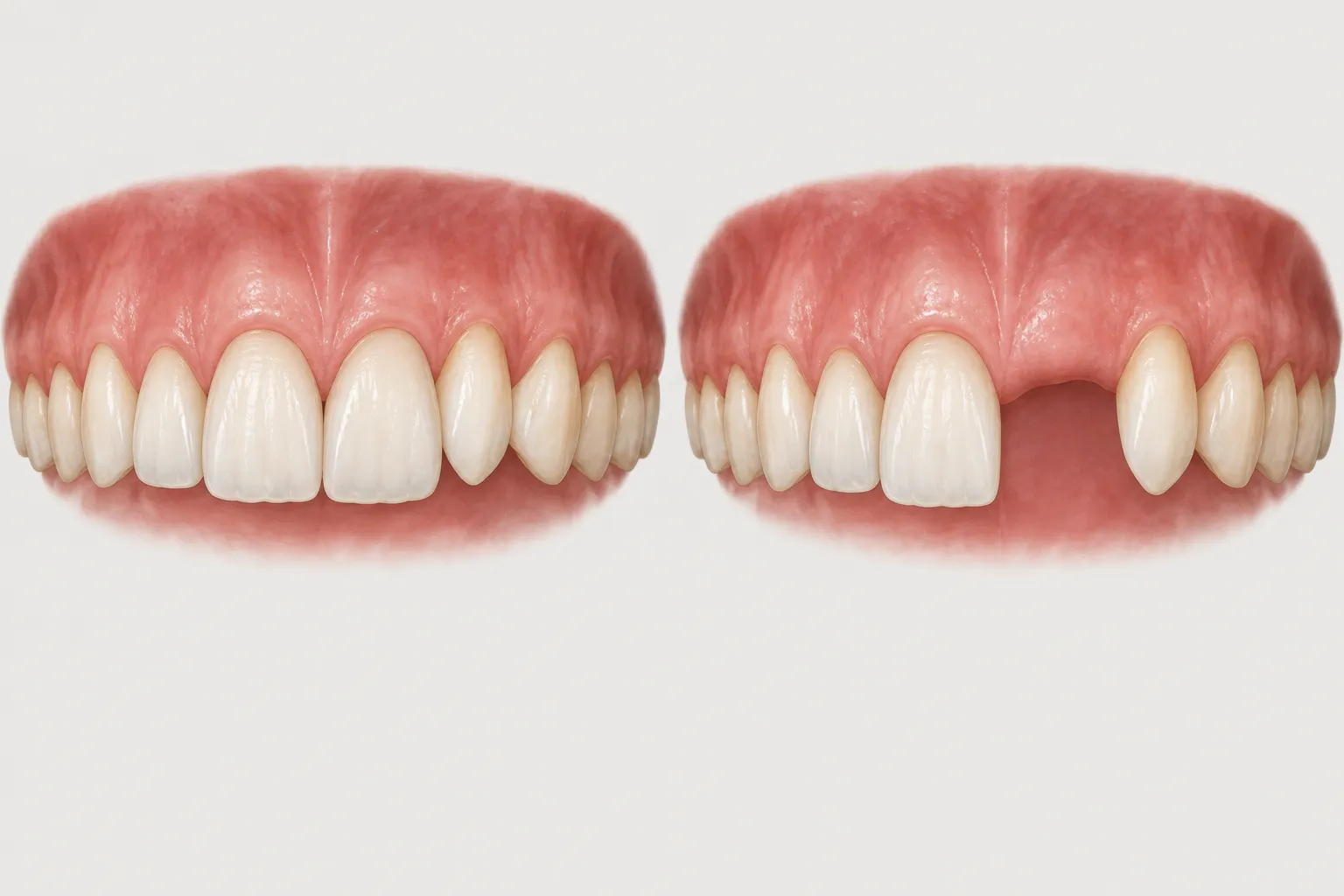
Braces or clear aligners move the teeth beside the gap. The canine can move forward to take the missing tooth’s place, or stay farther back while the orthodontist creates room for a replacement. If the left and right sides differ, they may need different plans.
|
Question |
Close the space |
Open and maintain the space |
|---|---|---|
|
What happens? |
The canine moves into the missing incisor’s place; the first premolar moves toward the canine position. |
Neighboring teeth and their roots are positioned to allow a replacement tooth. |
|
What completes the smile? |
The canine may be reshaped or restored to resemble a lateral incisor. |
A temporary tooth may fill the gap until a bridge or implant-supported crown is appropriate. |
|
How does growth matter? |
No implant waiting period is required for the missing-tooth site. |
A growing patient may need a temporary solution until implant placement is appropriate. |
|
What needs follow-up? |
Retainers and any reshaping or restoration need upkeep. |
Retainers preserve the planned space; temporary and permanent restorations need ongoing care. |
|
Main constraint |
The canine’s shape, color, gum line, and the bite must work with substitution. |
There must be suitable space between crowns and roots, plus a coordinated restorative plan. |
Closing space with canine substitution
With space closure, the canine moves into the absent lateral incisor’s place. The first premolar moves into the canine region. A dentist may soften the canine’s point or add tooth-colored material to change its appearance. The orthodontist also plans how the upper and lower teeth will meet.
Crowding can make space closure worth considering. The canine also has to look right beside the front tooth after reshaping. If it is prominent or noticeably darker, or the bite would be compromised, closing the gap may be less appealing. Any reshaping or added material may need care later.
“In a matched study of 44 patients assessed at least five years after treatment, overall aesthetic satisfaction did not differ significantly between implant and space-closure groups.” – European Journal of Orthodontics study
Opening space for a future tooth
Space opening keeps the canine in its usual region. Your orthodontist must arrange the roots as well as the visible gap, and coordinate with the dentist who will provide the final tooth. They can then plan its width, the gum line, and the type of replacement together.
A teen who is still growing may wear a retainer that holds a temporary tooth or use another provisional restoration. Later, a bridge may suit some patients. An implant-supported crown is another option once the implant team considers growth and the site suitable. Families need to know how the space will look and stay open while they wait.
Why age changes the implant timeline
An implant stays fixed in bone while the nearby teeth and jaws can continue to change during growth. If the implant goes in too early, its crown may end up out of line with neighboring teeth. The dental team assesses growth and the implant site rather than relying on a birthday.
|
Stage |
Practical decision |
|---|---|
|
Child with baby teeth or erupting permanent teeth |
Confirm which permanent teeth are present, assess the bite, and preserve reasonable future options. |
|
Teen in active orthodontic care |
Decide whether to close or prepare the space; plan appearance and retention if a replacement must wait. |
|
Patient whose growth is complete |
Reassess space, bone, gums, and the final restorative choice with the appropriate dental clinicians. |
|
Adult with a longstanding gap or shifted teeth |
Assess whether orthodontics should reposition teeth before a restoration or close the residual space instead. |
You can discuss orthodontics well before implant placement is possible. If neighboring teeth drift into the planned space, the orthodontist may have to move both their crowns and roots. Retainers help hold the space after orthodontics. In a study of 94 patients with opened lateral-incisor spaces, 11% had enough root re-approximation during retention to prevent implant placement. The figure concerns patients waiting for implants after space opening; it is not a space-closure failure rate.
What if the baby lateral incisor is still there?
A baby tooth can remain even though no permanent lateral incisor formed beneath it. If it stays stable, the dental team may keep it for a time while monitoring its roots, gum support, and place in the bite. It may not last indefinitely. Removing it before making a plan can affect both space and appearance. If the baby tooth can no longer stay, the choice between space closure and replacement remains.
Where peg laterals fit in the plan
For a peg lateral, the tooth is present; its position and finished shape guide the plan. An orthodontist can arrange the spacing and bite before a dentist adds composite bonding or chooses another restoration. If one lateral is missing and the other is peg-shaped, each side may need a different treatment to bring the proportions into balance.
The orthodontist and dentist should agree on the finished tooth’s width and how its edge will meet the lower teeth. Bonding alone cannot correct the bite; orthodontics without a finished tooth shape in mind may leave the dentist too much or too little room.
How an orthodontist chooses a plan
An orthodontic evaluation brings the treatment choices down to a few questions:
-
Imaging shows whether the lateral incisor is absent, has yet to erupt, or is simply small. It also shows the neighboring roots.
-
The bite and available space matter: crowding, midlines, canine position, and how the upper and lower teeth meet all affect the options.
-
For space closure, the orthodontist considers canine color, shape, and gum height. For replacement, the team plans tooth proportions and gum contours.
-
Growth and family preferences count. You might prefer to avoid a future implant or keep the canines in their usual positions. Either choice needs maintenance.
-
If treatment involves a temporary tooth, bridge, bonding, or implant, the orthodontist and restorative dentist agree on tooth positions before active movement ends.
Ask how each option will affect the bite and appearance during treatment. Find out who will provide a temporary tooth if one is needed, and what follow-up the chosen route involves. The movements needed, particularly control of the adjacent roots, help determine whether braces, clear braces, or aligners make sense.
Orthodontic care near Passaic, NJ
Eisenberger and Meister Orthodontics in Passaic sees children, teens, and adults with missing or peg-shaped lateral incisors. At the first visit, North Jersey families can talk through both routes and ask what will happen between orthodontics and any final restoration.
Families searching within roughly 20 miles of Passaic, and those farther out, may find the office convenient. The towns below are grouped by county. Some addresses are beyond a 20-mile drive:
|
County |
Nearby towns and cities |
|---|---|
|
Passaic |
Passaic, Clifton, Paterson, Haledon, North Haledon, Prospect Park, Hawthorne, Woodland Park, Little Falls, Totowa, Wayne, Pompton Lakes, Wanaque, Ringwood, West Milford |
|
Bergen |
Garfield, Wallington, Lodi, Saddle Brook, Elmwood Park, Fair Lawn, Rutherford, East Rutherford, Carlstadt, Hasbrouck Heights, Wood-Ridge, Hackensack, Maywood, Paramus, Ridgewood, Glen Rock, Wyckoff, Teaneck, Fort Lee, Englewood, Bergenfield, Mahwah |
|
Essex |
Montclair, Upper Montclair, Bloomfield, Nutley, Belleville, Glen Ridge, Cedar Grove, Verona, West Orange, East Orange, Newark, Livingston, Maplewood, South Orange, Millburn |
|
Hudson |
Secaucus, Kearny, Harrison, North Bergen, Union City, West New York, Weehawken, Hoboken, Jersey City, Bayonne |
|
Morris |
Lincoln Park, Pequannock, Riverdale, Montville, Boonton, Parsippany, Denville, Mountain Lakes, Morristown |
|
Union |
Union, Hillside, Elizabeth, Roselle Park, Kenilworth, Springfield, Summit |
Choose a plan for the bite and the years ahead
For a missing lateral incisor, braces can close the space if canine substitution suits the bite and smile. They can also prepare room for a future tooth. A peg lateral may instead need alignment and a planned restoration. Growth and the care needed afterward should shape the decision from the start.
Eisenberger and Meister Orthodontics offers personalized care in Passaic for North Jersey families weighing these options. Schedule a complimentary consultation to discuss the right route for your child or for you.