
If your front teeth stay apart when you bite down, you may have an anterior open bite. If you are seeking open bite treatment in Passaic, NJ, you may wonder whether you can close the gap without jaw surgery. Orthodontic treatment helps many patients, though the plan depends on tooth position, jaw growth and any habit that continues to push the teeth apart.
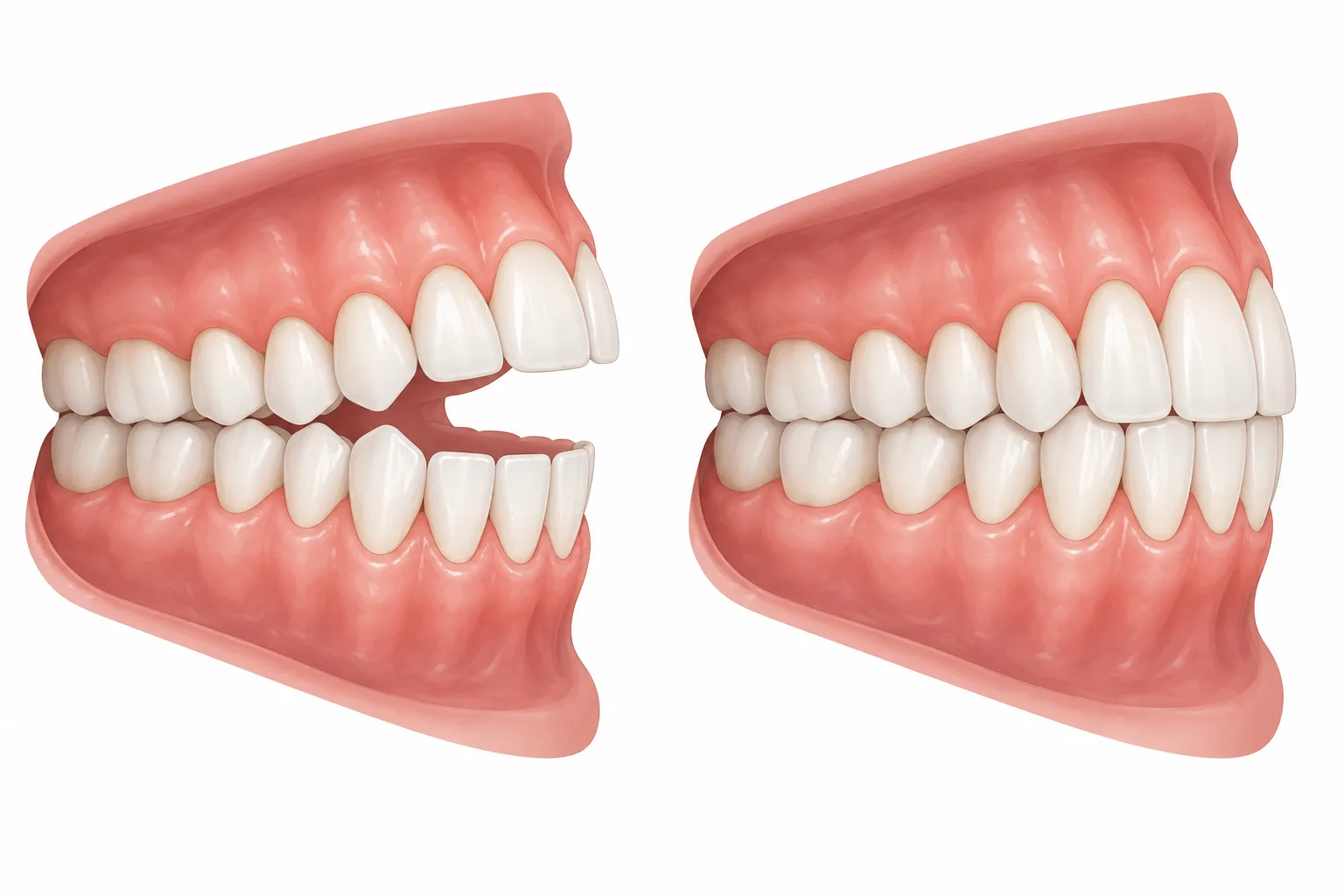
An open bite describes upper and lower teeth that do not touch when the back teeth are together. That differs from a space between neighboring teeth. Your orthodontist can assess the cause and explain which changes your bite can support.
Open bite treatment in Passaic, NJ: causes, options and consultation
What does an open bite feel like?
With an anterior open bite, the front teeth do not overlap or meet when the jaws close. Biting into a sandwich can be awkward; speech may change, too. A posterior open bite involves back teeth that do not meet and calls for a different assessment. The front gap’s size alone cannot tell you which treatment will work.
Why do front teeth stay apart?
Your orthodontist may find one or several contributing factors:
-
Thumb or finger sucking can put prolonged pressure on developing teeth. A child may need help stopping the habit as well as treatment to align the teeth.
-
The tongue may press between the front teeth during swallowing or at rest. Your orthodontist can assess whether additional support for tongue posture or function would help during and after treatment.
-
Tooth eruption and jaw growth affect how the upper and lower teeth meet. Some open bites involve mainly tooth position; in others, jaw structure plays a larger part.
-
A history of cleft palate can affect upper-jaw and tooth development. Coordinated care may be more appropriate than a standard aligner plan.
-
Habits and jaw patterns can occur together. Even after a child stops sucking a thumb, an established opening may need treatment.
The American Association of Orthodontists explains that prolonged sucking can push teeth forward and contribute to an open bite.
A selfie or a measurement of the front gap cannot show its cause. A child whose jaws are growing and an adult with the same-looking opening may need different plans.
What happens at a consultation in Passaic, NJ?
At Eisenberger and Meister Orthodontics, tell the team what bothers you about the bite, whether you struggle to bite food, dislike the gap or have noticed a change. Mention when it began, any thumb-sucking or tongue-thrust pattern, and past orthodontic care.
The orthodontist checks how your back teeth fit and evaluates the bite and growth pattern. Records can help plan tooth movement. Before choosing an appliance, discuss these points:
-
Ask whether tooth position, jaw relationships or an ongoing habit is causing the opening.
-
Discuss the goal for both front-tooth contact and how the bite will function once treatment ends.
-
Find out what the plan asks of you: wearing aligners, caring for braces, attending visits and using retainers. Habit support may also be needed.
The practice offers complimentary consultations for children, teens and adults. At that visit, you can discuss treatment choices, the proposed cost and payment options. Financing includes 0% APR options with no hard credit checks.
Can an open bite close without jaw surgery?
Often, yes. Controlled tooth movement may bring the teeth together properly. A severe jaw mismatch may require a discussion with an oral surgeon about jaw surgery and non-surgical goals. Orthodontics moves teeth in adults, but it cannot reposition a fully grown jaw the way surgery can. Your orthodontist should explain what a non-surgical plan could achieve for your bite.
|
Approach |
When it may be considered |
What the patient should know |
|---|---|---|
|
Clear aligners, including Invisalign |
A suitable bite that can be corrected with planned tooth movement |
Wear and tracking matter; some movements may require attachments or a change in plan. |
|
Braces, including clear or custom options |
Cases where fixed appliances offer useful control or the patient prefers not to manage removable trays |
Brackets stay on the teeth; oral hygiene and adjustment visits remain important. |
|
Growth guidance or an appliance for a child |
A developing bite where growth and habits affect the plan |
Timing depends on dental development; an early assessment does not always mean immediate treatment. |
|
Habit or functional support |
Thumb sucking or tongue positioning may be contributing to the opening |
This supports stability but does not automatically replace tooth movement. |
|
Jaw surgery with orthodontics |
A substantial skeletal discrepancy that tooth movement alone cannot adequately address |
This is a separate decision made after a full evaluation, not the default for every visible gap. |
In a difficult skeletal case, the orthodontist may coordinate with oral surgeons and explain what surgery could change compared with tooth movement alone. Eisenberger and Meister Orthodontics also offers clear braces and custom LightForce ceramic braces. Bite mechanics, rather than appearance alone, determine which appliance fits the plan.
Can Invisalign treat an anterior open bite?
For some patients with an anterior open bite, Invisalign can move the teeth toward better contact. Your orthodontist will consider the movements needed and whether you can wear the trays as directed. Eisenberger and Meister Orthodontics offers both Invisalign and braces, so the conversation can start with your bite rather than a preferred appliance.
Do braces help when tongue thrust is involved?
Braces can move teeth affected by a tongue-thrust pattern. If that pattern continues, the team may also recommend support for tongue posture or swallowing. Treating the tooth position and the habit together may help protect the result, though relapse remains possible.
Why treatment time varies
Two similar-looking front gaps can take different amounts of time to treat. Your orthodontist considers the distance the teeth must move, whether the back teeth also need correction, whether growth is ongoing and whether a habit must change. Aligner wear and tooth movement affect progress; with braces, appliance care and adjustment visits matter.
A photograph cannot provide a dependable treatment estimate. After the examination, ask how the team will assess progress, when they might refine the plan and what could extend the timeline. The office offers Dental Monitoring for convenience, while the clinician remains responsible for decisions about your bite.
Keeping the front teeth together afterward
Once the front teeth meet, retainers help hold their new positions. Persistent thumb sucking or tongue pressure can make that harder. Ask about retainer use and any habit support while you discuss the active treatment plan.
North Jersey communities near Passaic
Families come to Passaic from nearby North Jersey towns and communities farther out. This county-by-county list is a geographic guide, not a travel-time estimate.
|
County |
Surrounding towns and communities |
|---|---|
|
Passaic County |
Clifton, Paterson, Woodland Park, Little Falls, Totowa, Wayne, Haledon, North Haledon, Prospect Park, Hawthorne, Pompton Lakes, Bloomingdale, Ringwood, Wanaque, West Milford |
|
Bergen County |
Garfield, Lodi, Wallington, East Rutherford, Rutherford, Carlstadt, Wood-Ridge, Hasbrouck Heights, Hackensack, Saddle Brook, Elmwood Park, Fair Lawn, Maywood, Rochelle Park, Paramus, Glen Rock, Ridgewood |
|
Essex County |
Nutley, Belleville, Bloomfield, Glen Ridge, Montclair, Cedar Grove, Verona, Newark, East Orange, West Orange, Livingston, Millburn |
|
Hudson County |
Secaucus, Kearny, Harrison, North Bergen, Union City, Weehawken, Hoboken, Jersey City |
|
Morris County |
Lincoln Park, Pequannock, Riverdale, Butler, Kinnelon, Montville, Denville |
Take the next step with a plan made for your bite
If your front teeth do not touch, Eisenberger and Meister Orthodontics can assess why and explain whether Invisalign, braces or another approach fits your bite. A complimentary consultation in Passaic gives North Jersey families time to discuss realistic non-surgical goals and financing before making a decision.
Can Invisalign fix an open bite?
Invisalign can treat some open bites by moving teeth toward better contact. Whether it is appropriate depends on the cause and severity of the bite, the movements needed and consistent aligner wear. An orthodontic examination can also show when braces or a different plan would be more suitable.