

When parents consider orthodontic treatment for their children, straight teeth and a confident smile tend to be the focus. What often goes unrecognized is how closely treatment timing connects to something far more fundamental: the way your child breathes. The jaw and nasal passages develop together, and the window to positively influence that development is narrower than most people expect. Waiting too long may mean missing a critical opportunity to guide growth in a direction that supports lifelong health.
At Eisenberger and Meister Orthodontics, we approach airways and orthodontics as an essential component of care for younger patients. Drs. Eisenberger and Meister bring advanced training in orthodontics and dentofacial orthopedics, and our team understands that jaw structure directly influences how your child breathes. Early evaluation allows us to identify concerns before they become more complex and to put a plan in place that works with your child’s natural growth. Families across northern New Jersey trust our approach to early orthodontics to address these concerns before they become harder to correct.
Why Jaw Structure and Airway Health Are Connected
The upper and lower jaws form the physical gateway to the upper airway. When the jaws are narrow or underdeveloped, there is simply less space for air to pass through, which can contribute to mouth breathing, disrupted sleep, and, in some children, obstructive sleep apnea. A child with a narrow palate, a recessed lower jaw, or a posterior crossbite may show signs of breathing restriction long before anyone connects those issues to orthodontics.
The roof of the mouth is also the floor of the nasal cavity. When the upper jaw is too narrow, it can restrict nasal airflow and push a child toward mouth breathing.
Over time, that habit alters how the jaws and face develop, often resulting in a longer face, a narrower upper arch, and crowded teeth. Research published in the European Journal of Dentistry found that certain jaw and bite problems respond significantly better when addressed during active growth phases, underscoring why timing is not simply a matter of convenience. The National Heart, Lung, and Blood Institute also recognizes orthodontic treatment as an intervention for children with sleep-related breathing concerns.
Orthodontic Evaluation by Age 7
The American Association of Orthodontists recommends that children receive their first orthodontic evaluation by age 7. At this point, a child has enough permanent teeth coming in that an experienced orthodontist can assess jaw development and identify patterns that may benefit from early attention. This does not mean every child will begin treatment at age 7, but it does mean concerns can be caught before they become harder to address.
Signs that may point to a structural or breathing concern include:
- Mouth breathing: breathing through the mouth during the day or while sleeping
- Sleep disruption: snoring, restless sleep, or frequent nighttime waking
- Narrow, high-arched palate
- Recessed lower jaw or pronounced overbite
- Difficulty chewing or chewing consistently on one side
Any of these signs is worth discussing with an orthodontist, especially if your child also seems tired during the day, struggles to concentrate, or has been flagged for behavioral concerns at school. For a deeper look at how these issues present specifically in younger patients, our overview of orthodontic care for children with airway concerns covers what parents can expect from an evaluation.
What Early Treatment May Look Like
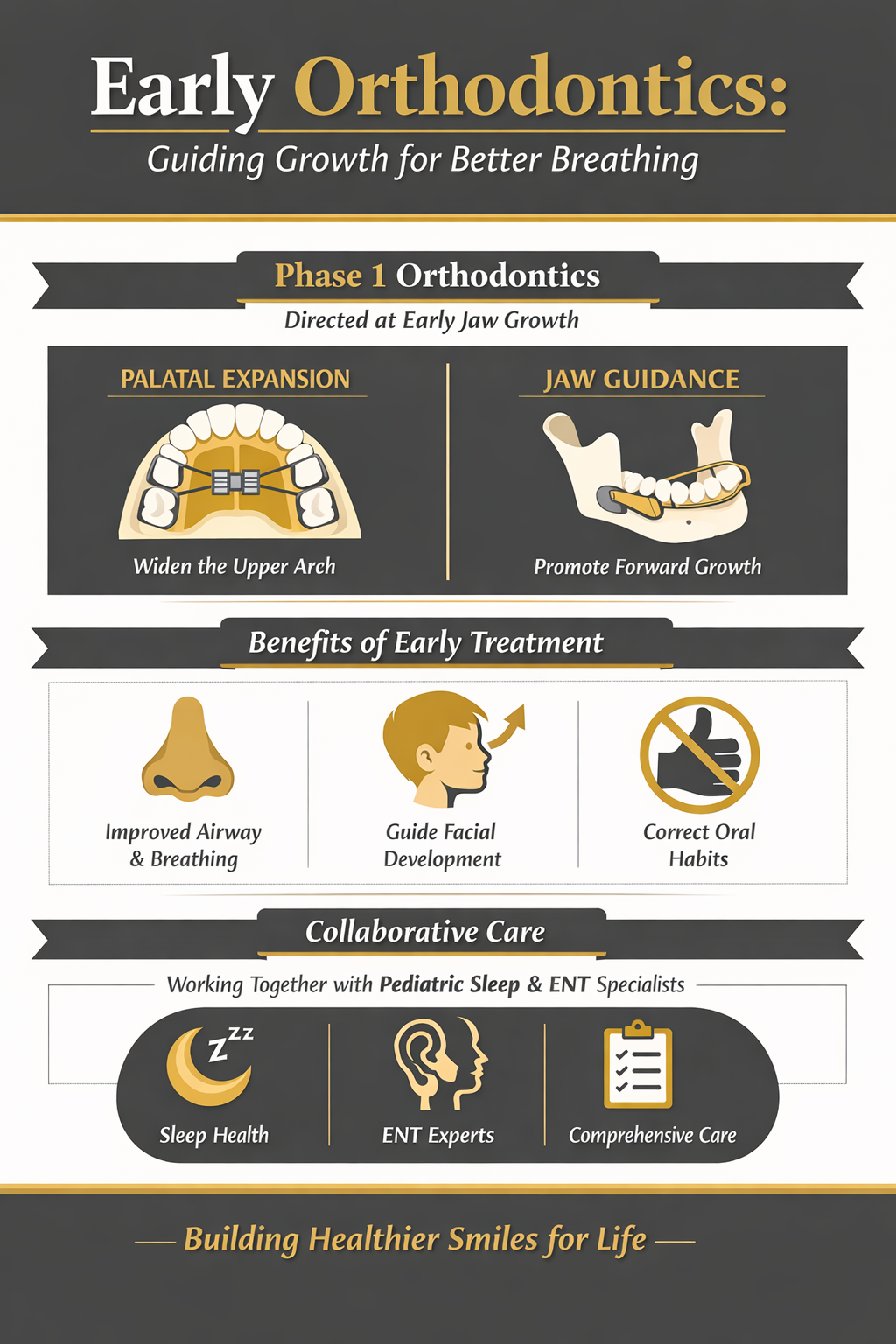
Phase 1, or interceptive orthodontic treatment, focuses on guiding jaw growth rather than moving fully erupted permanent teeth. This may involve palatal expansion to widen a narrow upper arch, which can open the nasal passage and improve breathing. It may also include appliances designed to encourage forward growth of the lower jaw, correct crossbites, or address habits like thumb-sucking that alter the shape of the palate over time.
A key but often overlooked factor is oral rest posture — the natural position of the tongue, lips, and jaw when your child is not speaking or eating. Ideally, the tongue rests gently against the roof of the mouth, the lips remain closed, and breathing occurs through the nose. When a narrow jaw disrupts this posture, the effects can compound over time.
Because the bones of the face are still forming during childhood, they respond to gentle, consistent forces in ways that are not possible once growth has slowed. A jaw guided into a healthier position during development may mean your child avoids more involved teen orthodontics later and, more importantly, may breathe better for the rest of their life. When sleep concerns are significant, we may coordinate with pediatric sleep medicine or ENT providers to make sure your child receives well-rounded care. Once the major growth concerns are addressed, a Phase 2 course of braces or aligners can then fine-tune alignment and bite with greater efficiency.
Schedule a Consultation at Eisenberger & Meister Orthodontics
Drs. Eisenberger and Meister bring internationally recognized training to every patient they see, including advanced research in orthodontics and dentofacial orthopedics completed at NYU College of Dentistry. Our offices serve families across northern New Jersey, and we offer Invisalign and other modern treatment options alongside growth-guidance appliances, so we can tailor care to what works best for your child’s needs and your family’s life.
If you have noticed signs of mouth breathing, disrupted sleep, or jaw concerns in your child, early evaluation can provide answers and a clear path forward. While teen orthodontics remains the right fit for many patients, children showing signs of breathing difficulty often benefit most from earlier care. Reach out to our team through our contact page to schedule a consultation and learn what treatment timing may look like for your child.