
Phase 1 orthodontics can help when a developing bite or tooth-position problem would be harder to treat later. An orthodontist should be able to show you the problem and explain what treatment now would accomplish. Age alone is no reason for a seven-year-old to start braces.
You can have your child evaluated without committing to an appliance or a course of appointments.
What phase 1 orthodontics actually means
Phase 1, also called interceptive treatment, takes place while a child has both baby and permanent teeth. The orthodontist addresses a developing problem at this stage, leaving comprehensive alignment for later if it is needed. Depending on the diagnosis, treatment might involve an expander, a limited set of phase 1 braces or another appliance.
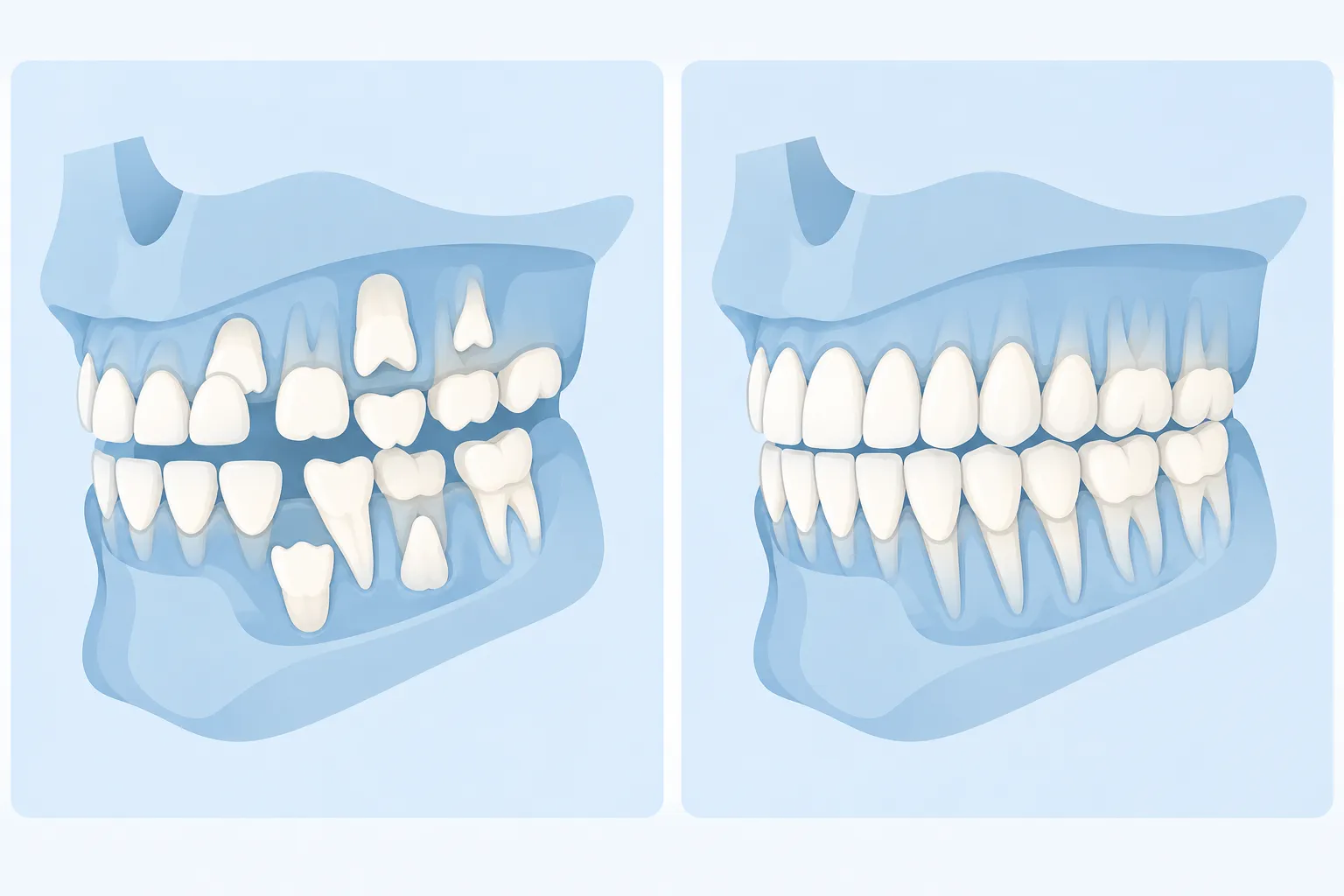
The American Association of Orthodontists (AAO) recommends an orthodontic check-up no later than age 7. That visit can lead to treatment or to observation as the permanent teeth come in.
When early treatment may be worth it
If your child has one of these findings, ask what could happen if you wait:
|
Finding |
Why an orthodontist may recommend acting early |
What to ask about waiting |
|---|---|---|
|
Crossbite, including a bite that shifts the lower jaw to one side |
Correcting the bite during growth may help address an abnormal jaw position or uneven bite function. |
Is there a functional shift, and what could change if we observe it? |
|
Prominent upper front teeth |
In some children, earlier treatment can reduce the chance of injury to exposed incisors. |
How significant is this child’s injury risk? |
|
Severe crowding or an eruption problem |
A specific tooth may have too little room or may be coming in along a problematic path. |
Which tooth is affected, and what evidence supports intervention now? |
|
Jaw growth or bite discrepancy |
The orthodontist may be able to influence a developing relationship while the child is growing. |
What measurable goal would this appliance achieve? |
|
A habit affecting the bite |
If a persistent habit is changing tooth position or the bite, intervention may help address the effect. |
Would habit management and observation be enough? |
None of these findings settles the question on its own. Mild crowding in the front teeth, for instance, does not show that two rounds of treatment will produce a better result.
For prominent upper front teeth, a Cochrane review found fewer new incisor injuries with early two-phase treatment than with one course in adolescence. It found no other advantage to two-phase treatment for that problem. Ask which benefit your child’s plan aims to achieve.
“In a comparison of functional appliances, new trauma occurred in 19% of children treated early and 30% of those treated later.” – Cochrane
When waiting may be reasonable
An orthodontist may recommend observation for mild alignment concerns when there is no functional bite problem, immediate risk to a tooth or time-sensitive growth issue. During observation, the orthodontist follows how permanent teeth erupt and reassesses the bite.
Ask what would trigger treatment later. Your orthodontist should identify the tooth or bite relationship to watch, what development to expect and when to reassess it. Your child may have an age-7 check-up and wait for treatment.
If the orthodontist proposes early treatment, ask what would happen if you defer it. Then weigh the expected benefit against the time, upkeep and cost of two stages.
Phase 1 and phase 2: what parents need to know
|
Phase 1 |
Phase 2 |
|
|---|---|---|
|
When |
While baby and permanent teeth are both present |
After more permanent teeth have erupted |
|
Main job |
Address a specific developing bite, space or eruption problem |
Align the permanent teeth and finish the bite |
|
Possible tools |
An expander, limited braces or another targeted appliance |
Full braces or another comprehensive orthodontic option, if needed |
|
End point |
A defined early-treatment goal, followed by observation |
A finished bite and retention plan |
Some children need phase 2 even after phase 1. Others wait through the mixed-dentition years because nothing calls for early intervention. If a first phase is proposed, ask what it would change for your child.
What timing and treatment usually involve
An orthodontist first evaluates the teeth, bite and growth, often around age 7. For children who need phase 1, treatment begins before all the permanent teeth come in. Starting age, appliance and duration vary with the problem; an orthodontist can give you an estimate for your child’s plan.
After the active early stage, the orthodontist may monitor the child while the remaining permanent teeth erupt. Phase 2, if needed, comes later. Ask what monitoring the plan includes and what findings would prompt a second phase.
Do phase 1 braces mean a full mouth of braces? No. Limited braces may target a few teeth; a palatal expander or another appliance may suit a jaw or bite issue. Ask how the recommended appliance addresses your child’s diagnosis.
Cost and commitment: questions to settle before starting
The price of phase 1 orthodontics depends on the appliance and scope of care. A later phase may have its own fee. Before agreeing to treatment, ask for a written breakdown:
-
What is the specific diagnosis, and what is the goal of this phase?
-
What appliance is proposed, and how long is active treatment expected to last for my child?
-
What does the fee include, including visits, appliance repairs and the observation period?
-
If phase 2 is needed, is it priced separately, and how is that decision made?
-
What would you monitor if we choose to wait?
Eisenberger and Meister Orthodontics lists financing options through Cherry and HFD for early orthodontic care. Ask how any payment plan applies to the proposed phase, and whether a later phase would require a new agreement.
Even if you are ready to start, get clear on what the first phase will address and what it cannot promise.
Making the decision near Passaic
Eisenberger and Meister Orthodontics offers early orthodontics in Passaic, New Jersey, and a complimentary consultation. Families across North Jersey can use that visit to discuss a child’s bite. Ask to see the specific finding and hear how treatment now compares with monitoring.
Communities near Passaic and across the broader North Jersey area include:
-
Passaic County: Passaic, Clifton, Paterson, Woodland Park, Little Falls, Totowa, Haledon, North Haledon, Prospect Park, Hawthorne, Wayne, Pompton Lakes, Wanaque, Ringwood, West Milford and Bloomingdale.
-
Bergen County: Garfield, Wallington, East Rutherford, Rutherford, Carlstadt, Wood-Ridge, Hasbrouck Heights, Lodi, South Hackensack, Hackensack, Maywood, Rochelle Park, Saddle Brook, Elmwood Park, Fair Lawn, Glen Rock, Ridgewood, Paramus, Teaneck, Englewood and Fort Lee.
-
Essex County: Nutley, Belleville, Bloomfield, Montclair, Glen Ridge, Cedar Grove, Verona, West Orange, Orange, East Orange, Newark, North Caldwell, Caldwell and Livingston.
-
Hudson County: Secaucus, Kearny, Harrison, North Bergen, Union City, West New York, Weehawken, Hoboken, Jersey City and Bayonne.
-
Morris County: Lincoln Park, Pequannock, Riverdale, Montville, Boonton, Parsippany, Denville, Morristown, East Hanover and Florham Park.
-
Union County: Elizabeth, Hillside, Union, Roselle Park, Kenilworth, Springfield, Summit and New Providence.
Phase 1 is worthwhile when it addresses a clear, time-sensitive problem. If you are weighing a recommendation, schedule a complimentary consultation with Eisenberger and Meister Orthodontics. The aim is a plan for your child, with a reason to start treatment or keep watching.
FAQ
What are the stages of orthodontic treatment?
If early care is needed, phase 1 addresses a specific problem while baby and permanent teeth are present. A period of observation may follow, then phase 2 can finish alignment and the bite once more permanent teeth have erupted. Not every child needs both treatment phases.
Is it okay to get braces too early?
Braces can be appropriate during the mixed-dentition years when they address a defined problem that benefits from early care. Starting treatment solely because a child has turned seven is different: the age-7 recommendation is for a check-up, not automatic braces.
How much do phase 1 orthodontics cost?
There is no universal price because the appliance and scope of care vary. Ask for a written estimate that separates the first phase from any possible later treatment and states what follow-up visits include.