
If you searched for playing-musical-instruments-singing-with-braces-vs-invisalign, the practical question is how each appliance affects lip comfort and rehearsal flexibility. You can perform with either appliance. Brackets may rub the lips; aligners feel smoother and can come out for a concert if you can still meet your prescribed wear time. Your instrument, bite and willingness to manage removable trays should guide the choice for a North Jersey band or choir student.
playing-musical-instruments-singing-with-braces-vs-invisalign: a quick comparison
|
Concern |
Fixed braces |
Invisalign clear aligners |
|---|---|---|
|
Contact with lips |
Brackets can rub the inside of the lips, especially under a mouthpiece |
Smooth trays cover the teeth, although their thickness can change the feel of an embouchure |
|
Rehearsal and performance |
Stay in place, so you adapt to one setup |
Can stay in or come out briefly, but removal uses part of the daily time out of trays |
|
Singing and speech |
Initial soreness or a bracket rubbing the lip may distract from diction |
A new tray can temporarily change how consonants feel |
|
Daily responsibility |
Brush carefully around brackets and wires; protect sore spots with wax |
Keep track of wear time, store trays in a case and clean teeth before putting them back |
|
Best fit |
Students who need fixed treatment or prefer not to manage removable trays |
Eligible students who can maintain wear time and want flexibility for music |
Your orthodontist will need to examine your bite before recommending either treatment. The differences in the table can help you explain what happens during your rehearsals.
What changes when you play a wind instrument?
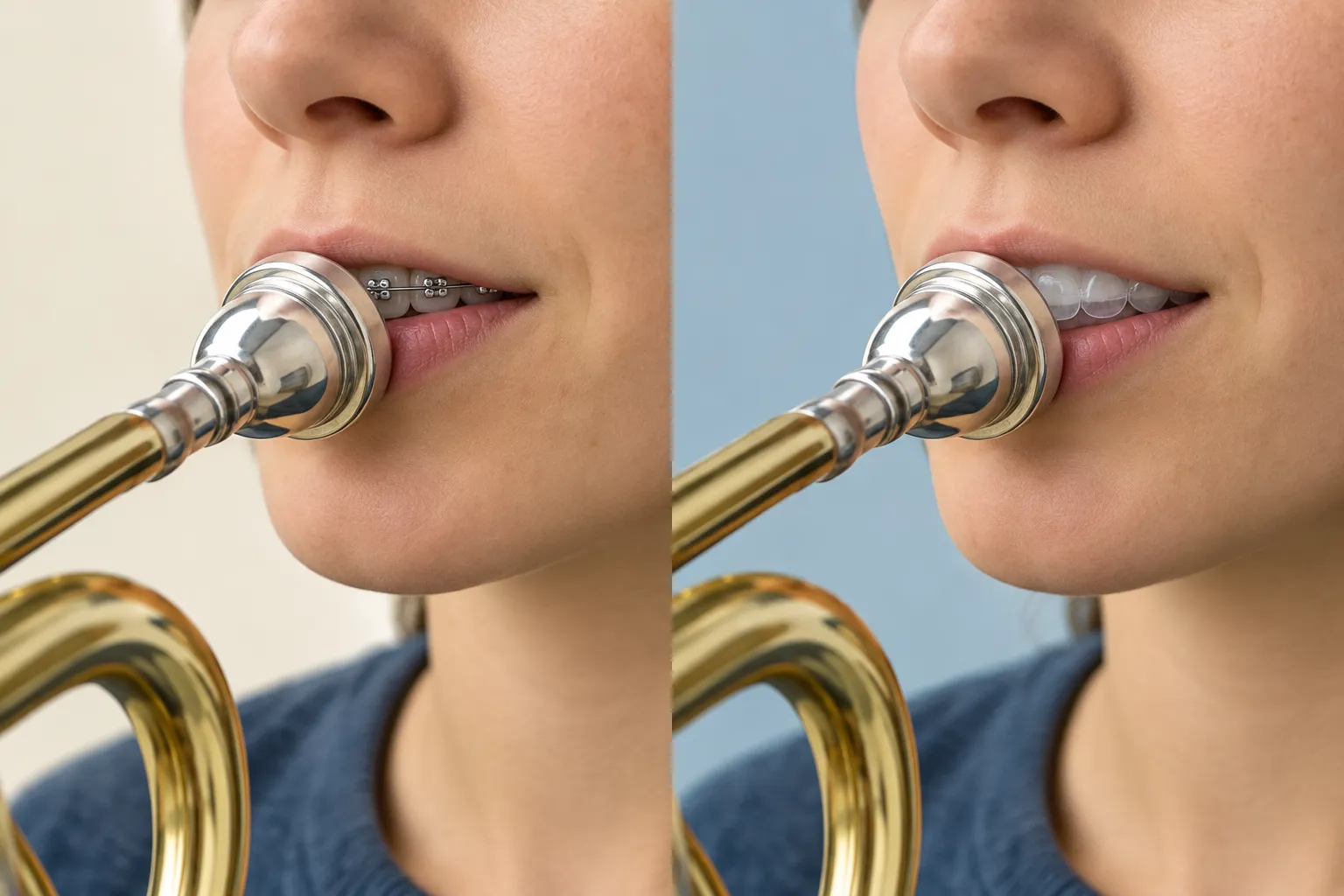
Your embouchure is how your lips and facial muscles meet the mouthpiece or reed. Brackets may make the inner lips tender as they press against your teeth. Aligners cover the teeth with a thin layer instead of exposed bracket edges. At first, either appliance may change how a note, air direction or articulation feels.
Give yourself a series of practices to adjust. Start with short, comfortable warmups and notice where the appliance makes contact. Build up playing time as your mouth allows, then listen for changes in tone, range and endurance. In a student survey about fixed braces, reed players generally adjusted in under a month, while brass players generally took one to three months. Your own adjustment may differ, and a new aligner may also take getting used to. The British Orthodontic Society’s guidance for wind instrumentalists recommends planning treatment around performance needs. Call your orthodontic team if a spot is being cut, an appliance feels loose or pain prevents you from playing.
“In a survey of 78 student wind players, 14% reported no adverse effect from braces.” – Journal of Clinical Orthodontics
Trumpet and trombone: manage mouthpiece pressure
Trumpet and trombone mouthpieces press the lips toward the front teeth. With braces, that pressure can push the inner lip against brackets. Trumpet players may notice it most when working in the upper register; trombone players can also feel it during long rehearsals. Start with easy midrange notes, take breaks before the lip becomes raw and avoid compensating by pressing harder.
For a bracket that rubs, dry the bracket with a tissue and press a small piece of orthodontic wax over it, smoothing the wax so the lip meets a soft surface. Replace it when it falls away or gets dirty. Wax cushions friction; it does not repair a loose bracket or a poking wire. Ask your orthodontist about persistent irritation or an appliance problem.
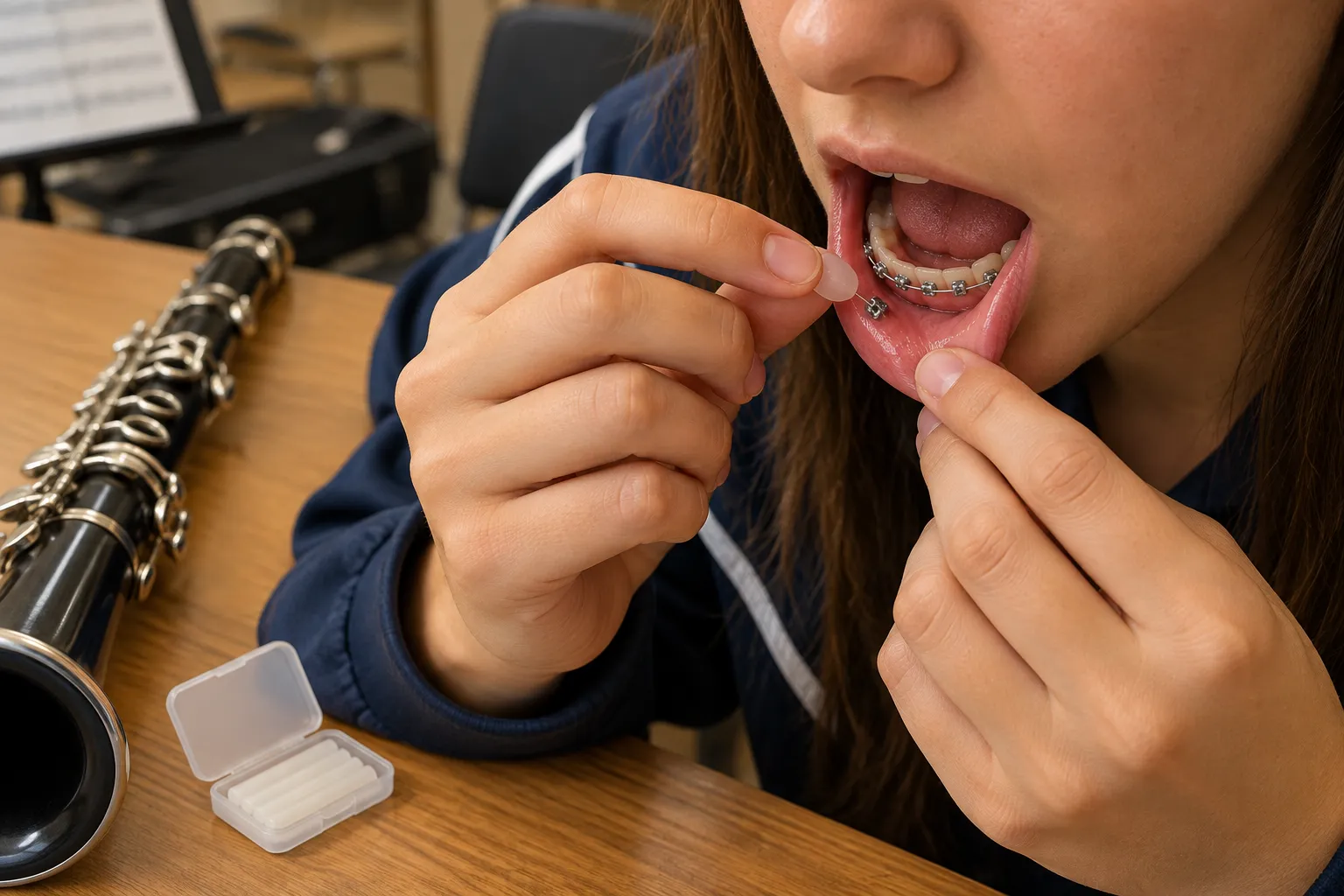
With Invisalign, try practicing with trays seated first so that your everyday embouchure remains consistent. If playing with them in compromises an important performance, talk through a removal plan with your orthodontist before the concert. Keep removed trays in their case, not a napkin or instrument case pocket.
Flute, clarinet and saxophone: note where the lips sit
A flute rests near the lower lip rather than being held between the teeth. Changes to lip position or the air stream may be more noticeable than direct bracket pressure. Begin with sustained notes, then work back into changes of register and articulation.
For clarinet and saxophone, the lower lip cushions the reed against the teeth. A tender lip may find braces uncomfortable where that pressure lands; wax on the irritating bracket can help. Aligners may alter the amount of space the lower lip feels against the teeth. Practice familiar scales and passages before trying to judge your full range or endurance. For oboe or bassoon, discuss any specific embouchure difficulty with your teacher and orthodontist rather than changing your bite to accommodate an appliance.
Can you sing with braces or Invisalign?
Yes. Braces and aligners leave your vocal cords alone, though they may change how your mouth feels as you form words. A new bracket may make a lip tender, and a new aligner may make a consonant feel strange for a while. You can keep attending choir while you adjust.
Read the lyrics aloud and sing at a comfortable volume before a long rehearsal. Listen to your consonants and vowel shape; ease off if your mouth is sore. If you remove aligners for a solo, count the time out and reinsert them after cleaning your teeth. Many singers rehearse with aligners in and prefer to use the same setup onstage.
A band and choir plan that protects treatment
-
Before the first fitting: Tell your orthodontist what you play and when auditions, marching band events or solos fall. If possible, leave room for a few practice sessions between a new appliance or tray and a major performance.
-
Before rehearsal: Warm up gently. Braces wearers can apply wax to a bracket that actually rubs; aligner wearers should seat their trays fully if playing with them in.
-
During practice: Take brief breaks when the lips become sore. Ask a music teacher to listen for changes in tone or articulation rather than pushing mouthpiece pressure to compensate.
-
Afterward: Brush around braces carefully. If you removed aligners, rinse them, clean your teeth and reinsert them; store trays in their case whenever they are out.
Invisalign wear time matters more than a single performance. According to Invisalign’s official FAQ, aligners are typically worn 20 to 22 hours a day, with time out for meals and cleaning as well as any music-related removal. A long band rehearsal without trays every day is different from taking them out briefly for one solo. Work out that schedule with your orthodontist instead of silently reducing wear time.
What to pack for rehearsal
If you have braces, put a little orthodontic wax in your music bag, along with a toothbrush for after snacks. Wax belongs over the bracket that is rubbing, not across every bracket in anticipation of trouble. If a wire has moved or a bracket comes loose, contact the practice rather than trying to reshape the appliance yourself.
If you wear aligners, bring the tray case and supplies to clean your teeth before reinserting them. A case makes it easier to account for the trays between rehearsal and the next class. For a concert, decide ahead of time whether you will play with the trays in. Trying both setups only during the performance makes it harder to tell whether a change in sound comes from the trays or from nerves.
Which option fits a band or choir student?
Invisalign Teen may suit a student who wants to remove trays for an audition or finds bracket contact troublesome on a brass or reed mouthpiece. The tradeoff is keeping up with prescribed wear time and keeping track of trays between class, lunch and rehearsal. Some aligner plans include attachments on the teeth, so taking out the trays may still leave small raised areas.
Braces, including lower-profile bracket options, stay put if a student prefers a fixed appliance or needs one for their bite. A wind player’s lips may feel sore against the brackets at first. Wax and gradual warmups can help during the adjustment. Clear or custom brackets change their appearance and fit, although the lip can still press against them.
At Eisenberger and Meister Orthodontics in Passaic, a complimentary consultation can help you compare Invisalign, braces, clear braces and custom LightForce braces in light of your bite and music schedule. Bring your rehearsal calendar and tell the team which instrument you play. If lip irritation or aligner wear time worries you, say so; those details help shape a plan that works beyond the appointment.
North Jersey communities near Passaic
Students travel to music lessons, rehearsals and orthodontic visits across North Jersey. For families planning a visit to Passaic, here is a broad county-by-county list of nearby communities; this is a geographic reference, not a promise of a fixed travel time or an exact-radius service boundary.
|
County |
Nearby cities, boroughs and townships |
|---|---|
|
Passaic County |
Passaic, Clifton, Paterson, Haledon, North Haledon, Prospect Park, Hawthorne, Totowa, Woodland Park, Little Falls, Wayne, Pompton Lakes, Wanaque, Ringwood, West Milford |
|
Bergen County |
Garfield, Lodi, Elmwood Park, Saddle Brook, Fair Lawn, Maywood, Rochelle Park, Hackensack, Hasbrouck Heights, Wood-Ridge, Carlstadt, East Rutherford, Rutherford, Lyndhurst, North Arlington, Wallington, Teterboro, Paramus, Ridgewood, Glen Rock, Ho-Ho-Kus, Midland Park, Wyckoff, Franklin Lakes, Oakland, Mahwah, Ramsey, Allendale, Waldwick, Oradell, River Edge, New Milford, Teaneck, Englewood, Fort Lee |
|
Essex County |
Nutley, Belleville, Bloomfield, Glen Ridge, Montclair, Cedar Grove, Verona, West Orange, Orange, East Orange, Newark, North Caldwell, Caldwell, Roseland, Livingston, Millburn, Maplewood, South Orange, Fairfield |
|
Hudson County |
Secaucus, Kearny, Harrison, North Bergen, Union City, West New York, Weehawken, Hoboken, Jersey City, Bayonne, Guttenberg |
|
Morris County |
Lincoln Park, Pequannock, Riverdale, Boonton, Montville, Parsippany-Troy Hills, Denville, Mountain Lakes, Morris Plains, Morristown, East Hanover, Hanover, Florham Park, Kinnelon, Butler, Chatham |
|
Union County |
Hillside, Elizabeth, Union, Springfield, Kenilworth, Roselle Park, Roselle, Cranford, Summit, New Providence, Berkeley Heights |
Keep playing while your smile changes
For a student whose treatment needs allow either approach, Invisalign offers the most flexibility for a high-stakes performance, while braces offer the simplicity of a fixed routine. Neither eliminates an adjustment period. If you play trumpet, trombone, flute, clarinet or saxophone, or sing in a North Jersey choir, Eisenberger and Meister Orthodontics can help plan treatment around your instrument and rehearsal calendar at a complimentary consultation.
FAQ
Do braces change the way you sing?
Braces do not change your vocal cords, but new brackets or soreness may temporarily affect how your lips and tongue shape words. Practicing lyrics aloud and easing into singing can help; contact your orthodontist if a bracket is cutting your lip.
What is the hardest instrument to play with braces?
There is no single hardest instrument for everyone. Brass instruments such as trumpet can make bracket pressure against the lips especially noticeable, while clarinet and saxophone players may feel irritation where the lower lip meets the reed. Your embouchure and appliance fit determine how much adjustment you need.
What are you not allowed to do with braces?
Braces do not prohibit band or choir. Avoid pressing a mouthpiece harder to overcome soreness, and do not ignore a loose bracket or a wire that is poking you. Use wax for rubbing and contact your orthodontic team if an appliance is damaged.