
Power chains for braces are connected elastic ties that fit over several brackets and help close gaps. Your orthodontist puts one on, then changes it when needed. You leave it in place between visits. Despite the name, it looks much like the small ties already on your braces, joined in a row. Expect some pressure when it first goes on.
If your orthodontist also gives you rubber bands to hook between your upper and lower teeth, follow those instructions separately. The removable bands help guide your bite. The chain pulls on the teeth under it, and your plan may call for both.
What do power chains for braces do?
An archwire runs through your brackets and guides tooth movement. Small elastic ties hold it in place. A power chain joins those ties in a row. Once your orthodontist stretches the loops across the selected brackets, the elastic’s pull helps bring those teeth together.
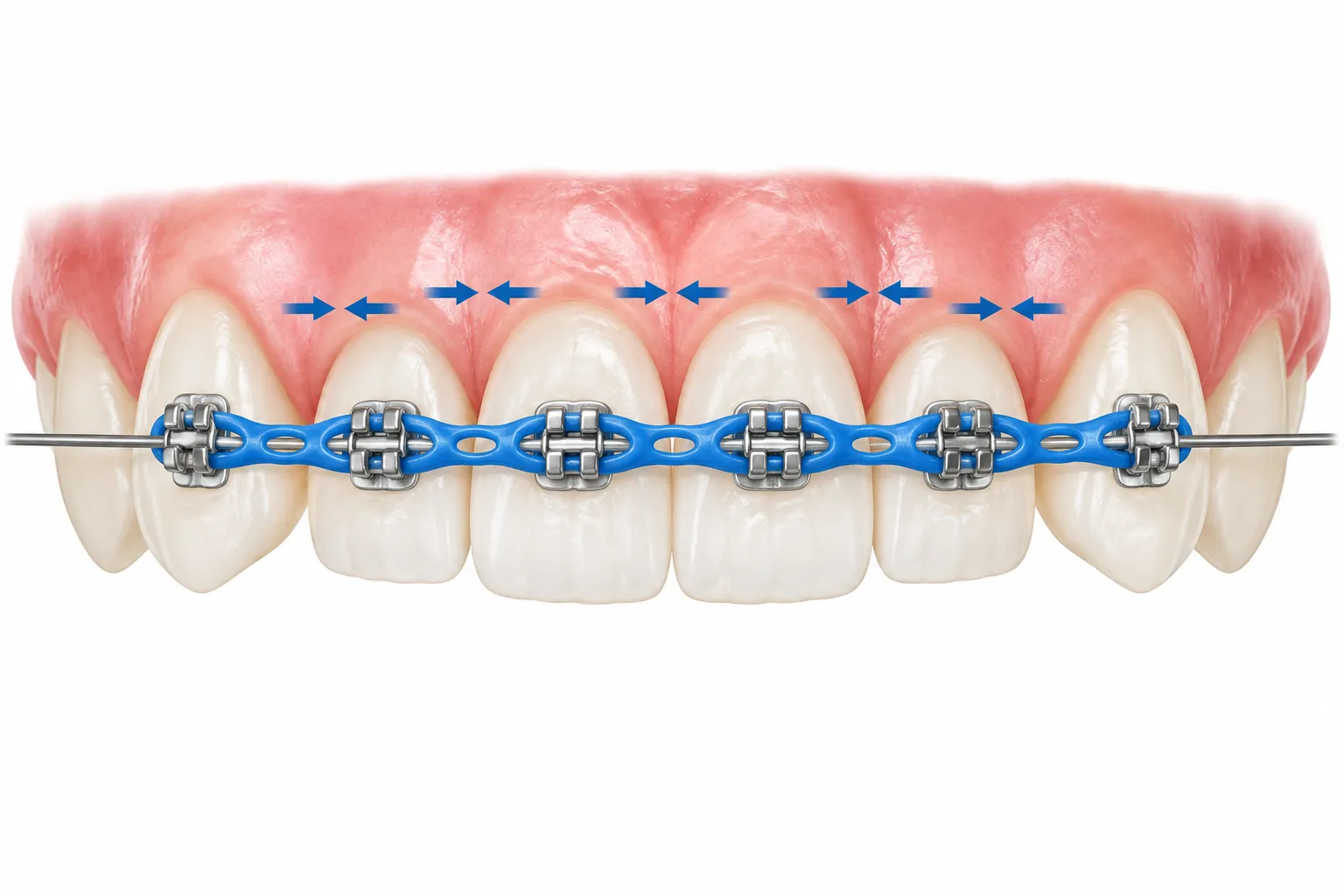
That can help close a natural gap, space left after an extraction, or small spaces that appear as teeth straighten. Depending on the plan, the loops can stretch across several teeth on the upper or lower arch. A chain is not a separate set of braces. It works with the archwire during braces treatment.
Many patients get a chain after their teeth have begun to straighten, though timing varies. Your orthodontist chooses which brackets to connect and changes the chain as it loses stretch. If the gap seems slow to close, the teeth may still be moving into their planned positions.
Power chains vs. orthodontic elastics: what is the difference?
The placement and wear instructions tell you which elastic is doing which job.
“Orthodontists may add elastic bands to braces to provide extra force that helps move teeth and correct the bite.” – American Association of Orthodontists
|
Question |
Power chain |
Orthodontic elastics (rubber bands) |
|---|---|---|
|
Where does it go? |
Across a selected run of brackets, usually on the same arch |
On hooks chosen by the orthodontist, often between upper and lower teeth |
|
Main job |
Helps bring teeth together and close spaces |
Helps guide the relationship between upper and lower teeth |
|
Who places or replaces it? |
The orthodontic team fits and changes it at visits |
The patient usually puts on fresh bands following a prescribed pattern |
|
Is it removed for meals? |
No; it stays on the braces |
Follow the specific wear schedule given by your orthodontist |
Your orthodontist might use a chain to close an upper-arch gap while you wear removable bands to help the upper and lower teeth meet. The American Association of Orthodontists explains how elastic bands help correct the bite. Stick to the pattern you were given: adding bands, switching their hooks, or tightening the chain yourself can pull teeth in the wrong direction.
What should you expect when a power chain is fitted?
At the appointment, the team fits the linked loops over the chosen brackets. The loops may sit close together or farther apart. Closed or continuous, short, and long are names for those spacings. Your orthodontist picks the one that fits your brackets and the movement planned.
You may feel tenderness after a new chain, much as you would after a routine adjustment. Soft foods can make chewing easier. If you need pain relief, ask the team what is suitable for you or your child, particularly if you have medication restrictions. Call the office for severe or worsening pain, or for a broken bracket or wire.
How long do you wear a power chain?
The chain stays on between appointments. The team replaces it when its elastic stretch wears down. You may need it for more than one visit: the size and location of the space, other planned movements, and your teeth’s response all affect the timing.
Do colors change how a chain works?
Chains come in a wide range of colors, including clear and pale shades. Choose a look you like; the color does not tell you how much force a chain applies. Light shades may stain from strongly colored food or drinks. Your orthodontist will decide on the type and placement.
How to care for a power chain and spot a problem
Brush along your gumline and around each bracket, including the spots where linked loops catch food. Use the flossing method or interdental tools your orthodontic team showed you. Hard or sticky foods can damage brackets or pull a chain loose.
If a loop slips off or the chain breaks, leave it alone and call your orthodontic office. Tell the team where it came loose; they can decide whether to see you sooner. If it is intact but a gap seems unchanged, raise it at your next visit. Do not add force yourself.
Closing the gap is one step. Your orthodontist also looks at the positions of your teeth and how your bite fits together. After braces, wear your retainer as prescribed to help keep the result.
Orthodontic care in Passaic and nearby North Jersey communities
At Eisenberger and Meister Orthodontics in Passaic, children, teens, and adults in North Jersey receive treatment plans tailored to their teeth. The team can show you which space a new chain is closing, explain whether you need removable elastics too, and tell you whom to call if a loop comes loose. You can discuss treatment options and financing at a complimentary consultation.

Families come to Passaic from many North Jersey towns and nearby New York communities. This county-by-county list spans a roughly 20-mile area; it is not an exact drive-time or distance boundary. A town at the edge may be farther than 20 miles from the office by road.
|
County |
Nearby municipalities and communities |
|---|---|
|
Passaic County, NJ |
Passaic, Clifton, Paterson, Haledon, Prospect Park, Hawthorne, North Haledon, Woodland Park, Totowa, Little Falls, Wayne, Pompton Lakes, Bloomingdale, Wanaque, Ringwood, West Milford |
|
Bergen County, NJ |
Garfield, Lodi, Wallington, East Rutherford, Rutherford, Carlstadt, Wood-Ridge, Hasbrouck Heights, Teterboro, Moonachie, South Hackensack, Hackensack, Saddle Brook, Elmwood Park, Fair Lawn, Maywood, Rochelle Park, Paramus, Ridgewood, Glen Rock, Ho-Ho-Kus, Wyckoff, Franklin Lakes, Oakland, Oradell, River Edge, New Milford, Teaneck, Bogota, Englewood, Fort Lee, Edgewater, Palisades Park, Leonia, Cliffside Park, Ridgefield, Ridgefield Park, Little Ferry, Bergenfield, Tenafly, Dumont, Cresskill, Closter, Hillsdale, Westwood, Emerson, Park Ridge |
|
Essex County, NJ |
Nutley, Belleville, Bloomfield, Glen Ridge, Montclair, Upper Montclair, Verona, Cedar Grove, West Orange, Orange, East Orange, Newark, North Caldwell, Caldwell, West Caldwell, Fairfield, Livingston, Roseland, Maplewood, South Orange, Millburn, Irvington |
|
Hudson County, NJ |
Secaucus, Kearny, Harrison, East Newark, North Bergen, Union City, West New York, Weehawken, Guttenberg, Hoboken, Jersey City, Bayonne |
|
Morris County, NJ |
Lincoln Park, Pequannock, Riverdale, Butler, Kinnelon, Montville, Boonton, Denville, Parsippany-Troy Hills, East Hanover, Hanover, Florham Park, Morristown, Morris Plains, Madison, Chatham |
|
Union County, NJ |
Hillside, Union, Elizabeth, Roselle Park, Roselle, Kenilworth, Springfield, Summit, New Providence |
|
Rockland County, NY |
Suffern, Airmont, Nanuet, Pearl River, Spring Valley, Monsey, New City, Nyack, South Nyack, Piermont |
|
New York City and Westchester County, NY |
Manhattan, the Bronx, northern Queens, Yonkers, Mount Vernon, Pelham, New Rochelle |
Wherever you live in North Jersey, you should know what the chain and any rubber bands are meant to do for your teeth. A fitted and monitored chain helps close spaces as part of your braces plan. If a gap, soreness, or rubber-band pattern concerns you, ask Eisenberger and Meister Orthodontics for guidance tied to your treatment.
FAQ
Why do they use power chains on braces?
A power chain links several brackets so its elastic tension helps move selected teeth closer together. Orthodontists commonly use it to close gaps, including spaces left by tooth movement or extraction.
How much does it cost to get power chain braces?
A power chain is an accessory used with braces, not a separate type of braces with a universal price. Your orthodontic team can explain how it fits into your treatment plan and overall fee at your consultation.
Why isn’t my power chain closing the gaps between my teeth?
Space closure may be gradual, and other tooth or bite movements may need attention at the same time. If the chain has slipped or broken, contact your orthodontic office; if it is intact, bring your concern to your next visit rather than trying to tighten it yourself.
What are the different types of power chains used for braces?
Closed or continuous, short, and long chains differ mainly in the spacing between their linked loops. Your orthodontist chooses the spacing and span that suit the brackets and tooth movement planned.
Are power chains more painful than braces?
A new chain can make teeth feel tender after placement or replacement, similar to an adjustment. It should not cause severe or worsening pain; contact your orthodontic office if it does.
Which color power chain is the strongest?
Color does not tell you which chain will provide the right force for your teeth. The orthodontist selects its type and placement; you can choose an available color without trying to adjust its strength.