
Rubber bands for braces help your upper and lower teeth fit together. Braces move teeth within each arch; removable orthodontic elastics pull between the arches to improve your bite. Aligner patients sometimes need them too. If your orthodontist prescribes elastics, where you hook them and how long you wear them matter more than how tight they feel.
You may need elastics even when your teeth look straight. Your orthodontist also checks how they meet when you close your mouth.
For a look at how elastics work, watch the video below. Use the hooks your orthodontist shows you, which may differ from those in the video.
What do rubber bands for braces actually do?
An elastic stretches between hooks on your upper and lower braces. That pull helps guide tooth movement so the arches fit together. Your orthodontist chooses the hooks, band size and force based on your bite.
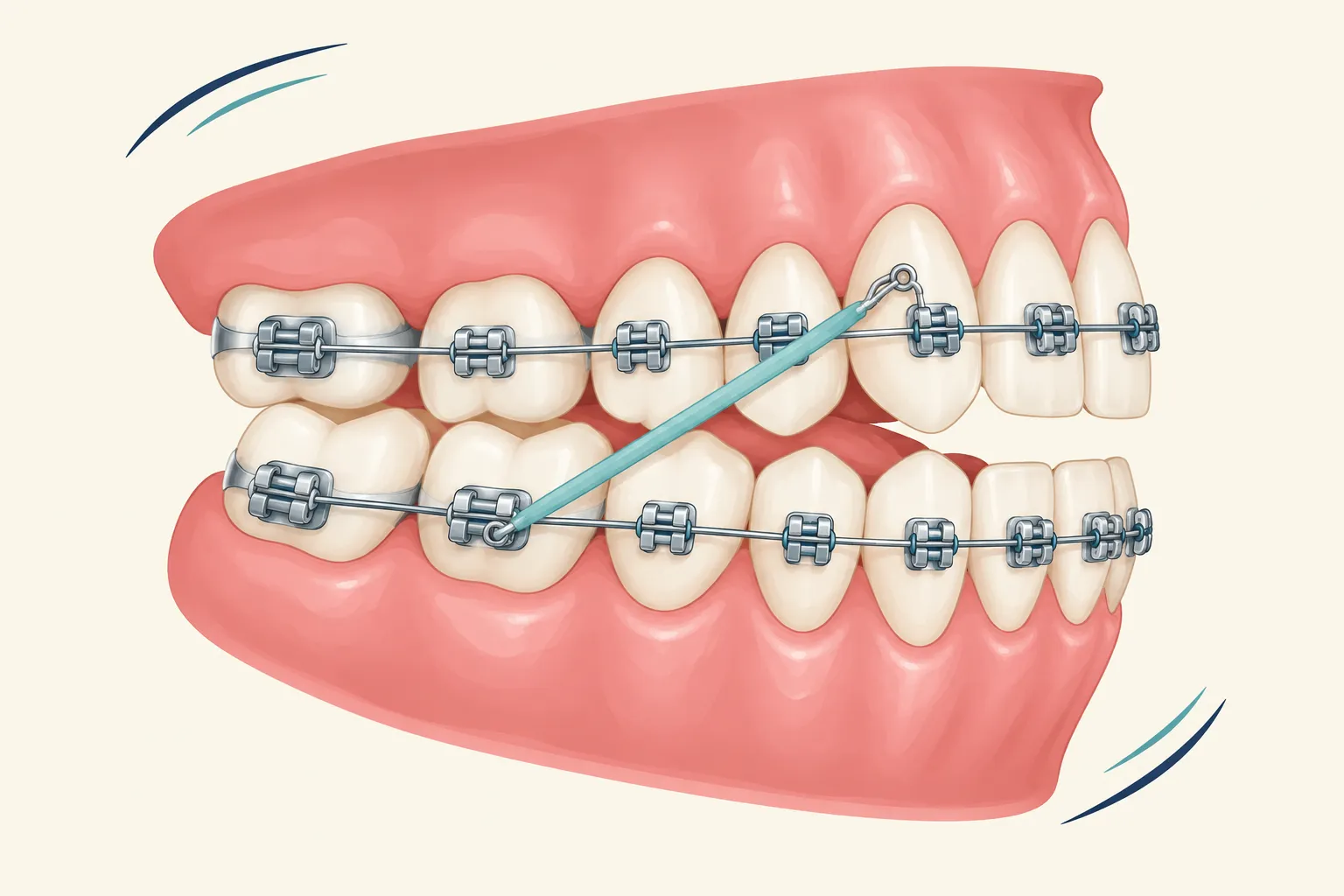
The tiny colored ties on brackets hold the wire in place. A power chain links brackets along one arch. Interarch elastics are different: you usually put these removable bands on yourself. With clear aligners, your orthodontist may have you connect them to attachments or precision cuts in the trays.
Which bite problems can elastics help?
People often call upper teeth that stick out an “overbite.” Orthodontists distinguish overjet, the horizontal distance between front teeth, from deep bite, excessive vertical overlap. Your bite determines the elastic pattern.
|
Elastic arrangement |
Common purpose |
What to know |
|---|---|---|
|
Class II |
Help improve an upper-front-teeth-forward bite or excess overjet |
A common example connects an upper canine to a lower molar. |
|
Class III |
Help improve a lower-front-teeth-forward bite or underbite |
A common example connects a lower canine to an upper molar. |
|
Vertical, triangle or box |
Bring upper and lower teeth together, including in some open bites |
The exact shape and hook positions vary by patient. |
|
Crossbite or midline pattern |
Adjust a crossbite or align the dental midlines |
A midline band can pull toward the opposite side. Never mirror a one-sided pattern without instructions. |
These patterns describe possible uses; they are not placement instructions. Hooking a band to the wrong tooth changes its pull. Your orthodontist may also use another appliance instead of elastics.
How to wear your elastics without guessing
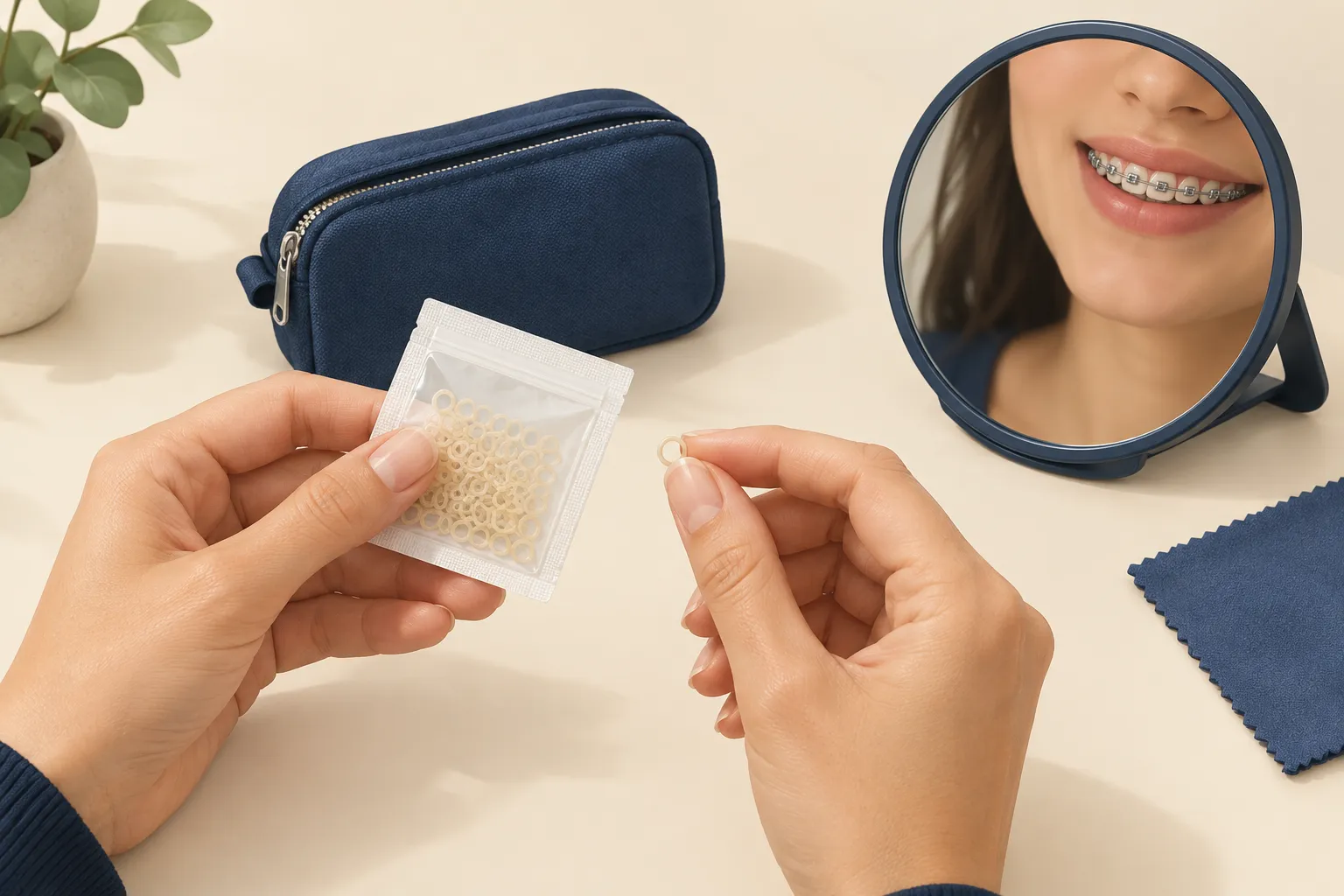
Before you leave the appointment, ask the team to point out your hooks and watch you put on a pair. A photo or diagram of your setup helps at home. Your wear schedule may call for most of the day or for specific times only.
-
Wash your hands. Stretch a fresh band between the hooks your team showed you, using clean fingers or the provided placer.
-
Compare what you see in the mirror with your diagram. Pay close attention if the two sides have different patterns.
-
Keep spares with you. Replace a band that breaks or slips off, and change bands on the schedule your orthodontist gives you.
-
Remove them for meals or cleaning if instructed, then put fresh ones back on.
Elastics lose pulling force with wear. In one clinical study, latex intermaxillary elastics lost 34.81% of their initial force after 24 hours in the mouth. That finding explains why replacement matters, though your orthodontist sets your schedule.
“Latex intermaxillary elastics lost 34.81% of their initial force after 24 hours in the mouth.” – Ptáčková et al., Clinical and Experimental Dental Research
Do not double up after missed wear; too much force can move teeth the wrong way. Return to your prescribed pattern if you miss a day. Lost the instructions? Ask the office to show you the pattern again. Household rubber bands, different sizes and a friend’s elastics are not substitutes.
Eating, drinking and brushing
Many patients remove elastics to eat or brush and put in fresh ones afterward. You may be allowed to keep them in while drinking water. If a meal or snack interrupts wear, put the bands back on as directed. Keep up with the brushing and flossing instructions for your braces or aligners.
If you use aligners
Aligner elastics help correct a bite too, but they attach differently. Your setup may use hooks on the trays or attachments on teeth. Keep the aligners seated and follow your instructions for both trays and bands. If a cut edge, hook or attachment breaks, call your team. Another attachment point could change the direction of the pull.
How long will you need rubber bands?
Your orthodontist decides when you start elastics and how many hours a day to wear them. You might begin early in orthodontic treatment or wait until your teeth are ready for bite adjustments. How long you need them depends on your bite, its response and your wear habits.
At each visit, your orthodontist can assess how your teeth meet and decide whether to change the pattern or stop the bands. Longer wear or two bands at once cannot make up for missed days. A full-time prescription also cannot be replaced with nighttime wear alone.
What feels normal, and when should you call?
Your teeth or jaw muscles may feel tender when you start wearing elastics. Contact your orthodontist if pain is severe or getting worse. Call, too, if a hook cuts your cheek, a bracket breaks or you cannot recreate your prescribed pattern.
Tell the team if you have a latex allergy; you may need latex-free bands. Replace a snapped elastic from your own supply, or call the office if you have run out. A loose rubber band placed around teeth to close a gap can injure gums and teeth.
Personalized bite care in Passaic and North Jersey
An elastic schedule should reflect your bite, whether you are a child, teen or adult. Eisenberger and Meister Orthodontics in Passaic plans braces and Invisalign treatment around each patient. At a complimentary consultation, you can ask whether elastics might help and how to put them on. If you are already in treatment, bring your elastic packet or a photo of your hook pattern to your next visit.
Nearby communities, county by county
Families travel to Passaic from communities across North Jersey. This county-by-county list names nearby communities; drive times and distances vary by address.
|
County |
Nearby towns and cities |
|---|---|
|
Passaic |
Clifton, Paterson, Haledon, North Haledon, Prospect Park, Hawthorne, Totowa, Woodland Park, Little Falls, Wayne, Pompton Lakes, Bloomingdale, Ringwood, Wanaque, West Milford |
|
Bergen |
Garfield, Lodi, Elmwood Park, Fair Lawn, Saddle Brook, Wallington, Wood-Ridge, Carlstadt, East Rutherford, Rutherford, Lyndhurst, North Arlington, Hasbrouck Heights, Hackensack, Maywood, Rochelle Park, Paramus, Glen Rock, Ridgewood, Ho-Ho-Kus, Waldwick, Wyckoff, Franklin Lakes, Oakland, Mahwah, Ramsey, Allendale, Upper Saddle River, Montvale, Park Ridge, Woodcliff Lake, River Vale, Hillsdale, Westwood, Emerson, Oradell, New Milford, River Edge, Teaneck, Englewood, Fort Lee, Palisades Park, Leonia, Bogota, Ridgefield Park, Little Ferry, Moonachie, Teterboro, South Hackensack, Bergenfield, Dumont, Tenafly, Cresskill, Closter, Demarest, Haworth, Harrington Park, Northvale, Norwood, Old Tappan, Alpine, Edgewater, Cliffside Park, Fairview, Ridgefield |
|
Essex |
Newark, Belleville, Nutley, Bloomfield, Glen Ridge, Montclair, Verona, Cedar Grove, West Orange, East Orange, Orange, South Orange, Maplewood, Irvington, Livingston, Roseland, North Caldwell, Caldwell, Essex Fells, Fairfield, Millburn |
|
Hudson |
Jersey City, Hoboken, Secaucus, Kearny, Harrison, East Newark, North Bergen, Union City, Weehawken, West New York, Guttenberg, Bayonne |
|
Morris |
Lincoln Park, Pequannock, Riverdale, Butler, Kinnelon, Montville, Boonton, Boonton Township, Mountain Lakes, Parsippany-Troy Hills, Denville, Rockaway, Rockaway Township, East Hanover, Hanover, Florham Park, Morris Plains, Morristown, Morris Township |
|
Union |
Elizabeth, Hillside, Union, Springfield, Summit, New Providence, Berkeley Heights, Mountainside, Westfield, Cranford, Roselle Park, Roselle, Kenilworth |
The takeaway
Straight teeth still need to meet well when you bite. Elastics give your orthodontist a way to work on that fit. Use your prescribed bands, hooks and schedule, and call if something feels wrong. Eisenberger and Meister Orthodontics offers personalized bite assessments for North Jersey families in Passaic. Book a complimentary consultation to discuss braces, aligners and whether elastics belong in your plan.
FAQ
Do braces use rubber bands?
Some braces patients need removable elastics to improve the way their upper and lower teeth meet. Not everyone needs them, and your orthodontist will decide whether they belong in your treatment plan.
What do the different animals on elastics mean?
Animal names or pictures on packets can help identify the prescribed elastic, but the name alone does not tell you where to hook it. Use the exact packet and placement instructions from your orthodontic team.
What size rubber bands do I need?
Your orthodontist selects the diameter and force for your particular hook positions and bite. Do not substitute a different size or strength, even if another band’s packaging looks similar.
How long do I have to wear elastics?
Both daily wear hours and the total period of use depend on your treatment plan. Some people wear them through most of the day and others at specified times; your orthodontist will tell you when to change or stop.
Can I take my elastics off for 2 hours?
That depends on your prescribed schedule. If you were told to wear them most of the day, an extra two-hour break is not part of that plan; ask your orthodontic team if you need to adjust wear for a specific activity.
Can you remove elastics while eating?
Many patients are instructed to remove them for meals and put fresh bands back on afterward. Follow your own orthodontist’s instructions, since your elastic pattern and wear schedule may differ.