
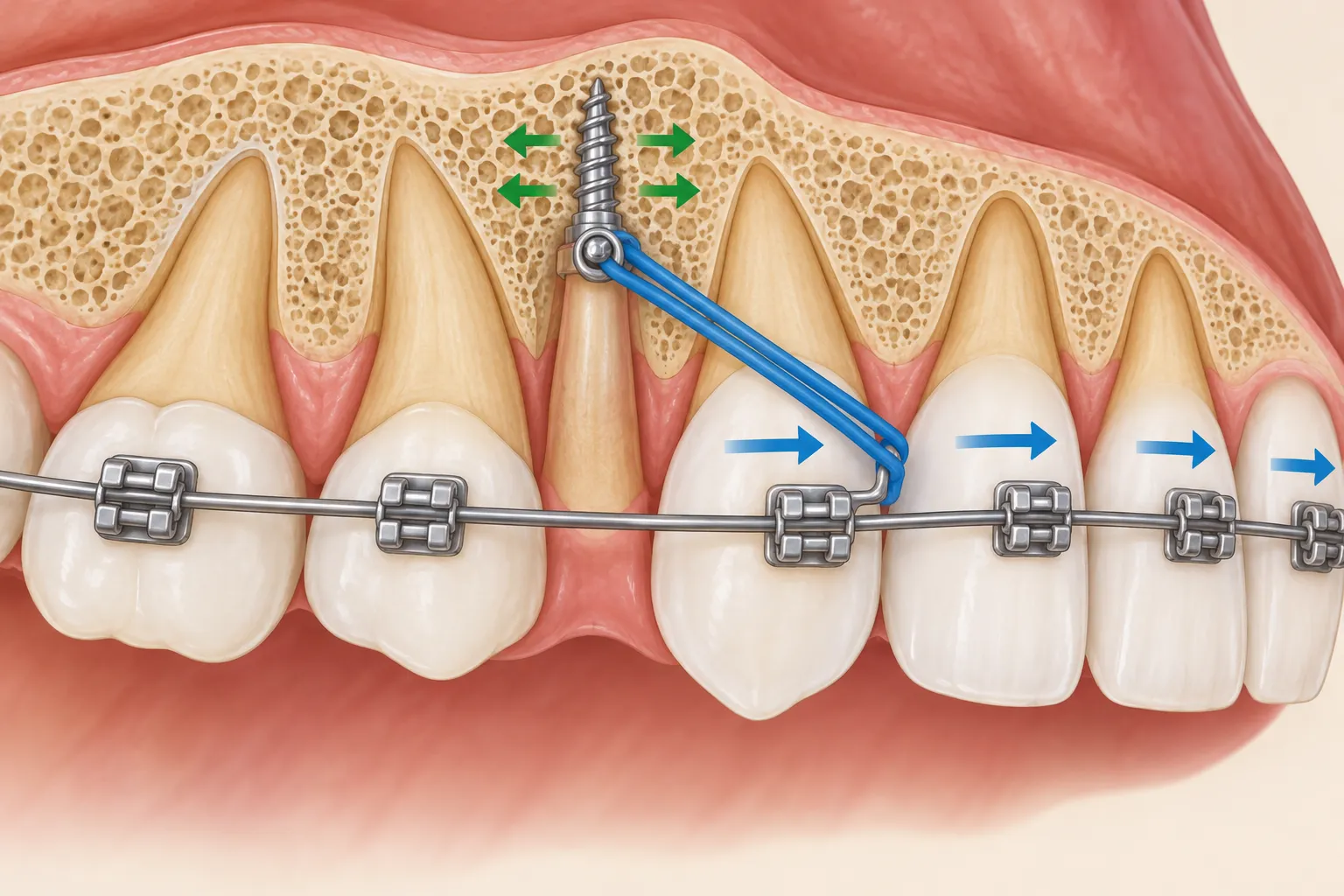
TADs braces treatment gives your orthodontist an anchor for moving selected teeth while limiting movement of neighboring teeth. A temporary anchorage device (TAD) is a small screw placed in the jawbone for part of treatment. A spring, elastic band or wire connects it to the braces; the clinician removes it when that movement is complete. Most people with braces do not need one. Ask why your treatment plan calls for this anchor.
How TADs braces treatment works
Traditional metal braces use brackets and wires to gradually move teeth, but pulling on one group can shift the teeth supporting the pull. In orthodontics, TADs provide an anchor in bone to guide selected teeth toward the desired positions without relying entirely on neighboring teeth. They may also work with ceramic braces, which use tooth colored ceramic brackets, when the treatment plan calls for extra anchorage. A TAD supplies anchorage; braces straighten teeth.
A TAD works with braces; it does not replace them or act as a permanent replacement tooth. Placement depends on the planned movement. Other patients get enough anchorage from teeth, elastic bands or another option.
Why might an orthodontist suggest a TAD?
Your orthodontist should be able to show you the movement a TAD would help with. Speed alone is not a useful explanation. Possible reasons include:
|
Treatment goal |
What extra anchorage may help accomplish |
Important limit |
|---|---|---|
|
Close a space after a missing tooth or extraction |
Move selected back teeth forward or front teeth back while limiting unwanted movement elsewhere |
Whether to close the space or preserve it for a replacement is a separate treatment decision. |
|
Address some open bites |
Help move back teeth vertically so the front teeth can meet more effectively |
A skeletal jaw discrepancy may need a different approach; a TAD does not move the jawbone into a new position. |
|
Reposition a tooth that has erupted too far |
Help move that tooth vertically without using nearby teeth as the only anchor |
The clinician must assess the available bone and neighboring structures. |
|
Correct certain asymmetries or guide a difficult tooth movement |
Apply force from a more useful location than another tooth could provide |
Not every asymmetry or impacted tooth calls for a TAD. |
Your teeth, gums, bone and bite affect that decision. Some clear aligner plans use TADs too. Neither full braces nor clear aligners alone mean you need one. A TAD may help address some bad bites, but it does not promise fewer adjustments, faster treatment or a replacement for surgery when the jaw itself needs correction.
What happens at placement and removal?
Your treating team chooses a site with tooth roots and nearby anatomy in mind. The American Association of Orthodontists glossary describes a TAD as a miniature screw positioned in gum and bone tissue. The AAO Insurance Company TAD consent form describes topical and/or local anesthetic before insertion. The connection to your braces might go on then or later. Ask who will place, monitor and remove the TAD.
You may feel pressure during placement despite the anesthetic. Soreness or irritation can follow. Call your clinician if pain worsens instead of settling. Once the movement no longer needs that anchor, the clinician removes it in the office, usually in a brief visit. Ask whether removal will involve numbing. Do not adjust or remove a loose TAD yourself.
|
Stage |
What to ask your team |
|---|---|
|
Before placement |
Where will it go, why that location, and are imaging or gum-health issues relevant to me? |
|
During treatment |
What is connected to it, when will it be checked, and whom should I call if it loosens? |
|
At removal |
What signals that the movement is complete, and what care will the site need afterward? |
Living with a TAD: cleaning and warning signs
For oral health, keep the gum around the TAD and nearby braces clean, following your clinician’s brushing and rinse instructions. Tell your team about gum disease or other dental conditions before placement. A spring or elastic may make the spot awkward to reach. Ask whether to avoid chewing gum or hard candies around the appliance. If an attachment rubs, leave it in place and ask how to protect the area.
Call the clinician who placed or monitors the TAD if it feels loose, the gum becomes more swollen or red, you notice drainage, or pain persists or worsens. A loose TAD may stop providing the planned anchorage. Your team can decide whether it needs to be repositioned or replaced. Seek prompt medical or dental assessment for severe swelling, fever or trouble swallowing.
Questions worth asking before you agree
-
What movement is the TAD intended to control? Ask to see which teeth should move and which should not.
-
What are the alternatives in my case? Compare a plan using a TAD with elastics, different anchorage or other treatment if those are realistic options.
-
Who places and removes it? The treating orthodontist may coordinate with another clinician; know who handles follow-up.
-
What if it loosens or the gum becomes irritated? Get the office’s contact instructions and the plan for an interruption.
-
Is it included in my treatment quote? Fees and insurance coverage depend on the practice, plan and insurer. Request a written breakdown before deciding.
Considering braces in Passaic and nearby North Jersey
Eisenberger and Meister Orthodontics offers personalized braces consultations in Passaic, New Jersey. Bring any proposed TAD plan to discuss your treatment options, whether traditional braces, ceramic braces or clear aligners fit. The practice does not list TAD placement among its published services; ask whether it is available for your case or requires a referral. Its orthodontic treatment process guide covers usual appointments and adjustments, not TAD placement.
Families across North Jersey within an approximate 20-mile straight-line radius of Passaic may travel to the practice. Communities in this area include:
-
Passaic County: Passaic, Clifton, Paterson, Little Falls, Woodland Park, Totowa, Haledon, North Haledon, Prospect Park, Hawthorne, Wayne, Pompton Lakes, Wanaque and Bloomingdale.
-
Bergen County: Wallington, Garfield, Wood-Ridge, Rutherford, East Rutherford, Carlstadt, Hasbrouck Heights, Lodi, South Hackensack, Hackensack, Maywood, Rochelle Park, Saddle Brook, Elmwood Park, Fair Lawn, Glen Rock, Ridgewood, Paramus, River Edge, Oradell, New Milford, Teaneck, Bogota, Englewood, Fort Lee, Bergenfield, Dumont, Tenafly, Cresskill, Alpine, Leonia, Palisades Park, Ridgefield, Ridgefield Park, Little Ferry, Moonachie, Teterboro, North Arlington and Lyndhurst.
-
Essex County: Nutley, Bloomfield, Belleville, Montclair, Glen Ridge, Cedar Grove, Verona, West Orange, Orange, East Orange, Newark, North Caldwell, Caldwell, Essex Fells, Fairfield, Livingston, Roseland, Maplewood, South Orange and Millburn.
-
Hudson County: Secaucus, Kearny, Harrison, East Newark, North Bergen, Union City, Weehawken, West New York, Guttenberg, Hoboken, Jersey City and Bayonne.
-
Morris County: Lincoln Park, Pequannock, Riverdale, Butler, Kinnelon, Montville, Boonton, Parsippany-Troy Hills and East Hanover.
-
Union County: Hillside, Elizabeth, Union, Springfield, Kenilworth, Roselle, Roselle Park, Linden, Cranford, Westfield and Summit.
These are communities in the broader North Jersey area around Passaic, not additional office locations or a guarantee that every address falls within 20 miles. Driving distances and travel times differ from a straight-line radius.
The bottom line
A TAD is useful when braces need an anchor for a specific movement. It will not suit every plan, shorten treatment by default or replace surgery for a jaw problem. If you are considering braces in North Jersey, book a personalized consultation with Eisenberger and Meister Orthodontics to talk through your options and find out whether TAD-based anchorage is appropriate and available.
FAQ
What are TADs for in braces?
They give braces a temporary anchor in bone, helping the orthodontist move selected teeth without relying only on other teeth for support. They are used for specific movements, not for every patient with braces.
What are the disadvantages of TADs?
Placement involves a minor procedure and can cause short-term soreness or gum irritation. The device may loosen or the surrounding tissue may become inflamed, so it needs monitoring and cleaning according to your clinician’s instructions.
Does it hurt to get TADs removed?
Removal is usually brief, and some people feel pressure or mild discomfort. Ask your clinician whether local numbing is appropriate for your removal; do not attempt to remove the device yourself.
How long does TADs pain last?
Mild soreness after placement generally settles over the next few days, though experiences vary. If pain is worsening, persistent or accompanied by swelling, contact the clinician caring for your TAD.
How much do TADs cost?
There is no single price for every case, and this practice has not published a TAD fee here. Ask for a written treatment estimate that says whether placement, follow-up and removal are included, as well as what your insurance may cover.
Are TADs covered by insurance?
Coverage depends on your plan and how the placement is billed; it cannot be assumed from braces coverage alone. Ask for an estimate showing the placement and removal charges, then ask your insurer how those charges are handled under your policy.